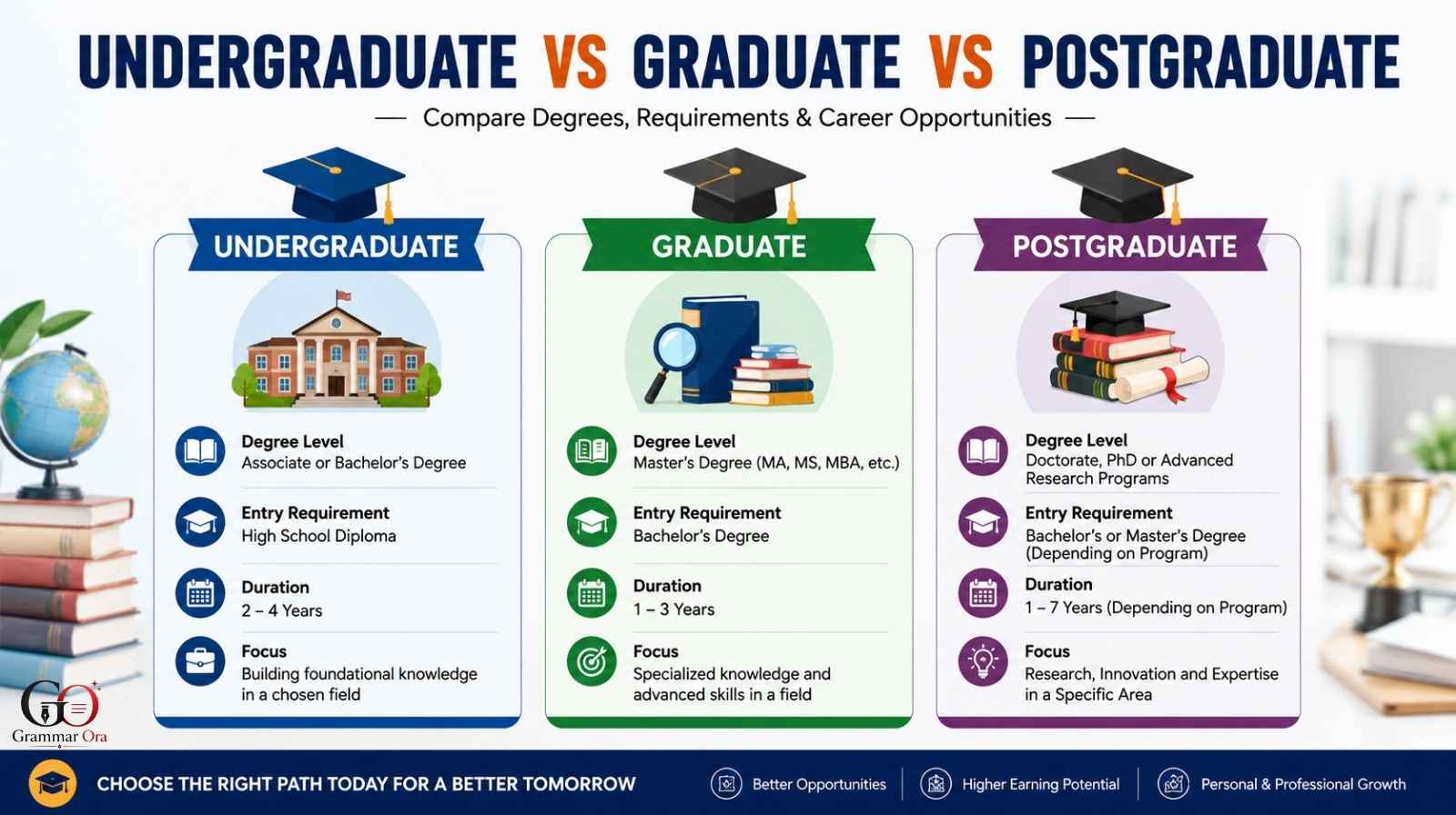
Choosing the right educational path can be confusing, especially when terms like undergraduate, graduate, and postgraduate are often used interchangeably. Many students struggle to understand what each level means, how they differ, and which option aligns with their career goals.
Understanding the distinction between these academic levels is essential before applying to colleges or universities. Whether you’re finishing high school, considering a master’s degree, or planning advanced research studies, knowing your options helps you make informed decisions.
This guide explains the differences between undergraduate vs graduate vs postgraduate programs, compares their requirements, and helps you determine which path is right for you.
What Is the Difference Between Undergraduate, Graduate, and Postgraduate?
The main difference lies in the level of study and academic advancement.
| Education Level | Typical Degree | Entry Requirement | Duration |
|---|---|---|---|
| Undergraduate | Associate or Bachelor’s Degree | High School Diploma | 2–4 Years |
| Graduate | Master’s Degree | Bachelor’s Degree | 1–3 Years |
| Postgraduate | Master’s, Doctorate, PhD, Professional Research Programs | Bachelor’s or Master’s Degree | 1–7 Years |
Undergraduate Education Explained
An undergraduate program is the first level of higher education after high school.
Students typically pursue:
- Associate degrees
- Bachelor’s degrees
- Foundation programs
Examples include:
- Bachelor of Science (BSc)
- Bachelor of Arts (BA)
- Bachelor of Business Administration (BBA)
The focus is on building foundational knowledge in a chosen field.
Graduate Education Explained
Graduate education begins after earning a bachelor’s degree.
Common graduate programs include:
- Master of Science (MS)
- Master of Arts (MA)
- Master of Business Administration (MBA)
Graduate students study more specialized topics and often complete research projects.
Postgraduate Education Explained
In many countries, postgraduate education refers to any study completed after a bachelor’s degree. However, it is frequently associated with advanced research degrees such as:
- PhD programs
- Doctoral degrees
- Research fellowships
- Professional doctorates
These programs emphasize expertise, original research, and academic contribution.
Undergraduate vs Graduate vs Postgraduate: Key Differences
Understanding the distinctions helps students choose the right academic pathway.
Academic Depth
Undergraduate programs provide broad knowledge.
Graduate programs focus on specialized expertise.
Postgraduate programs emphasize advanced research and innovation.
Admission Requirements
Undergraduate applicants typically need:
- High school transcripts
- Standardized test scores (where applicable)
Graduate applicants usually require:
- Bachelor’s degree
- Academic references
- Personal statement
Postgraduate applicants often need:
- Master’s degree (depending on program)
- Research proposal
- Academic publications (sometimes)
Career Outcomes
Different educational levels lead to different career opportunities.
For example:
- Undergraduate graduates may enter entry-level positions.
- Graduate degree holders often qualify for management and specialized roles.
- Postgraduate researchers may pursue academic, scientific, or executive leadership positions.
Why Students Choose Graduate or Postgraduate Education
Higher education beyond a bachelor’s degree can provide several benefits.
Increased Earning Potential
According to data from the U.S. Bureau of Labor Statistics, workers with advanced degrees generally earn significantly more than those with only a bachelor’s degree.
Greater Career Specialization
Graduate and postgraduate studies allow professionals to become experts in specific fields such as:
- Data Science
- Engineering
- Medicine
- Law
- Education
Research Opportunities
Advanced academic programs offer opportunities to:
- Conduct original research
- Publish scholarly work
- Contribute to industry innovations
Leadership Development
Many graduate programs focus on leadership, strategic thinking, and advanced problem-solving skills.
Real-Life Example: Choosing the Right Academic Path
Consider Sarah, a high school graduate interested in environmental science.
She enrolls in a Bachelor of Science program, where she learns foundational concepts in biology, chemistry, and environmental policy. During her undergraduate years, she discovers a passion for climate research.
After graduation, Sarah secures an entry-level environmental analyst position. However, she notices that senior researchers and project managers possess advanced qualifications. To expand her career opportunities, she enrolls in a Master of Environmental Science program.
The graduate program allows her to specialize in climate modeling and sustainability strategies. Her expertise leads to a promotion and increased salary.
Later, Sarah decides to pursue a PhD focused on renewable energy systems. Through her postgraduate research, she publishes academic papers, collaborates with international organizations, and eventually becomes a university researcher and policy advisor.
Sarah’s journey demonstrates how undergraduate, graduate, and postgraduate education can build upon one another to create increasingly specialized career opportunities.
Education Trends and Statistics (2025–2026)
Recent higher education trends highlight the growing importance of advanced degrees.
Key Statistics
- Global enrollment in master’s programs continues to rise as employers seek specialized skills.
- Online graduate programs have expanded significantly between 2025 and 2026.
- STEM-related postgraduate research programs remain among the fastest-growing academic sectors.
- Employers increasingly value advanced credentials in fields such as artificial intelligence, cybersecurity, healthcare, and business analytics.
- Doctoral graduates continue to play a crucial role in research and innovation worldwide.
These trends indicate that lifelong learning and advanced education remain valuable investments for many professionals.
How to Choose Between Undergraduate, Graduate, and Postgraduate Programs
Step 1: Assess Your Current Education Level
Ask yourself:
- Have you completed high school?
- Do you already hold a bachelor’s degree?
- Are you interested in research?
Step 2: Define Career Goals
Consider whether your desired career requires:
- A bachelor’s degree
- A master’s degree
- A doctoral qualification
Step 3: Evaluate Time Commitment
Different programs require different investments of time.
Typical durations include:
- Bachelor’s: 4 years
- Master’s: 1–3 years
- PhD: 3–7 years
Step 4: Consider Financial Factors
Tuition costs, scholarships, assistantships, and future earning potential should all be part of your decision.
Step 5: Research Industry Requirements
Some professions require advanced credentials, while others prioritize practical experience.
Undergraduate vs Graduate vs Postgraduate: Which One Is Right for You?
Choose Undergraduate Education If:
- You recently completed high school.
- You need foundational knowledge.
- You are exploring career options.
Choose Graduate Education If:
- You already have a bachelor’s degree.
- You want specialized skills.
- You seek career advancement.
Choose Postgraduate Education If:
- You enjoy research and academic work.
- You want to become a subject-matter expert.
- You plan to pursue university teaching or advanced research careers.
FAQs
Q1: Is a graduate degree the same as a postgraduate degree?
A: Not always. In many countries, graduate and postgraduate are used interchangeably. However, some institutions distinguish master’s programs as graduate studies and doctoral programs as postgraduate studies.
Q2: What comes first: graduate or postgraduate?
A: Typically, graduate studies begin with a master’s degree, while postgraduate often refers to advanced study beyond that level.
Q3: Can I pursue a postgraduate degree without a master’s degree?
A: In some countries and programs, students can enter a PhD directly after completing a bachelor’s degree.
Q4: Is a master’s degree considered graduate or postgraduate?
A: It can be classified as both, depending on the educational system and country.
Q5: Which degree level offers the highest salary potential?
A: Generally, advanced degrees can increase earning potential, although outcomes vary by industry and profession.
Q6: How long does postgraduate education take?
A: Postgraduate programs can range from one year for specialized master’s programs to seven years or more for doctoral research.
Conclusion
Understanding undergraduate vs graduate vs postgraduate education is essential for making informed academic and career decisions. Undergraduate programs build foundational knowledge, graduate degrees provide specialized expertise, and postgraduate studies focus on advanced research and professional mastery.
Before choosing a program, evaluate your career goals, educational background, financial situation, and long-term aspirations. The right educational path can open doors to better opportunities, higher earning potential, and greater professional fulfillment.
Start researching programs today and take the next step toward achieving your academic and career goals.
👉 Discover more simple and practical grammar guides on Grammar Ora

Muhammad Bilal is an expert blogger in Grammar Guide, dedicated to simplifying English grammar and helping learners write and speak with clarity, confidence, and accuracy.