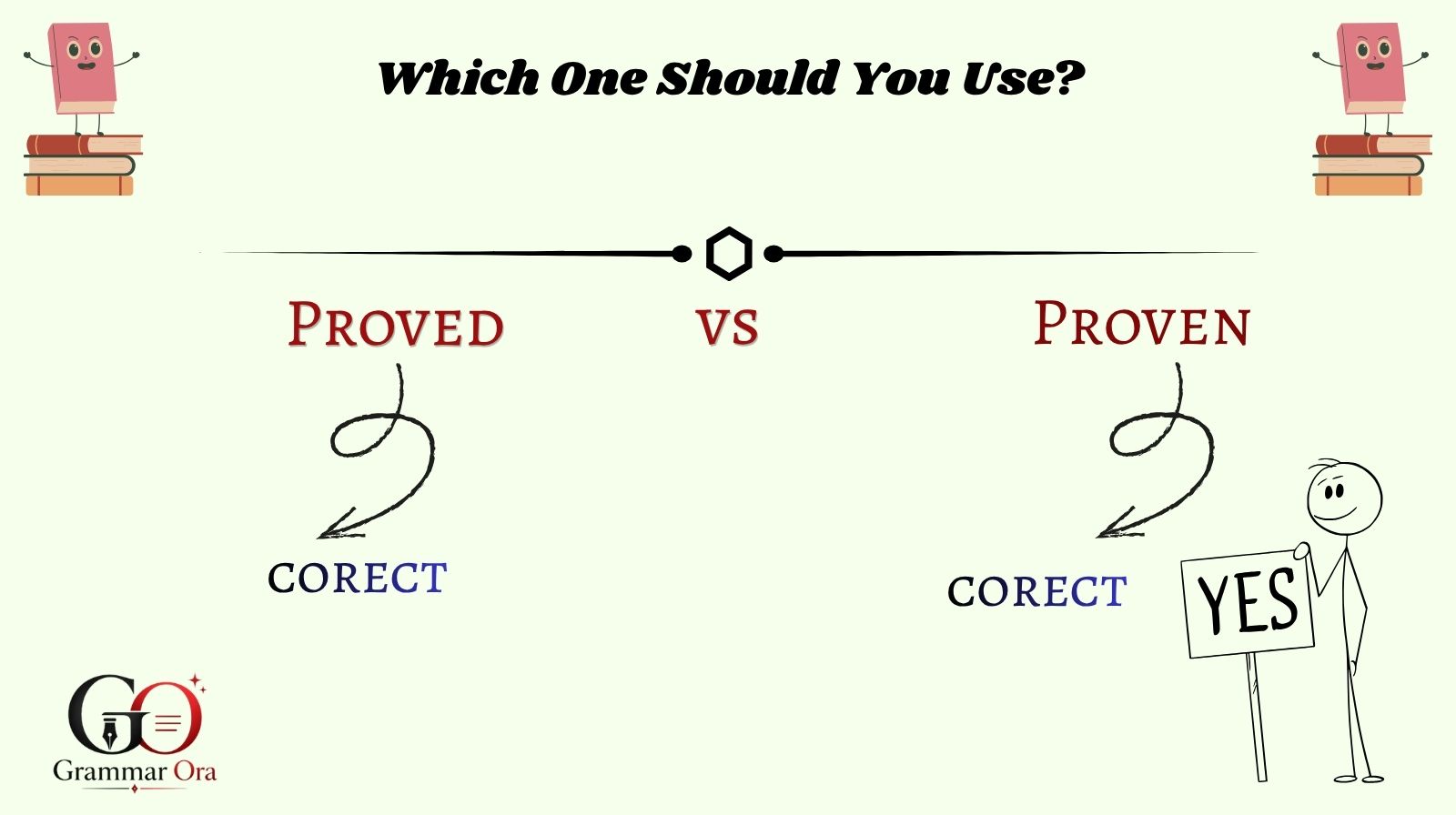
English is full of words that seem interchangeable but can create confusion when it comes to proper usage. One common example is proved vs proven. Many writers, students, and professionals wonder whether they should write proved or proven when talking about something that has been demonstrated to be true.
The confusion exists because both words come from the same verb, prove, and both are considered correct in certain situations. However, they are not always used in exactly the same way.
In this guide, you’ll learn the difference between proved and proven, when to use each one, common mistakes to avoid, and practical examples that make the rule easy to remember.
What Is the Difference Between Proved and Proven?
The simplest answer is:
- Proved is the traditional past tense and past participle of prove.
- Proven is commonly used as a past participle, especially in modern English.
Quick Definition
| Word | Function | Example |
|---|---|---|
| Proved | Past tense and sometimes past participle | She proved her point. |
| Proven | Past participle | The theory has been proven correct. |
Why the Confusion Exists
Historically, proved was the standard form for both uses. Over time, proven became widely accepted, especially in American English. Today, both forms appear in reputable publications, although their usage differs depending on context.
When Should You Use Proved?
Proved is most commonly used as the simple past tense of the verb prove.
Examples of Proved in Sentences
- The scientist proved the hypothesis.
- She proved that hard work pays off.
- The lawyer proved his client’s innocence.
In these examples, the action happened in the past and is complete.
Proved as a Past Participle
In some formal contexts, especially British English, proved can also function as a past participle.
Examples:
- The claim has proved difficult to verify.
- The strategy has proved effective.
While correct, many modern writers would choose proven in similar situations.
Grammar Tip
If you can replace the word with a simple past action, proved is usually the right choice.
When Should You Use Proven?
Proven is generally used as a past participle after helping verbs such as:
- has
- have
- had
- be
- been
Examples of Proven
- The method has been proven effective.
- His leadership skills are proven.
- The technology has proven reliable over time.
These examples show why proven is so popular in modern English it often sounds more natural in passive constructions.
Proven as an Adjective
One reason proven became common is that it also functions as an adjective.
Examples:
- a proven strategy
- a proven method
- a proven track record
Using proved as an adjective sounds awkward in modern English.
Correct:
- A proven solution.
Incorrect:
- A proved solution.
Proved vs Proven: Side-by-Side Comparison
Understanding the difference becomes easier when you compare them directly.
| Situation | Correct Choice |
|---|---|
| Simple past tense | Proved |
| Present perfect tense | Proven or Proved (depending on style) |
| Adjective form | Proven |
| Business writing | Proven |
| Marketing content | Proven |
| Academic writing | Often Proven |
| Traditional British usage | Often Proved |
Examples
Simple Past
- She proved her argument.
Past Participle
- She has proven her argument.
Adjective
- She has a proven record of success.
The context determines which form sounds most natural.
Real-Life Example: How Businesses Use Proven More Frequently
Consider a software company launching a new productivity tool. Their marketing team wants to convince potential customers that the product works effectively.
Instead of writing:
“Our software is a proved solution.”
They write:
“Our software is a proven solution trusted by thousands of businesses.”
The second version sounds more natural because proven functions as an adjective describing the solution.
The same pattern appears across industries. Fitness brands advertise “proven workout methods.” Financial advisors promote “proven investment strategies.” Technology companies highlight “proven security systems.”
A review of company websites, product pages, and marketing materials reveals that proven overwhelmingly dominates when businesses want to communicate reliability and trustworthiness. The reason is simple: readers instantly recognize proven as an adjective meaning “tested and successful.”
Meanwhile, proved remains common when describing a specific action in the past:
“The testing phase proved the system could handle high traffic volumes.”
Understanding this distinction helps writers choose the form that sounds natural and professional.
Usage Trends and Language Data (2025–2026)
Recent language-analysis tools and corpus databases continue to show that proven appears more frequently than proved in modern business, marketing, and online content.
Key Observations
- Proven dominates in advertising and branding.
- Proven is preferred when used as an adjective.
- Proved remains standard as a simple past-tense verb.
- American English uses proven more frequently than British English.
- Search interest for grammar-related queries about “proved vs proven” remains strong due to ongoing confusion among writers.
Language experts generally agree that both forms are correct, but context matters more than strict preference.
How to Remember the Difference
Simple Checklist
Use proved when:
✔ Referring to a completed past action
✔ Writing in simple past tense
✔ Describing what someone demonstrated
Use proven when:
✔ Using a past participle
✔ Describing something as tested or reliable
✔ Using the word as an adjective
✔ Writing marketing or business content
Easy Memory Trick
Think of it this way:
- Someone proved something.
- Something is proven.
This shortcut works in most situations.
Common Mistakes Writers Make
Mistake #1: Using Proven as a Simple Past Verb
Incorrect:
- She proven her theory yesterday.
Correct:
- She proved her theory yesterday.
Mistake #2: Using Proved as an Adjective
Incorrect:
- This is a proved method.
Correct:
- This is a proven method.
Mistake #3: Mixing Styles
Switching between proved and proven inconsistently within the same article can make writing appear less polished. Choose the style that best fits the context and stay consistent.
FAQs
Q1: Is proven grammatically correct?
A: Yes. Proven is widely accepted as the past participle of prove and is commonly used in modern English.
Q2: Is proved or proven better?
A: Neither is universally better. The correct choice depends on the sentence structure and context.
Q3: Can proven be used as an adjective?
A: Yes. This is one of its most common uses, such as “a proven strategy” or “a proven method.”
Q4: Do Americans and British people use these words differently?
A: Generally, American English favors proven more often, while British English traditionally uses proved more frequently.
Q5: Which form should I use in professional writing?
A: Use proved for simple past actions and proven when functioning as a past participle or adjective.
Q6: Is “has proved” wrong?
A: No. “Has proved” is grammatically correct and commonly used, especially in British English.
Conclusion
The debate over proved vs proven is easier to understand once you know their roles in a sentence. Proved is typically used as the simple past tense of prove, while proven is most often used as a past participle or adjective.
If you’re describing a completed action, choose proved. If you’re talking about something that has been tested, verified, or established as reliable, proven is usually the better choice.
By understanding this distinction, you’ll write more clearly, avoid common grammar mistakes, and use English with greater confidence. The next time you encounter proved vs proven, you’ll know exactly which word fits the situation.
References
- Merriam-Webster Dictionary
- Cambridge Dictionary
- Grammarly Writing Resources
👉 Discover more simple and practical grammar guides on Grammar Ora

Muhammad Bilal is an expert blogger in Grammar Guide, dedicated to simplifying English grammar and helping learners write and speak with clarity, confidence, and accuracy.