Have you ever wondered whether you should use exception vs exemption? Although these words sound similar and are often used in legal, academic, workplace, and everyday conversations, they do not mean the same thing.
Using the wrong word can change the meaning of your sentence, especially in contracts, policies, tax documents, school rules, or official communications.
In this guide, you’ll learn the exact difference between exception vs exemption, discover when each word is appropriate, see practical examples, avoid common mistakes, and remember the difference with an easy trick.
What Is the Difference Between Exception and Exemption?
Quick Answer (Featured Snippet):
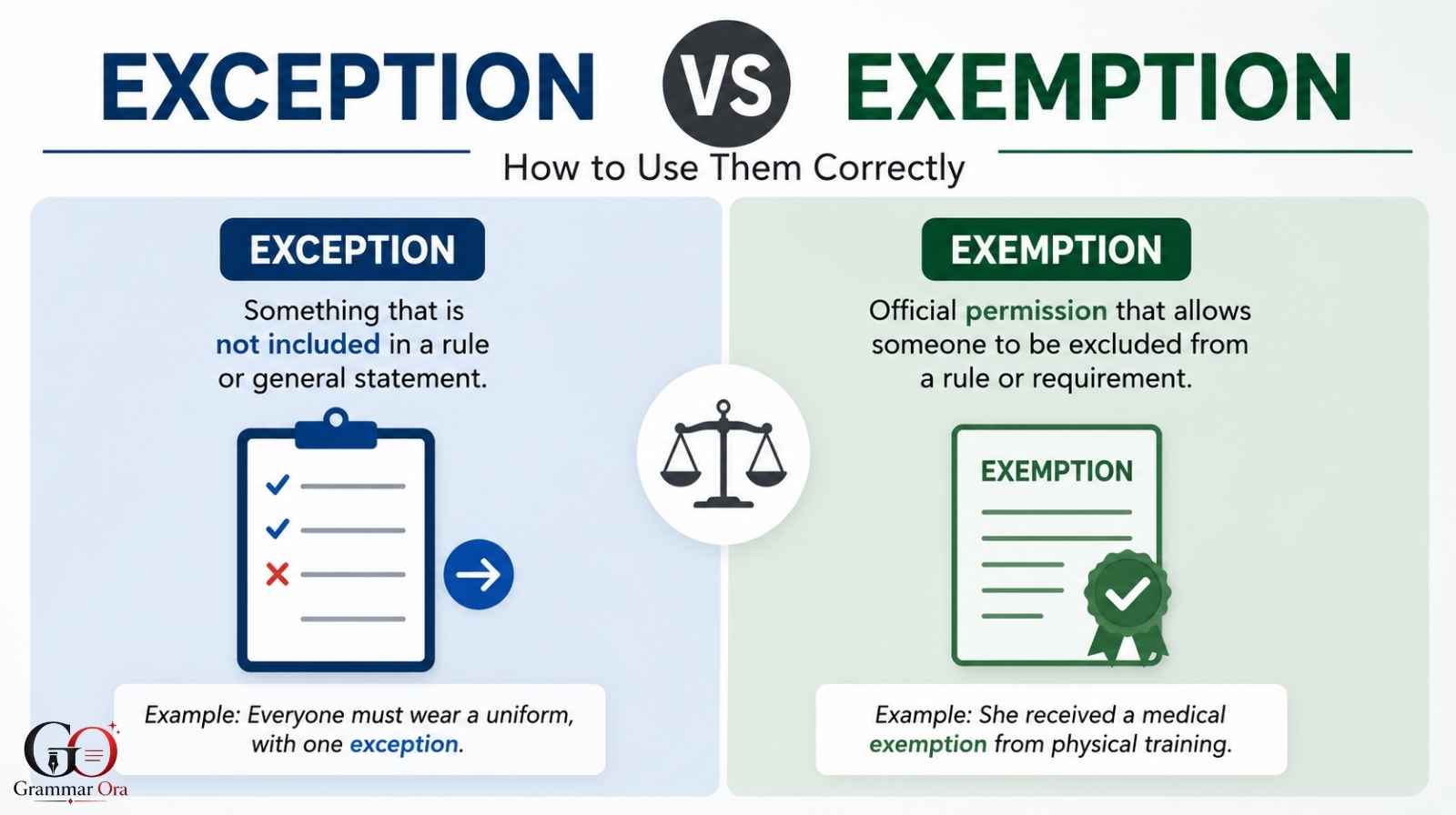
An exception is something that does not follow a general rule.
An exemption is official permission that allows someone or something to avoid following a rule, requirement, or obligation.
Although both involve rules, an exception changes the rule itself, while an **exemption releases a person or group from following the rule.
Exception Meaning
An exception refers to something that is excluded from a general statement or rule.
Examples:
- Everyone must wear a badge, except visitors with temporary passes.
- The restaurant is open every day, with the exception of Christmas.
- All products qualify for free shipping, with one exception.
Exemption Meaning
An exemption is formal permission that excuses someone from a requirement.
Examples:
- She received a medical exemption from military service.
- Certain charities qualify for tax exemptions.
- Students with approved accommodations may receive an exam exemption.
Exception vs Exemption: Side-by-Side Comparison
| Feature | Exception | Exemption |
|---|---|---|
| Meaning | Something excluded from a rule | Official release from a rule |
| Applies To | Rules, statements, patterns | People, organizations, property |
| Usually Granted? | No | Yes |
| Common Contexts | Grammar, policies, everyday language | Taxes, law, education, healthcare |
| Example | “With one exception…” | “She received an exemption.” |
Remember This Rule
Think of it this way:
- Exception = The rule has one special case.
- Exemption = Someone is excused from following the rule.
When Should You Use “Exception”?
Use exception whenever you’re talking about something that does not fit the normal pattern.
In Everyday Conversation
Examples:
- Everyone arrived on time except Alex.
- There are no exceptions to this policy.
- The rule has only one exception.
In Grammar
Writers often use exception to indicate a word or situation that doesn’t follow the usual grammar rule.
Example:
Most English nouns become plural by adding -s, but there are exceptions like children, men, and feet.
In Business Policies
Companies frequently mention exceptions in employee handbooks.
Example:
Returns are accepted within 30 days, with the exception of customized products.
When Should You Use “Exemption”?
Use exemption when someone has official approval not to follow a requirement.
Tax Exemptions
Governments often allow certain individuals or organizations to receive tax exemptions.
Example:
Nonprofit organizations may qualify for property tax exemptions.
Medical Exemptions
Doctors may provide official documentation allowing someone to skip a requirement.
Example:
The employee received a medical exemption from wearing protective equipment due to an allergy.
Educational Exemptions
Schools sometimes excuse students from specific courses or exams.
Example:
International students may receive language-course exemptions based on previous qualifications.
Common Situations Where People Confuse These Words
Saying “Tax Exception”
❌ Incorrect:
The company received a tax exception.
✅ Correct:
The company received a tax exemption.
Reason:
The government officially excused the company from paying certain taxes.
Saying “One Exemption to the Rule”
❌ Less accurate:
There is one exemption to the rule.
✅ Better:
There is one exception to the rule.
Reason:
You’re describing the rule itself not permission granted to someone.
Mixing Them in Workplace Policies
Incorrect:
Employees have an exception from the dress code.
Correct:
Employees received an exemption from the dress code.
Real-Life Case Study: Understanding the Difference in a Workplace Policy
Imagine a large technology company introduces a policy requiring all employees to work from the office three days each week. The policy applies to every department to improve collaboration.
However, the company also states that customer support teams are an exception because they already operate remotely around the clock. In this case, the rule itself includes a built-in special case. Customer support isn’t individually excused; the policy simply doesn’t apply to that group in the same way.
Later, an employee undergoes surgery and cannot travel for several months. After reviewing medical documentation, the company’s HR department approves a medical exemption allowing that employee to work remotely full-time during recovery.
Notice the difference:
- The customer support team is covered by an exception written into the policy.
- The recovering employee receives an individual exemption because of personal circumstances.
Understanding this distinction helps managers write clearer policies, employees understand their rights, and organizations avoid misunderstanding legal or workplace documents.
Exception vs Exemption in Legal and Official Writing
Legal professionals use these words carefully because each has a specific meaning.
Exception
An exception identifies situations where a rule does not apply.
Example:
The contract applies to all suppliers except government agencies.
Exemption
An exemption is an officially approved release from compliance.
Example:
The applicant qualified for an environmental permit exemption.
Using the correct word improves precision in legal, academic, and business writing.
Usage Trends and Language Data (2025–2026)
Language usage data and major dictionaries continue to distinguish these terms consistently:
- Exception appears far more frequently in everyday English because it applies to general rules, conversations, and writing.
- Exemption is more common in legal, financial, educational, healthcare, and government documents.
- Search interest for both terms rises during tax season and academic admissions periods, when people frequently encounter exemption-related forms and exception-based policy questions.
- Style authorities such as Merriam-Webster, the Cambridge Dictionary, and the Oxford English Dictionary define these words with distinct meanings, reinforcing that they are not interchangeable.
This consistent usage across dictionaries and professional writing makes choosing the correct term important for clear communication.
Memory Trick to Never Forget
Here’s an easy way to remember the difference:
Exception = Exists outside the rule.
Exemption = Excused from the rule.
Another shortcut:
- Exception → Situation
- Exemption → Permission
This simple association helps you choose the correct word every time.
Common Mistakes to Avoid
Using exception when permission is involved
Incorrect:
She received an exception from paying taxes.
Correct:
She received an exemption from paying taxes.
Using exemption for a general rule
Incorrect:
There is one exemption to this grammar rule.
Correct:
There is one exception to this grammar rule.
Assuming the words are synonyms
Although related, they have different meanings and should not be used interchangeably.
FAQs
Q1: Is exception the same as exemption?
A: No. An exception is something excluded from a rule, while an exemption is official permission allowing someone to avoid a rule.
Q2: Which word is used for taxes?
A: Exemption is the correct choice because tax authorities officially excuse eligible individuals or organizations from certain tax obligations.
Q3: Can a person be an exception?
A: Yes. Someone may be an exception if they do not fit a general statement or pattern.
Example:
Everyone enjoyed the movie except John.
Q4: Can a person receive an exemption?
A: Yes. Governments, schools, employers, or other authorities may grant exemptions for legal, medical, educational, or financial reasons.
Q5: Which word is more common?
A: Exception is generally more common in everyday English, while exemption is frequently used in formal, legal, educational, and tax-related contexts.
Q6: How can I remember the difference?
A: Remember:
- Exception = Outside the rule
- Exemption = Excused from the rule
Conclusion
Understanding exception vs exemption is easier once you focus on how each word relates to a rule. An exception describes something that naturally falls outside a general rule or pattern, while an exemption is official permission that excuses someone from meeting a requirement.
Whether you’re writing business documents, legal agreements, academic papers, or everyday emails, choosing the correct term makes your writing more accurate and professional. The next time you encounter these words, ask yourself a simple question: Am I talking about a special case in the rule, or permission to avoid the rule? The answer will immediately tell you whether you need exception or exemption.
👉 Discover more simple and practical grammar guides on Grammar Ora

Muhammad Bilal is an expert blogger in Grammar Guide, dedicated to simplifying English grammar and helping learners write and speak with clarity, confidence, and accuracy.