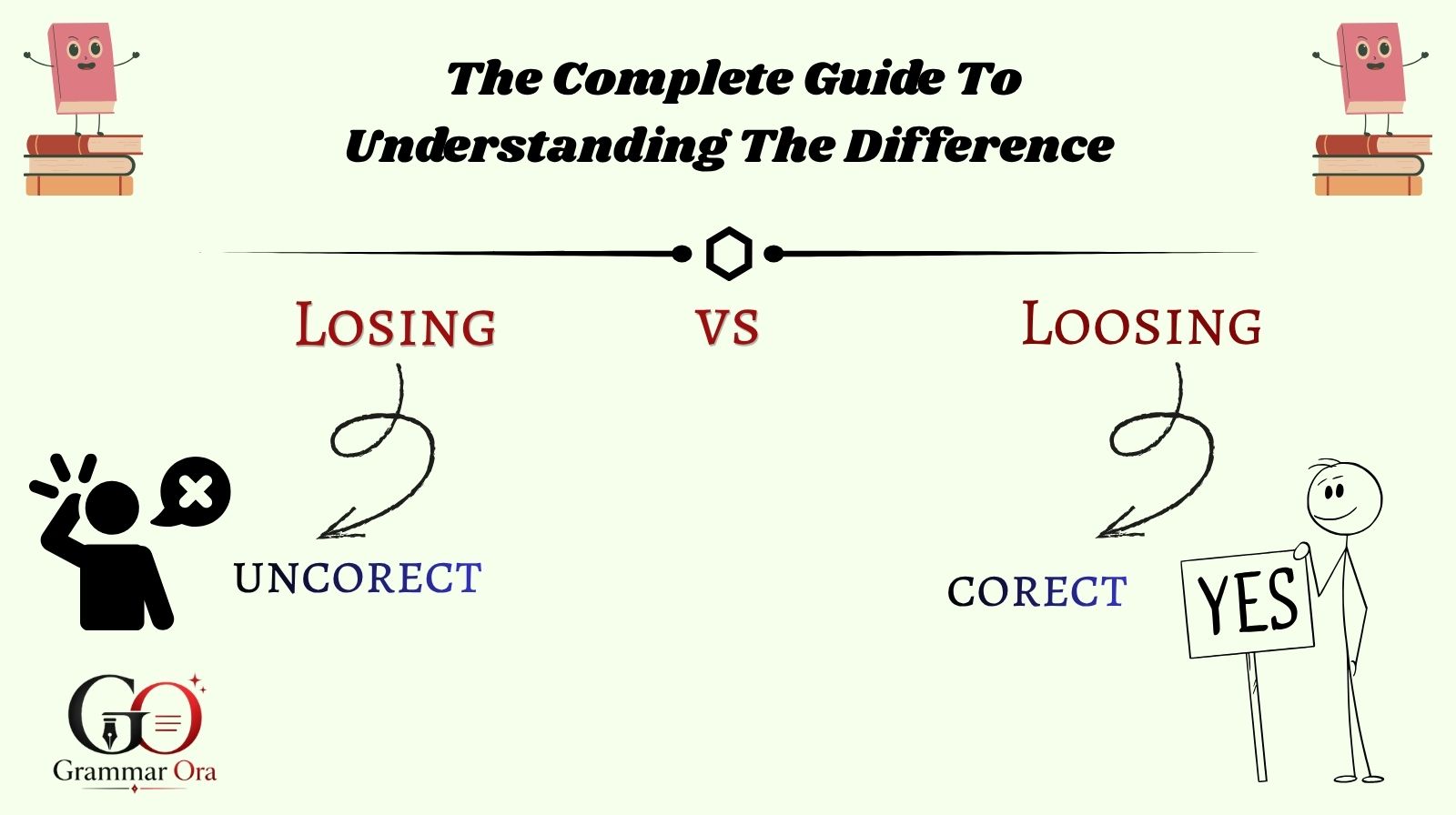
English has many words that look similar but have completely different meanings. One of the most commonly confused pairs is losing vs loosing. Because the two words differ by only one letter, many writers accidentally use the wrong one in emails, essays, social media posts, and professional documents.
If you’ve ever wondered whether you should write “I am losing my keys” or “I am loosing my keys,” you’re not alone. Thousands of people search for this grammar question every month because the mistake is surprisingly common.
The good news is that understanding the difference is simple once you know what each word means and how it is used in real-life situations. In this guide, you’ll learn the definitions, grammar rules, pronunciation differences, examples, common mistakes, and practical tips for remembering the correct spelling every time.
What Is the Difference Between Losing and Loosing?
The simplest way to understand the difference is this:
| Word | Meaning | Example |
|---|---|---|
| Losing | Failing to win or no longer having something | I am losing my patience. |
| Loosing | Releasing, setting free, or making less tight | The sailor is loosing the ropes. |
Although they look similar, these words serve completely different purposes in English.
Why People Confuse These Words
Several factors contribute to the confusion:
- Nearly identical spelling
- Similar pronunciation
- Fast typing habits
- Autocorrect errors
- Lack of familiarity with “loosing”
In modern English, losing appears far more frequently than loosing, which is why many readers are unfamiliar with the latter.
Quick Answer
If you’re talking about:
- Not winning → losing
- Misplacing something → losing
- Becoming less successful → losing
- Releasing or untightening something → loosing
What Does Losing Mean?
Losing is the present participle of the verb lose.
It refers to failing to keep, maintain, win, or retain something.
Common Meanings of Losing
Losing a Competition
When someone does not win a game, contest, or election, they are losing.
Examples:
- Our team is losing the match.
- She hates losing at chess.
- The candidate is losing support among voters.
Losing Possessions
You can also lose physical objects.
Examples:
- I keep losing my wallet.
- He is losing important documents.
- She worries about losing her phone.
Losing an Ability or Quality
Sometimes people lose qualities, skills, or emotions.
Examples:
- The company is losing customers.
- He is losing confidence.
- She is losing interest in the project.
Losing in Everyday English
“Losing” is one of the most commonly used verbs in modern English because it applies to countless situations involving failure, absence, decline, or reduction.
For example:
- Losing weight
- Losing money
- Losing time
- Losing focus
- Losing control
- Losing energy
Because of its wide usage, most grammar mistakes occur when writers accidentally add an extra “o” and write “loosing.”
What Does Loosing Mean?
Loosing comes from the verb loose, which means to release, free, untie, or make less tight.
Although it is a real word, it is much less common in modern English.
Common Meanings of Loosing
Releasing Something
Examples:
- The hunter is loosing an arrow.
- The soldiers were loosing their weapons.
- The trainer is loosing the dogs.
Untying or Relaxing
Examples:
- He is loosing the knot.
- She is loosing the straps on her backpack.
- They are loosing the ropes on the boat.
Historical Use of Loosing
Historically, loosing appeared frequently in military, hunting, and nautical contexts.
For example:
- Loosing arrows
- Loosing cannon fire
- Loosing hounds during a hunt
While these uses still exist, they are relatively rare in everyday conversation today.
Why Loosing Sounds Strange
Many English speakers rarely encounter the word “loosing.” As a result, whenever they see it, they often assume it is a spelling mistake.
However, in the right context, it is perfectly correct.
Losing vs Loosing: Side-by-Side Comparison
Understanding the distinction becomes easier when the words are compared directly.
| Feature | Losing | Loosing |
|---|---|---|
| Root Word | Lose | Loose |
| Part of Speech | Verb Form | Verb Form |
| Meaning | Not winning or no longer having something | Releasing or making less tight |
| Frequency | Very common | Rare |
| Everyday Use | High | Low |
| Common Contexts | Sports, business, daily life | Hunting, sailing, historical writing |
Example Comparisons
Correct:
- I am losing my keys.
- We are losing money.
- The team is losing the game.
Correct:
- The sailor is loosing the ropes.
- The archer is loosing an arrow.
- The worker is loosing the knot.
Incorrect:
- I am loosing my wallet. ❌
- We are loosing the match. ❌
- She is loosing interest in school. ❌
In these examples, the correct word is “losing.”
Common Mistakes People Make
Many grammar errors occur because people assume that adding an extra “o” follows English spelling patterns.
However, English often behaves differently.
Mistake #1: Using Loosing Instead of Losing
Incorrect:
- I am loosing weight.
Correct:
- I am losing weight.
Mistake #2: Using Loosing for Sports
Incorrect:
- Our team is loosing.
Correct:
- Our team is losing.
Mistake #3: Using Loosing for Money
Incorrect:
- The company is loosing profits.
Correct:
- The company is losing profits.
Why These Errors Happen
People often think:
- Lose → Loose → Loosing
However, English grammar doesn’t work that way.
The correct progression is:
- Lose → Losing
Not:
- Lose → Loosing
This irregular spelling pattern is the main source of confusion.
Real-Life Case Study: A Small Typo That Changed Professional Communication
A marketing agency was preparing a proposal for a major client worth thousands of dollars. During the final review, a manager noticed the sentence:
“The company is loosing market share to competitors.”
Although it seemed like a minor typo, the mistake appeared multiple times throughout the document.
The client receiving the proposal included senior executives and industry experts. In professional settings, grammar errors can affect credibility, especially when they occur repeatedly.
The team corrected every instance of “loosing” to “losing” before submitting the proposal. Afterward, one executive mentioned that clear communication played a role in forming a positive impression of the agency.
This example highlights an important lesson. While readers may understand your intended meaning, frequent spelling mistakes can create distractions and reduce trust in your writing. In business communication, academic work, and online publishing, using the correct word demonstrates professionalism and attention to detail.
The difference between losing and loosing may involve only one letter, but that single letter can significantly affect how your message is perceived.
Statistics and Language Trends (2025–2026)
Language data continues to show that confusion between losing and loosing remains one of the most common spelling mistakes online.
Key Findings
- Search engines process thousands of monthly searches related to “losing vs loosing.”
- Grammar-checking software regularly flags “loosing” as a misuse.
- Educational websites report that this confusion ranks among the most common English spelling questions.
- Online editors frequently identify the error in blog posts, social media content, and business communications.
Why the Mistake Persists
Several modern factors contribute:
Fast Digital Communication
People often type quickly on phones and computers.
Autocorrect Limitations
Some systems fail to recognize contextual grammar errors.
Visual Similarity
The words appear nearly identical at first glance.
Pronunciation Similarities
Many speakers pronounce them similarly in casual conversation.
As digital communication continues to grow, grammar awareness remains an important skill for professionals, students, and content creators.
How to Remember the Difference Between Losing and Loosing
Fortunately, there are several easy memory tricks.
Trick #1: Think About the Missing “O”
Notice that “losing” has only one “o.”
When you lose something, an “o” is gone.
Lose something → lose an O → losing
This simple association helps many learners remember the correct spelling.
Trick #2: Connect Loosing With Loose
Loosing comes from loose.
Examples:
- Loose rope
- Loose knot
- Loose strap
If something is becoming loose, “loosing” may be the correct choice.
Trick #3: Ask Yourself a Question
Before writing, ask:
“Am I talking about not winning or not having something?”
If yes, use losing.
“Am I talking about releasing or untightening something?”
If yes, use loosing.
Quick Checklist
Before using the word:
✔ Referring to failure? → Losing
✔ Referring to misplacing something? → Losing
✔ Referring to releasing something? → Loosing
✔ Referring to untightening something? → Loosing
✔ Talking about sports? → Usually Losing
Losing vs Loosing in Professional Writing
Professional writers, editors, and content creators strongly recommend using careful proofreading practices.
Academic Writing
Grammar mistakes can lower perceived quality.
Example:
- Correct: The company is losing revenue.
- Incorrect: The company is loosing revenue.
Business Communication
Clients often notice repeated spelling errors.
Content Marketing
Search engines prioritize high-quality content that demonstrates expertise and trustworthiness.
Social Media
Although casual language is common, clear spelling improves credibility and readability.
Therefore, learning the distinction between losing and loosing benefits anyone who writes regularly.
FAQs
Q1: Is loosing a real word?
A: Yes. Loosing is a legitimate English word that means releasing, freeing, or making something less tight.
Q2: Which is more common: losing or loosing?
A: Losing is significantly more common in everyday English.
Q3: Is “I am loosing weight” correct?
A: No. The correct sentence is:
“I am losing weight.”
Q4: Why is losing spelled with one O?
A: English spelling evolved historically, and “losing” became the accepted present participle form of “lose.”
Q5: What does loosing an arrow mean?
A: It means releasing or shooting an arrow.
Q6: Can loosing be used in modern English?
A: Yes, although it is relatively uncommon and usually appears in specific contexts involving release or untightening.
Q7: How can I quickly remember the difference?
A: Remember that when you lose something, you also lose an “O.” Therefore, the correct spelling is losing.
Conclusion
Understanding losing vs loosing is easier once you recognize that the words have completely different meanings. Losing refers to failing to win, misplacing something, or experiencing a reduction, while loosing means releasing, freeing, or making something less tight.
Because losing is far more common in everyday English, it is usually the correct choice when discussing sports, business, money, possessions, or personal experiences. Loosing, on the other hand, appears mainly in specialized contexts such as archery, sailing, and historical writing.
The next time you’re unsure, remember the simple rule: if you’re talking about not winning or no longer having something, choose losing. Applying this distinction consistently will improve your writing, strengthen your credibility, and help you communicate more clearly.
👉 Discover more simple and practical grammar guides on Grammar Ora

Muhammad Bilal is an expert blogger in Grammar Guide, dedicated to simplifying English grammar and helping learners write and speak with clarity, confidence, and accuracy.