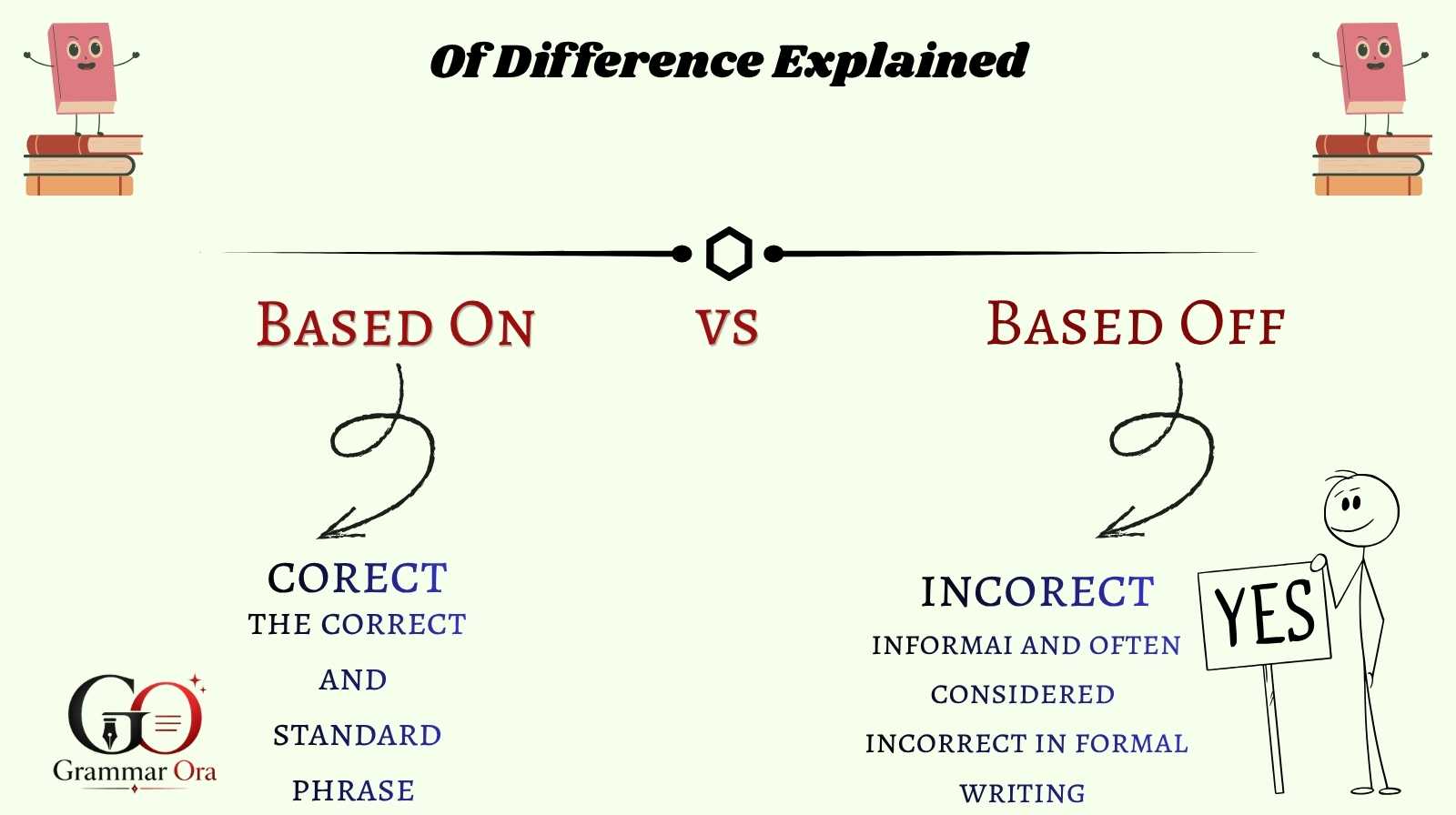
Have you ever written a sentence and paused to wonder whether you should use “based on” or “based off of”? You’re not alone. Many English speakers use both phrases interchangeably, yet one is generally preferred in formal writing while the other is more common in casual speech.
Understanding the difference can improve your writing, help you sound more professional, and prevent grammar mistakes in academic or business contexts.
In this guide, you’ll learn what each phrase means, when to use them, common mistakes to avoid, and 12 practical examples that make the distinction easy to understand.
What Does “Based On” Mean?
The phrase “based on” means that something is founded, developed, or built upon a particular source, fact, idea, or piece of information.
It is the standard expression accepted by most grammar guides, editors, and style manuals.
Why Is “Based On” Preferred?
In traditional English grammar, something is said to be “based on” a foundation.
Think of a building:
- A house is based on a foundation.
- A theory is based on evidence.
- A movie is based on a true story.
This relationship makes logical sense and sounds natural in both formal and informal writing.
Examples of “Based On”
- The report is based on recent market research.
- The movie is based on a true story.
- Our decision was based on customer feedback.
- The article is based on scientific evidence.
- Her conclusion was based on years of experience.
- The ranking system is based on performance metrics.
What Does “Based Off Of” Mean?
“Based off of” is a more recent expression that has become common in spoken American English.
Many people use it to mean the same thing as “based on.”
Is “Based Off Of” Grammatically Correct?
The answer depends on context.
While many native speakers use it naturally, grammar experts often consider “based on” more precise and appropriate, especially in formal writing.
However, language evolves, and “based off of” is now widely understood in everyday conversation.
Examples of “Based Off Of”
- The design was based off of the original prototype.
- The app was created based off of user suggestions.
- His character was based off of a real person.
- The strategy was developed based off of previous results.
- The recipe was adapted based off of family traditions.
- The campaign was planned based off of audience behavior.
Based On vs. Based Off Of: Key Differences
Although both phrases often communicate the same idea, there are differences in tone, formality, and acceptance.
| Feature | Based On | Based Off Of |
|---|---|---|
| Formal Writing | Preferred | Usually avoided |
| Academic Writing | Recommended | Rarely used |
| Business Communication | Preferred | Less common |
| Casual Conversation | Common | Common |
| Grammar Guide Approval | Strong | Mixed |
| Clarity | High | Moderate |
Quick Rule
If you’re writing for:
- School
- Business
- Publishing
- Professional communication
Use “based on.”
If you’re speaking casually, either phrase may be understood.
Real-Life Example: How Word Choice Affected Professional Communication
A marketing agency was preparing a major client proposal for an international brand. During the editing process, the team noticed multiple instances of the phrase “based off of customer data.”
While the wording wasn’t technically confusing, the senior editor recommended changing every occurrence to “based on customer data.”
Why?
The client expected professional, polished communication. Using the more widely accepted phrase created a stronger impression and aligned with business writing standards.
After revising the document, the proposal appeared more authoritative and consistent. The agency later adopted a style guide requiring employees to use “based on” in all official reports, presentations, and client communications.
This example highlights an important lesson: even small grammar choices can influence how professional and credible your writing appears.
Language Trends and Usage Statistics (2025–2026)
Recent language analysis tools and publishing databases continue to show that “based on” dominates formal writing.
Key Findings
- Academic journals overwhelmingly prefer “based on.”
- Major news organizations use “based on” as their editorial standard.
- Professional business documents favor “based on” for clarity.
- “Based off of” appears more frequently in conversational content and social media discussions.
These trends suggest that while both expressions are understood, “based on” remains the safer choice for professional writing in 2025–2026.
Common Mistakes to Avoid
Using “Based Off Of” in Academic Papers
Professors and editors typically expect “based on.”
Correct: The study is based on survey results.
Less Preferred: The study is based off of survey results.
Mixing Styles Within One Document
Consistency matters.
Choose one form and use it throughout the document.
Following Informal Habits in Professional Writing
Everyday speech doesn’t always match formal grammar expectations.
When in doubt, use “based on.”
How to Choose the Right Phrase
Use “Based On” When:
- Writing essays
- Creating reports
- Publishing articles
- Sending professional emails
- Preparing presentations
Use “Based Off Of” When:
- Speaking casually
- Writing dialogue
- Mimicking conversational language
- Creating informal content
Easy Memory Trick
Think of a building:
A structure sits on a foundation, not off of one.
Therefore, most ideas are naturally based on something.
FAQs
Q1: Is “based off of” wrong?
A: Not necessarily. It is widely used in everyday English, but many editors prefer “based on” in formal writing.
Q2: Which phrase is more professional?
A: “Based on” is generally considered more professional and appropriate for business, academic, and formal contexts.
Q3: Do Americans use “based off of”?
A: Yes. The phrase is common in American conversational English.
Q4: What do grammar experts recommend?
A: Most grammar authorities recommend using “based on” whenever possible.
Q5: Can I use both interchangeably?
A: In many situations, yes. However, “based on” is usually the safer and more widely accepted choice.
Q6: Is “based off” different from “based off of”?
A: Both forms appear in modern English, but “based off of” is more common than “based off” alone.
Conclusion
Understanding the difference between “based on” and “based off of” can help you write with greater confidence and clarity. While both phrases are commonly understood, “based on” remains the preferred option in formal, academic, and professional writing.
When accuracy and credibility matter, choose “based on.” Reserve “based off of” for casual conversations and informal contexts where a conversational tone is acceptable.
The next time you’re unsure which phrase to use, remember the simple rule: professional writing is usually based on strong foundations.
References
- Merriam-Webster Dictionary
- Purdue OWL Writing Lab
👉 Discover more simple and practical grammar guides on Grammar Ora

Muhammad Bilal is an expert blogger in Grammar Guide, dedicated to simplifying English grammar and helping learners write and speak with clarity, confidence, and accuracy.