Have you ever stopped while writing and wondered whether to use disenroll or unenroll? You are not alone. Many students, English learners, and even native speakers get confused because both words seem to have the same meaning.
The confusion becomes even more common when schools, online courses, apps, and subscription platforms use different terms in their settings and emails. One platform may use “unenroll,” while another says “disenroll.” Naturally, this leaves many people wondering which word is actually correct.
The good news is that both words are real and accepted in English. However, they are not always used in the same situations, and one of them is much more common in modern everyday English.
In this guide, you will learn the real difference between disenroll vs unenroll, their meanings, correct usage, grammar rules, sentence examples, and the easiest way to remember which word sounds more natural in everyday writing.
What Do Disenroll and Unenroll Mean?
Both disenroll and unenroll mean:
“To remove someone from enrollment in a course, program, membership, or service.”
For example:
- A student may leave a university course.
- A user may cancel an online learning program.
- A customer may remove themselves from automatic membership.
Even though the meanings are almost identical, usage patterns are different.
Simple Definitions
| Word | Meaning | Common Usage |
|---|---|---|
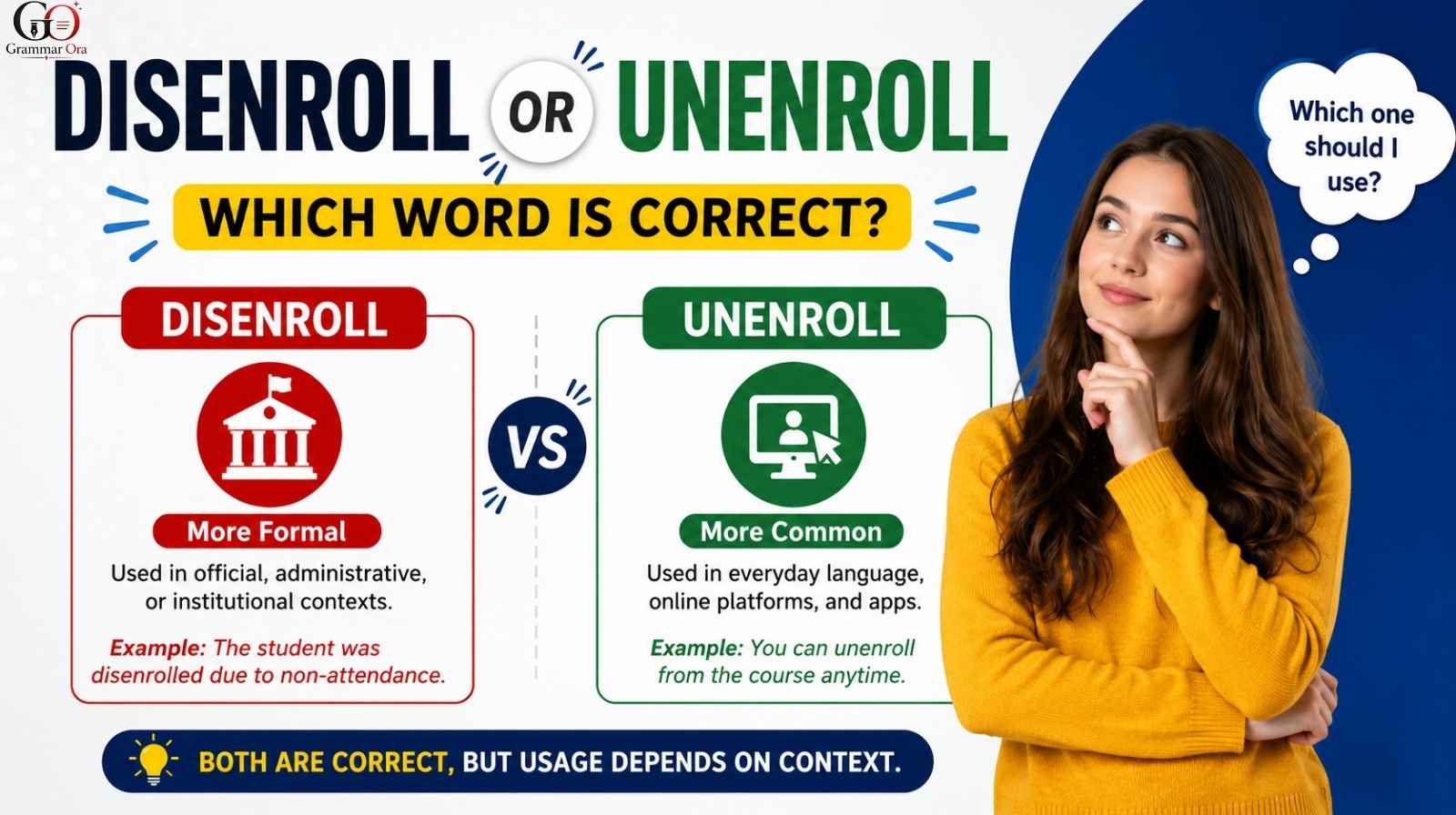
| Disenroll | Officially remove from enrollment | More formal |
| Unenroll | Cancel or leave enrollment | More modern and common |
Therefore, the difference is mostly about preference, tone, and regional usage rather than meaning.
Which Word Is More Correct?
“Unenroll” Is More Common in Modern English
Today, unenroll is generally the preferred word in everyday English, especially online.
You will often see it used on:
- Educational platforms
- Online courses
- School portals
- Subscription settings
- Learning management systems
Examples:
- “Click here to unenroll from the course.”
- “Students can unenroll anytime.”
- “You have successfully unenrolled.”
“Disenroll” Still Exists
The word disenroll is also correct, but it sounds more formal or administrative.
It is sometimes used in:
- Government documents
- Insurance systems
- Healthcare programs
- Official school records
Example:
- “The student was disenrolled due to non-attendance.”
So, while both words are correct, unenroll is usually the safer and more natural choice in modern writing.
Disenroll vs Unenroll: Key Difference Explained
Tone and Context Matter
The main difference between disenroll and unenroll is tone and usage style.
When to Use “Unenroll”
Use unenroll when writing:
- Informal content
- Website instructions
- User interfaces
- Blog posts
- Emails
- Online education content
Examples:
- “You can unenroll from the newsletter anytime.”
- “I decided to unenroll from the class.”
- “Tap the button below to unenroll.”
When to Use “Disenroll”
Use disenroll in:
- Formal reports
- Institutional documents
- Legal or medical contexts
- Administrative writing
Examples:
- “The patient was disenrolled from the program.”
- “Students may be disenrolled after repeated violations.”
Therefore, the best choice depends on your audience and writing style.
Why Do People Confuse Disenroll and Unenroll?
English prefixes can be tricky. That is the main reason many people become confused.
Understanding the Prefixes
| Prefix | Meaning |
|---|---|
| Un- | Reverse or remove |
| Dis- | Opposite, remove, separate |
Since both prefixes can imply removal, both words logically make sense.
However, modern English increasingly prefers simpler forms with un- in digital communication.
For example:
- unlock
- unsubscribe
- unfollow
- uninstall
- unenroll
Because of this pattern, “unenroll” feels more natural to many English speakers.
Is “Unenroll” Grammatically Correct?
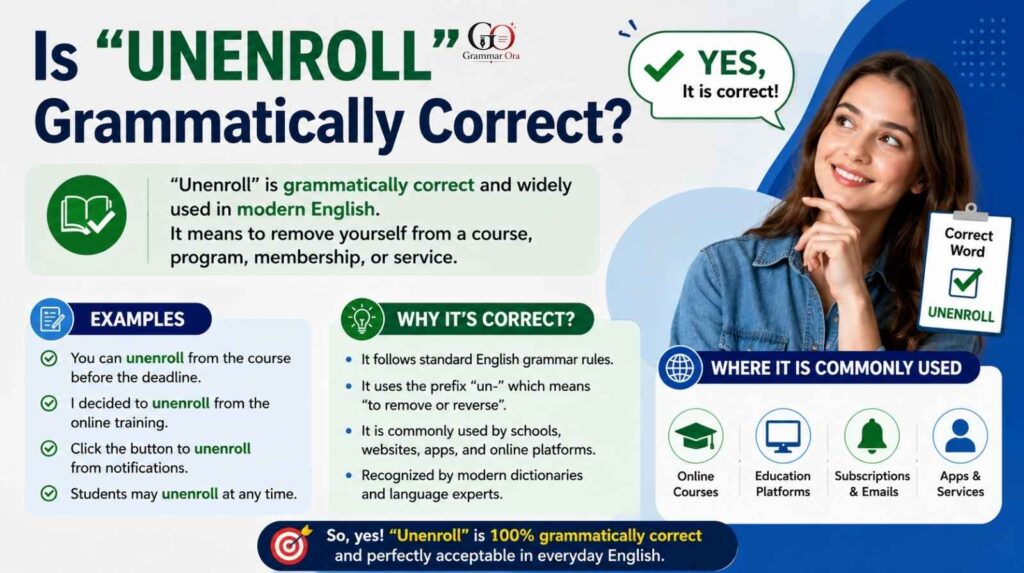
Yes, absolutely. Unenroll is grammatically correct and widely accepted in modern English dictionaries and educational platforms.
Many major platforms use it regularly, including online learning systems and digital course providers.
Real Usage Examples
Here are some natural examples:
- “Students may unenroll before the deadline.”
- “I accidentally unenrolled from the training program.”
- “Would you like to unenroll from notifications?”
These examples sound natural in everyday English.
Real-Life Example: A Student Confused During Course Registration
In 2025, an online English-learning community discussed confusing academic terms used in digital education platforms. One student shared that they were trying to leave an online certification course but became confused because the website used the word “disenroll” while another platform used “unenroll.”
The student initially thought the two words had different meanings. As a result, they hesitated to click the button because they feared losing account access permanently.
Later, the platform’s support team explained that both simply meant removing enrollment from a course. However, the company admitted that “unenroll” was easier for international learners to understand because it follows simpler and more familiar English patterns.
This small example highlights an important lesson in modern communication: clarity matters. Many businesses now prefer plain English terms because global users understand them faster.
That is one major reason why “unenroll” has become more popular online.
Usage Trends and Language Data (2025–2026)
Language usage data from recent educational and digital platforms shows a clear trend toward simpler wording.
According to modern UX writing studies and online education interfaces between 2025 and 2026:
- “Unenroll” appears more frequently on online platforms.
- “Disenroll” is still used in administrative systems.
- Simpler language improves user understanding and engagement.
Many companies now choose words based on readability and user experience rather than traditional formality.
Why Simpler English Is Growing
Modern readers prefer words that are:
- Easy to understand
- Quick to scan
- Familiar in digital environments
Therefore, words like “unsubscribe” and “unenroll” continue becoming more popular.
For readability guidelines and plain language recommendations, organizations like Google Search Central and HubSpot encourage clear, user-focused writing.
Disenroll or Unenroll: Quick Comparison Table
| Feature | Disenroll | Unenroll |
|---|---|---|
| Correct English? | Yes | Yes |
| More Formal? | Yes | No |
| More Common Online? | Less | More |
| Easier for Beginners? | No | Yes |
| Common in Apps/Websites? | Rarely | Frequently |
| Best for Everyday Writing? | Sometimes | Usually |
Common Mistakes to Avoid
Many writers misuse these words because they assume one must always be wrong. That is not true.
Mistake #1 – Thinking “Disenroll” Is Incorrect
Wrong idea:
- “Disenroll is not a real word.”
Correct explanation:
- It is a real and accepted English word.
Mistake #2 – Using Formal Words in Casual Writing
Example:
- “Please disenroll from our email updates.”
This sounds overly formal.
Better version:
- “Please unenroll from our email updates.”
Mistake #3 – Switching Terms Randomly
Try to stay consistent within the same article, platform, or document.
If your website uses “unenroll,” avoid suddenly changing to “disenroll.”
How to Remember the Correct Word Easily
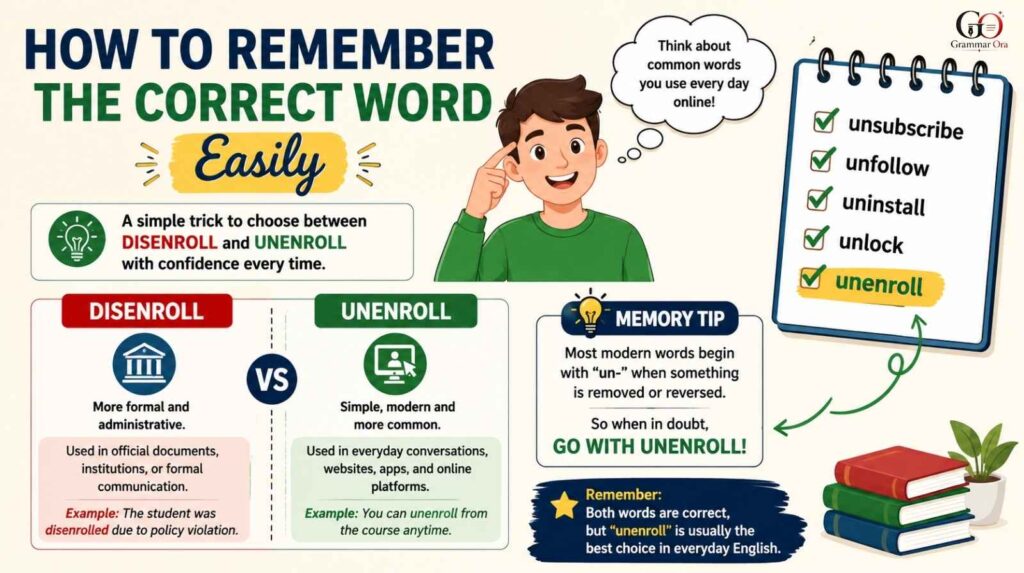
A simple trick can help you remember the difference.
Use This Memory Tip
Think about other modern internet words:
- unsubscribe
- unfollow
- uninstall
- unlock
Now add:
- unenroll
It matches the same simple pattern. That is why it sounds more natural online.
Meanwhile, “disenroll” feels more official and administrative.
FAQs
Q1:Is unenroll a real word?
A: Yes. “Unenroll” is a correct and widely used English word.
Q2:Is disenroll more formal?
A: Yes. “Disenroll” usually sounds more formal or institutional.
Q3:Which is more common in modern English?
A: Unenroll” is more common, especially on websites and apps.
Q4:Can I use both words interchangeably?
A: In most situations, yes. Their meanings are extremely similar.
Q5:Which word should students use?
A: Students usually sound more natural using “unenroll.”
Q6:Do dictionaries accept both words?
A: Yes. Most modern dictionaries recognize both terms.
Q7:Why do apps prefer “unenroll”?
A: Because it is simpler, clearer, and easier for users worldwide to understand.
Conclusion
The confusion between disenroll or unenroll is understandable because both words are correct and share almost the same meaning. However, modern English strongly favors unenroll, especially in online communication, apps, educational platforms, and casual writing.
Meanwhile, disenroll still appears in formal or administrative contexts such as healthcare, government systems, and official records.
If you want the safest and most natural choice for everyday English, “unenroll” is usually the better option.
👉 Discover more simple and practical grammar guides on Grammar Ora

Muhammad Bilal is an expert blogger in Grammar Guide, dedicated to simplifying English grammar and helping learners write and speak with clarity, confidence, and accuracy.