Have you ever stopped while writing and wondered whether to use bosses or boss’s? You are not alone. Many English learners, students, and even native speakers get confused because both words look very similar but follow completely different grammar rules.
The confusion usually happens because one word is a plural noun, while the other shows possession. Even a small apostrophe can completely change the meaning of a sentence.
In this simple grammar guide, you will learn the difference between bosses and boss’s, when to use each one correctly, common grammar mistakes to avoid, and easy tricks to remember the right form every time.
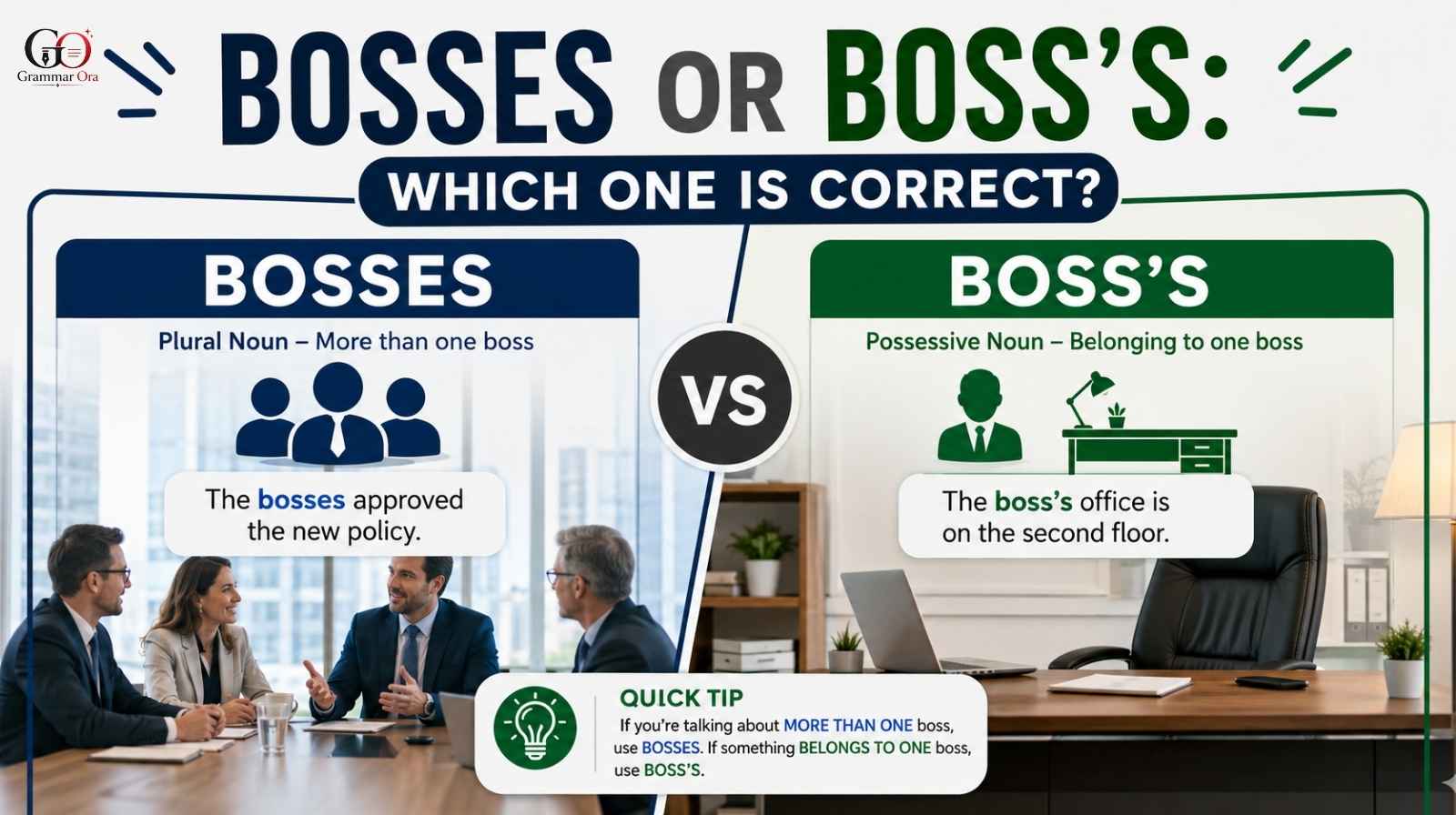
What Is the Difference Between Bosses and Boss’s?
The main difference is simple:
| Word | Meaning | Grammar Type |
|---|---|---|
| Bosses | More than one boss | Plural noun |
| Boss’s | Something belonging to one boss | Possessive noun |
For example:
- The bosses agreed on the new policy.
(There are multiple bosses.) - The boss’s office is on the second floor.
(The office belongs to one boss.)
This tiny apostrophe changes the meaning completely. Therefore, understanding plural and possessive forms is important for correct writing.
Why People Get Confused
English punctuation rules can sometimes feel inconsistent. Words ending in s often create confusion because writers are unsure where the apostrophe belongs.
For example:
- bosses
- boss’s
- bosses’
- bos’s ❌
Only some of these are correct depending on the sentence.
Quick Rule to Remember
If you are talking about more than one boss, use bosses.
If you are showing that something belongs to one boss, use boss’s.
How to Use “Bosses” Correctly
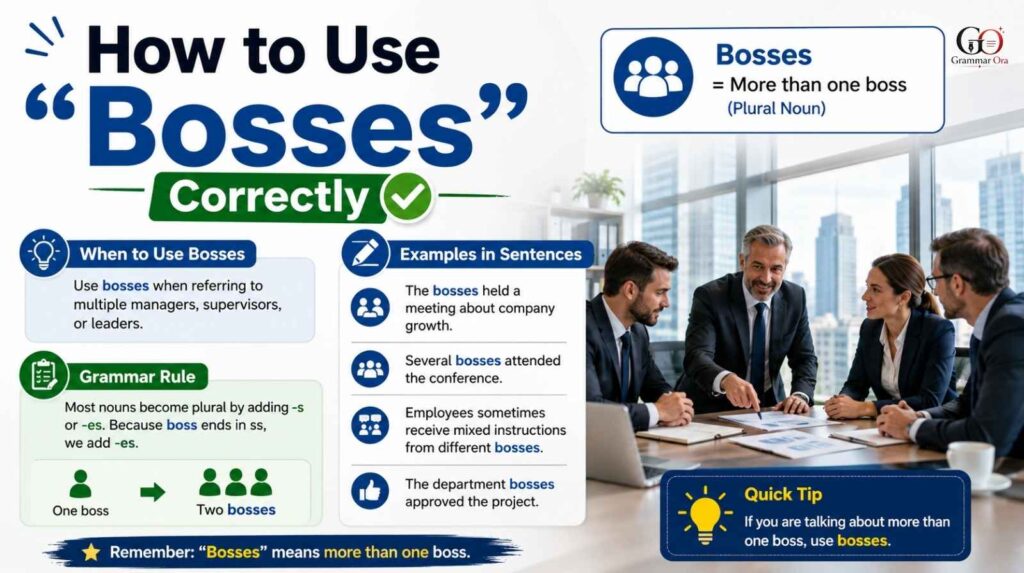
The word bosses is simply the plural form of boss.
When to Use Bosses
Use bosses when referring to multiple managers, supervisors, or leaders.
Examples of Bosses in Sentences
- The bosses held a meeting about company growth.
- Several bosses attended the conference.
- Employees sometimes receive mixed instructions from different bosses.
- The department bosses approved the project.
In all these examples, the word refers to more than one person.
Grammar Rule Behind Bosses
Most English nouns become plural by adding -s or -es.
Because boss ends in ss, you add -es:
- one boss
- two bosses
This follows standard English grammar rules.
Common Mistakes With Bosses
Many people incorrectly write:
- boss’s when they actually mean multiple bosses
- boses ❌
- bosss ❌
The correct plural spelling is always bosses.
How to Use “Boss’s” Correctly
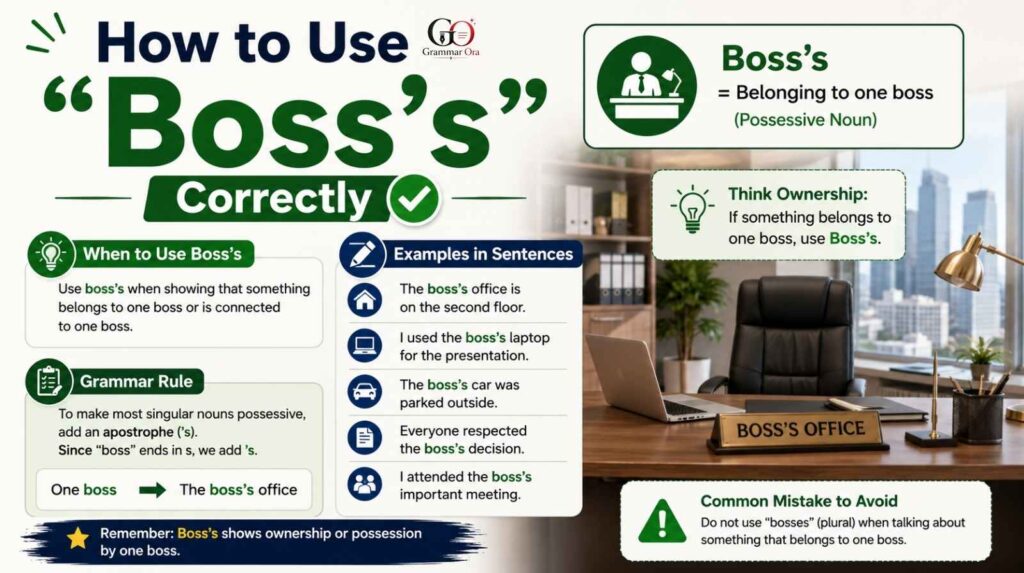
The word boss’s is the singular possessive form of boss.
It shows ownership or connection.
When to Use Boss’s
Use boss’s when something belongs to one boss.
Examples of Boss’s in Sentences
- The boss’s laptop was missing.
- I attended the boss’s presentation.
- Everyone respected the boss’s decision.
- The boss’s car was parked outside.
In these examples, the object belongs to one boss.
The Apostrophe Rule Explained
To make most singular nouns possessive:
- Add an apostrophe
- Add s
Example:
- teacher → teacher’s
- manager → manager’s
- boss → boss’s
Therefore, boss’s is grammatically correct in modern English.
Is Boss’ Also Correct?
Some style guides accept boss’ without the extra s, especially in journalistic writing. However, most modern grammar experts and style manuals prefer boss’s because it matches normal pronunciation.
For clarity and consistency, using boss’s is usually the safest choice.
Bosses vs Boss’s: Side-by-Side Comparison
Here is an easy comparison table to help you remember the difference quickly.
| Feature | Bosses | Boss’s |
|---|---|---|
| Meaning | More than one boss | Belonging to one boss |
| Grammar Type | Plural noun | Singular possessive noun |
| Apostrophe Used? | No | Yes |
| Example | The bosses arrived early. | The boss’s office is large. |
| Refers to Ownership? | No | Yes |
Simple Memory Trick
Ask yourself this question:
“Am I talking about ownership?”
- If YES → use boss’s
- If NO and there are multiple bosses → use bosses
This quick trick helps avoid most grammar mistakes.
Real-Life Example: Workplace Email Confusion
A marketing employee once sent an important company-wide email that read:
“All boss’s must attend tomorrow’s leadership meeting.”
At first glance, the sentence looked acceptable. However, several employees noticed the grammar mistake immediately.
The writer meant multiple bosses, so the correct word should have been bosses, not boss’s.
The corrected sentence became:
“All bosses must attend tomorrow’s leadership meeting.”
While this may seem like a tiny punctuation issue, grammar mistakes in professional communication can affect credibility. According to business communication experts, incorrect grammar in workplace emails can create confusion and make writing appear less professional.
In another situation, an employee wrote:
“The bosses office is being renovated.”
This sentence was also incorrect because the office belonged to one boss. The proper sentence should have been:
“The boss’s office is being renovated.”
These examples show why understanding plural and possessive nouns matters in real-world communication. Small grammar errors can change meaning entirely.
Why Apostrophe Mistakes Are So Common
Apostrophe mistakes are among the most common grammar errors in English writing.
According to educational language reports published between 2025 and 2026, punctuation and possessive noun mistakes remain one of the top issues in workplace communication and student writing.
Many writers struggle because English apostrophe rules contain exceptions and style variations.
Common Reasons for Confusion
1. Similar Spellings
Words like:
- bosses
- boss’s
- bosses’
look extremely similar.
2. Pronunciation Sounds Similar
In spoken English, the difference is often subtle.
3. Multiple Grammar Rules
English has separate rules for:
- plural nouns
- singular possessive nouns
- plural possessive nouns
This naturally causes confusion.
Why Correct Grammar Matters
Good grammar improves:
- professional writing
- academic performance
- communication clarity
- reader trust
Even small punctuation mistakes can make sentences harder to understand.
How to Remember the Correct Usage Easily
Learning grammar becomes easier when you use memory techniques.
Trick #1: Look for Ownership
If something belongs to someone, use an apostrophe.
Example:
- The boss’s desk
- The teacher’s book
Trick #2: Count the People
If there is more than one boss, use bosses.
Example:
- The bosses discussed salaries.
Trick #3: Replace the Word
Try replacing the word with another noun.
Example:
- manager → managers
- manager’s
This often makes the grammar pattern easier to notice.
Practice Sentences
Choose the correct word:
- The ______ approved the proposal.
→ bosses - The ______ meeting starts at 3 PM.
→ boss’s - Several ______ attended the seminar.
→ bosse - The ______ computer stopped working.
→ boss’s
Regular practice helps grammar rules become automatic.
Common Grammar Mistakes Related to Bosses and
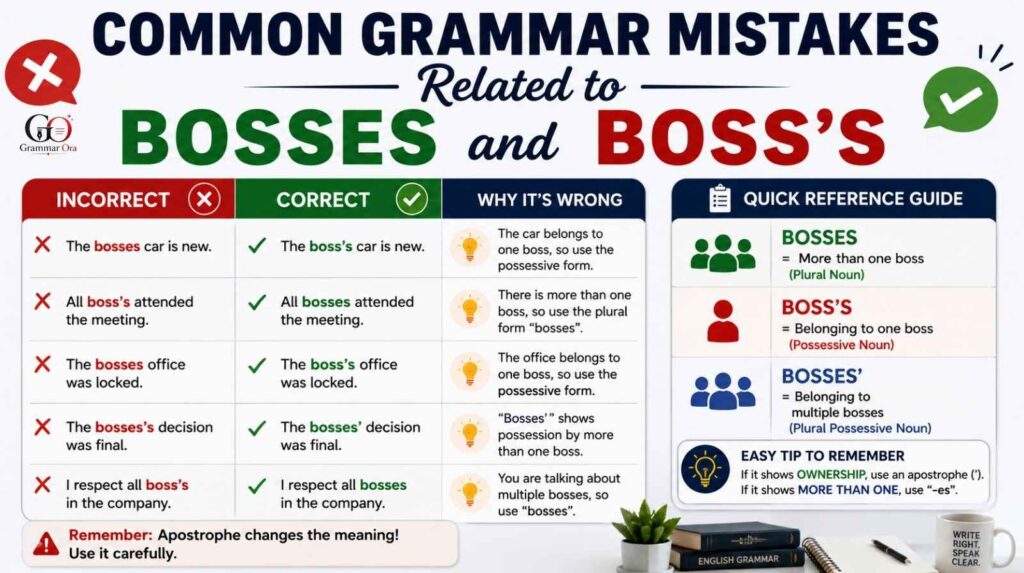
Boss’s
Many writers accidentally mix plural and possessive forms.
Incorrect Examples
❌ The bosses car is new.
✅ The boss’s car is new.
❌ All boss’s attended the meeting.
✅ All bosses attended the meeting.
❌ The bosses’s office was locked.
✅ The boss’s office was locked.
Another Common Confusion: Bosses’
The word bosses’ is the plural possessive form.
It means something belongs to multiple bosses.
Example:
- The bosses’ meeting room was renovated.
This means the meeting room belonged to several bosses.
Quick Summary
| Word | Usage |
|---|---|
| boss | one person |
| bosses | multiple people |
| boss’s | belonging to one boss |
| bosses’ | belonging to multiple bosses |
Understanding these forms makes writing much clearer.
What Grammar Experts and Style Guides Say
Most modern grammar experts support using boss’s as the singular possessive form.
Major style resources such as:
recommend adding apostrophe + s for singular nouns ending in s.
Example
- boss → boss’s
- class → class’s
- bus → bus’s
However, some older newspaper styles may drop the extra s after the apostrophe.
Still, in everyday writing and modern English, boss’s is widely accepted and preferred.
FAQs
QIs bosses grammatically correct?
A: Yes. Bosses is the correct plural form of boss.
QIs boss’s grammatically correct?
A: Yes. Boss’s is the correct singular possessive form showing ownership.
QWhat does bosses’ mean?
A: Bosses’ means something belongs to multiple bosses.
Example:
A: The bosses’ schedules were updated.
QWhich is more common: boss’ or boss’s?
A: Modern grammar guides usually prefer boss’s.
QHow do I know whether to use bosses or boss’s?
Ask yourself:
A: Are you talking about multiple bosses? → bosses
Are you showing ownership? → boss’s
QWhy are apostrophes confusing in English?
A: English punctuation rules include several exceptions and style differences, which can make apostrophes difficult for learners.
QCan grammar mistakes affect professional writing?
A: Yes. Grammar mistakes can reduce clarity and professionalism, especially in business emails and formal communication.
Conclusion
Understanding the difference between bosses and boss’s is actually much easier once you know the grammar rule behind each word.
- Bosses = more than one boss
- Boss’s = something belonging to one boss
The apostrophe is the key difference. Although the words look similar, they serve completely different purposes in a sentence.
Whenever you feel unsure, simply ask yourself whether the sentence shows ownership or refers to multiple people. That quick check will help you choose the correct spelling almost every time.
Mastering small grammar details like bosses or boss’s can improve your writing, make communication clearer, and help you sound more professional in everyday English.
👉 Discover more simple and practical grammar guides on Grammar Ora

Muhammad Bilal is an expert blogger in Grammar Guide, dedicated to simplifying English grammar and helping learners write and speak with clarity, confidence, and accuracy.