Have you ever typed “chosing” and suddenly wondered whether it should actually be “choosing”? You are not alone. Many English learners, students, bloggers, and even native speakers get confused between these two spellings because the word sounds slightly different when spoken quickly.
The good news is that the answer is actually simple once you understand the spelling rule behind it. In English, small spelling changes can completely change whether a word is correct or incorrect. That is exactly what happens with choosing and chosing.
In this guide, you will learn the correct spelling, why people make this mistake, grammar rules, pronunciation tips, real examples, and simple tricks to remember the correct form every time. By the end of this article, you will never confuse choosing or chosing again.
What Is the Difference Between Choosing and Chosing?
The difference is very simple:
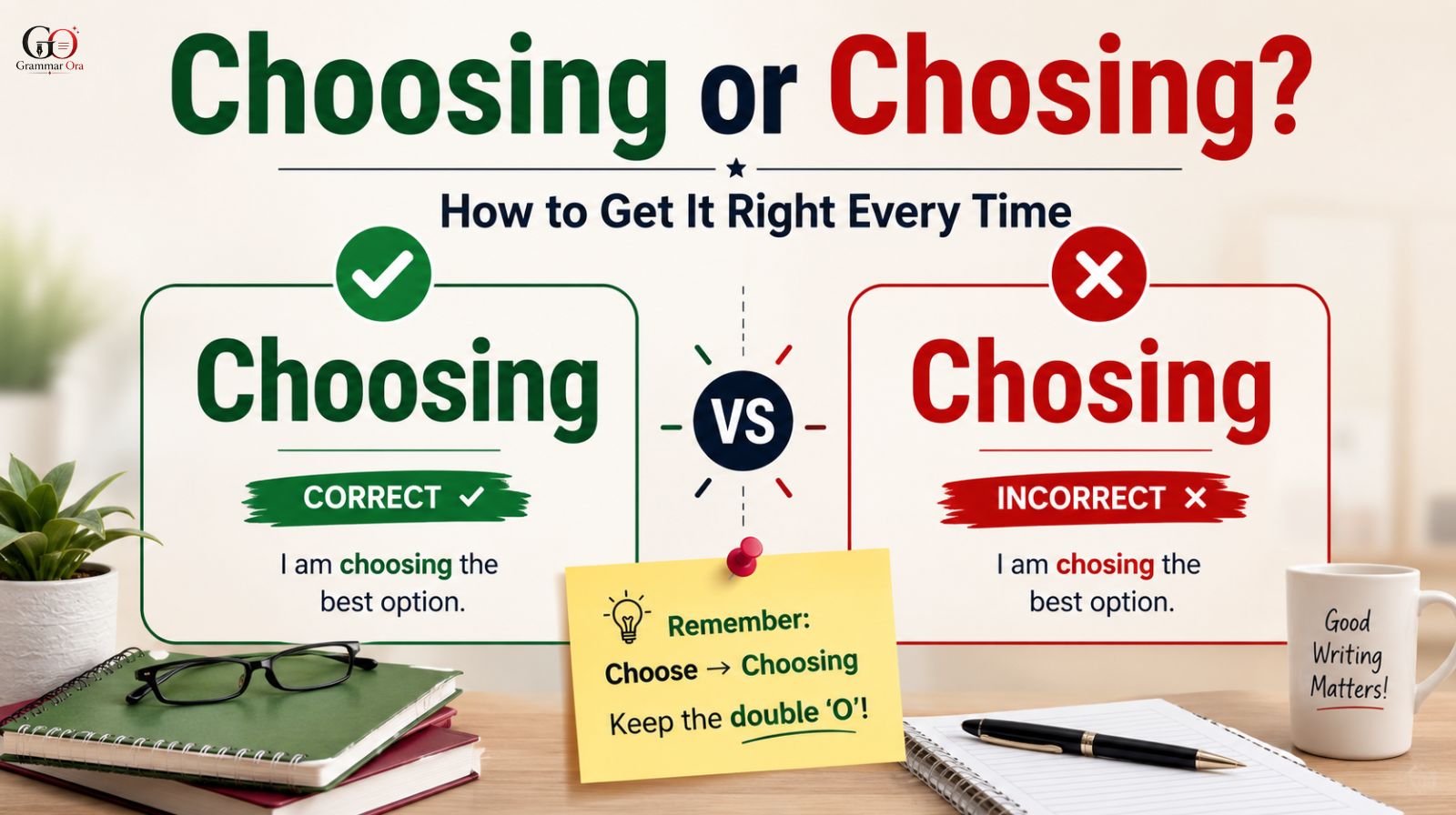
- Choosing is the correct spelling.
- Chosing is incorrect and not accepted in standard English.
The word “choosing” comes from the verb “choose,” which means selecting or deciding between options.
Correct Example
- I am choosing a new laptop for work.
- She is choosing the best dress for the event.
Incorrect Example
- I am chosing a new laptop.
- She is chosing the best dress.
Even though “chosing” may look reasonable, English spelling rules require the extra “o” in “choosing.”
Why Is “Choosing” the Correct Spelling?
The correct spelling follows a common English grammar pattern. When verbs ending in silent “e” are changed into present participles ending in “-ing,” the final “e” is usually removed.
For example:
| Base Verb | -ing Form |
|---|---|
| make | making |
| write | writing |
| choose | choosing |
| drive | driving |
The word “choose” becomes “choosing,” not “chosing.”
The Important Vowel Rule
The double “o” sound in “choose” stays in the spelling because it affects pronunciation. Removing one “o” would create an incorrect word structure.
That is why:
- choose → choosing ✅
- chose → chosing ❌
Many people accidentally mix up “choose” and “chose,” which causes the spelling error.
Why Do People Misspell Choosing as Chosing?
There are several reasons why this mistake is extremely common.
Confusion Between “Choose” and “Chose”
Many writers confuse these words:
- Choose = present tense
- Chose = past tense
Examples:
- I choose healthy food every day.
- Yesterday, I chose pizza.
Because “chose” is a real word, some people mistakenly think “chosing” should also exist.
Fast Pronunciation
In casual conversation, “choosing” may sound like “chozing,” especially in American English accents. Therefore, writers sometimes spell it the way they hear it.
Typing Quickly
Autocorrect does not always catch every spelling mistake immediately. As a result, “chosing” sometimes appears in emails, blogs, social media posts, and even professional writing.
Choosing vs Chosing: Quick Comparison Table
| Feature | Choosing | Chosing |
|---|---|---|
| Correct spelling | ✅ Yes | ❌ No |
| Standard English word | ✅ Yes | ❌ No |
| Dictionary accepted | ✅ Yes | ❌ No |
| Verb form | Present participle | Incorrect form |
| Example | Choosing a career | Chosing a career |
If you want grammatically correct writing, always use choosing.
How to Remember the Correct Spelling of Choosing
One of the easiest ways to avoid this mistake is to use memory tricks.
Remember the Base Word
The word comes from choose.
Since “choose” has a double “o,” “choosing” keeps the double “o” too.
Think:
choose → choosing
NOT:
chose → chosing
Use the “Double O” Trick
A simple memory tip is:
“You need two options to choose, so keep two O’s.”
This small trick helps many learners remember the correct spelling instantly.
Read More English Content
Reading books, blogs, and professional articles helps your brain recognize correct spelling naturally over time. According to research from the Cambridge Dictionary, repeated exposure to correct word forms improves long-term spelling accuracy.
Real-Life Example: How a Small Spelling Mistake Changed a Job Application
A university student applying for a marketing internship once wrote:
“I am excited about chosing your company for my career growth.”
Although the rest of the application was strong, the recruiter noticed the spelling mistake immediately. According to hiring experts at Grammarly, spelling errors in professional communication can negatively affect credibility because they suggest a lack of attention to detail.
The student later corrected the mistake and resubmitted the application. However, the experience taught an important lesson: even one small spelling error can influence how others perceive your professionalism.
This situation happens more often than people realize. Whether you are writing emails, blog posts, assignments, or business proposals, using the correct spelling matters. Words like “choosing” are common in everyday communication, which means mistakes become highly visible.
For example:
- Choosing the right university
- Choosing a business partner
- Choosing healthy habits
- Choosing software for work
Because the word appears so frequently, learning the correct spelling once can improve your writing permanently.
Common Sentences Using “Choosing”
Here are some natural examples of the correct usage.
Everyday Examples
- She is choosing a birthday gift for her friend.
- We are choosing a restaurant for dinner.
- He spent hours choosing the perfect phone.
- They are choosing new office furniture.
Professional Examples
- Choosing the right strategy can improve business growth.
- Companies are choosing remote work models more often.
- Customers are choosing brands with better customer service.
Academic Examples
- Students are choosing online learning platforms for flexibility.
- Researchers are choosing advanced tools for data analysis.
Using correct examples repeatedly helps build stronger grammar habits.
Choosing, Choose, and Chose Explained
Many spelling mistakes happen because people mix these three forms together.
| Word | Meaning | Example |
|---|---|---|
| Choose | Present tense verb | I choose tea over coffee. |
| Chose | Past tense verb | She chose the blue dress. |
| Choosing | Continuous form | He is choosing a new car. |
Understanding these differences makes spelling much easier.
Easy Grammar Pattern
Here is the simplest way to remember:
- choose = now
- chose = past
- choosing = happening currently
2025–2026 Writing and Grammar Statistics
Correct spelling remains extremely important in digital communication. Recent language and workplace studies highlight how grammar affects credibility and engagement.
- A 2025 workplace communication survey reported that employers still consider spelling accuracy an important professional skill.
- Content marketing experts at HubSpot state that clear and error-free writing improves reader trust and user engagement.
- Educational researchers continue to find that repeated reading exposure helps learners improve spelling retention faster than memorization alone.
These findings show that spelling is not just about grammar rules. It directly affects communication quality, professionalism, and online credibility.
Step-by-Step Guide to Avoid Spelling “Choosing” Wrong
If you frequently confuse choosing or chosing, follow these simple steps.
Step 1: Start With the Base Word
Ask yourself:
What is the original verb?
The answer is “choose.”
Step 2: Add “-ing”
Remove the silent “e” and add “-ing.”
- choose → choosing
Step 3: Keep Both O’s
Never remove one “o.”
Step 4: Use Spell Check Carefully
Spell-check tools help, but they are not perfect. Always reread important writing manually.
Step 5: Practice Through Writing
Write a few sentences daily using:
- choose
- chose
- choosing
Practice improves memory much faster than memorization alone.
Common Mistakes Related to Choosing
People who misspell “choosing” often make similar grammar mistakes too.
| Incorrect | Correct |
|---|---|
| chosing | choosing |
| looseing | losing |
| writeing | writing |
| moveing | moving |
English spelling patterns can feel inconsistent. However, understanding the root word usually helps.
FAQs
Q1: Is chosing ever correct?
A: No. “Chosing” is not a correct English word.
Q2: Why does choosing keep two O’s?
A: Because it comes from the word “choose,” which already contains double “o.”
Q3: What is the difference between choose and chose?
A: Choose” is present tense, while “chose” is past tense.
Q4: How do you spell choosing in British English?
A: The spelling is the same in both British and American English: “choosing.”
Q5: Why do people type chosing?
A: Most people confuse “choose” and “chose” or spell the word based on pronunciation.: :
Q6: Is choosing a verb?
A: Yes. It is the present participle form of the verb “choose.”
Q7: Can spelling mistakes affect SEO writing?
A: Yes. Grammar and spelling mistakes can reduce reader trust, increase bounce rates, and lower content quality perception.
Conclusion
If you have ever wondered whether to write choosing or chosing, the answer is simple: choosing is always the correct spelling.
The confusion usually happens because people mix up “choose” and “chose.” However, once you remember that the original word is “choose,” it becomes much easier to spell “choosing” correctly every time.
Whether you are writing emails, blog posts, assignments, or professional documents, using correct spelling improves clarity and credibility. Therefore, the next time you type the word, remember to keep both “o’s” in choosing.
👉 Discover more simple and practical grammar guides on Grammar Ora

Muhammad Bilal is an expert blogger in Grammar Guide, dedicated to simplifying English grammar and helping learners write and speak with clarity, confidence, and accuracy.