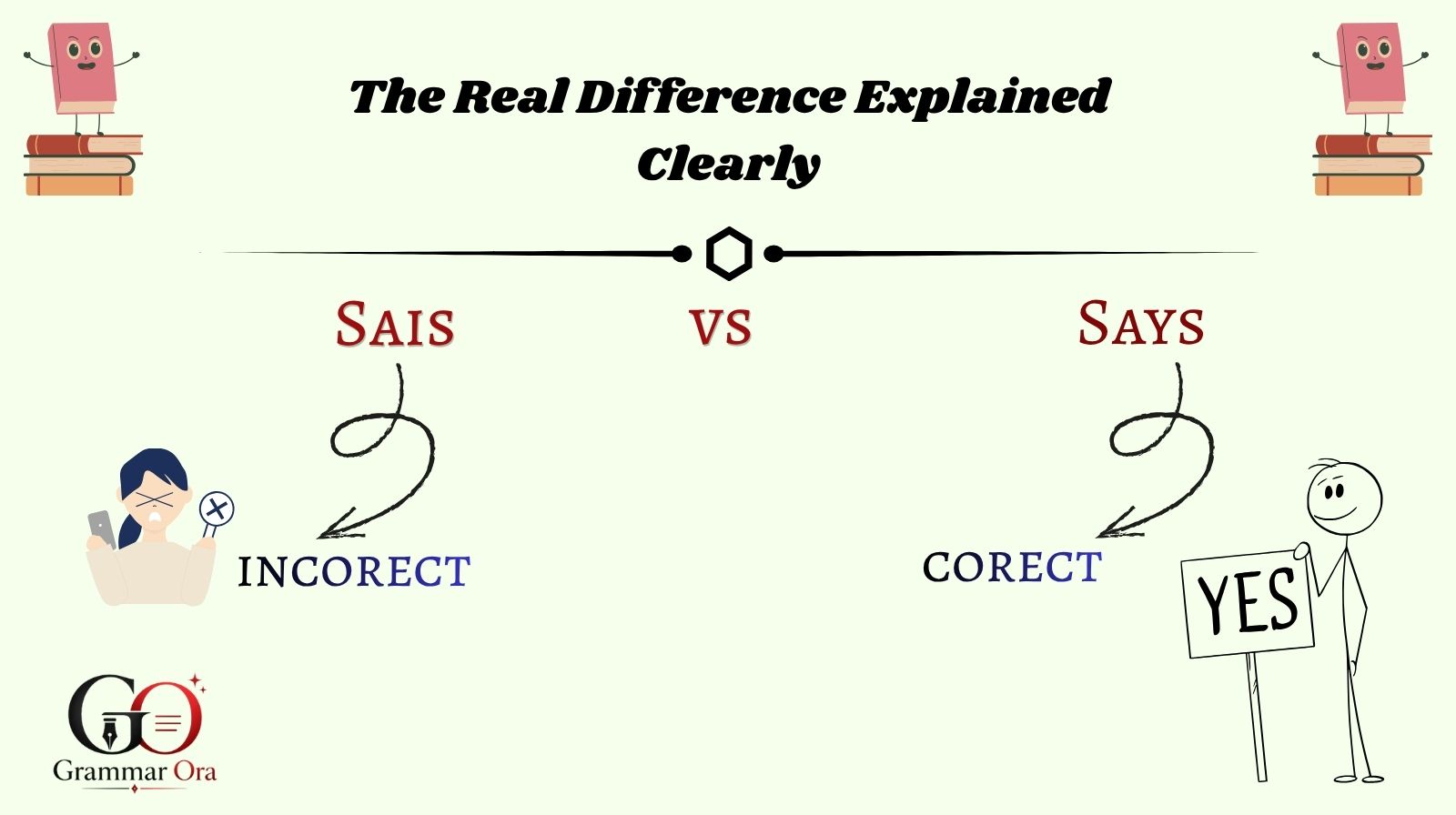
Have you ever typed “sais” when you meant to write “says”? If so, you’re not alone. English spelling can be confusing, especially when words sound similar or when pronunciation doesn’t match spelling rules.
Many writers, students, bloggers, and even native English speakers occasionally wonder whether “sais” is a valid word or simply a misspelling of “says.” Because the pronunciation of says sounds closer to “sez” than “says,” it’s easy to see why confusion happens.
In this guide, you’ll learn the exact difference between sais vs says, when each word is used, whether “sais” is ever correct, and how to avoid this common mistake in everyday writing. By the end, you’ll know which spelling to use confidently in emails, articles, school assignments, and professional communication.
What Is the Difference Between Sais and Says?
Quick Answer
The word “says” is the correct present-tense form of the verb “say.”
The spelling “sais” is usually considered a misspelling of “says” in modern English.
| Word | Correct? | Meaning |
|---|---|---|
| Says | Yes | Third-person singular form of “say” |
| Sais | Usually No | Common misspelling of “says” |
Why People Get Confused
English contains many words where pronunciation doesn’t match spelling expectations. For example:
- Says → sounds like “sez”
- Does → sounds like “duz”
- Said → sounds like “sed”
Because of these irregular spellings, some writers mistakenly assume “sais” follows a logical spelling pattern.
Example
✅ Correct:
- She says she will arrive tomorrow.
- My teacher says practice improves writing.
❌ Incorrect:
- She sais she will arrive tomorrow.
- My teacher sais practice improves writing.
Understanding the Word “Says”
Definition of Says
Says is the third-person singular present tense of the verb say.
It is used when referring to:
- He says
- She says
- It says
- Someone says
Examples in Sentences
- He says the meeting starts at noon.
- Sarah says she enjoys reading.
- The sign says parking is prohibited.
- My doctor says I should exercise regularly.
Why the Spelling Looks Unusual
Many learners expect:
- Say → saies
- Play → plays
However, English treats say differently.
The accepted form is:
- I say
- You say
- We say
- They say
- He/She/It says
This exception has existed for centuries and is fully standardized in modern English.
Common Grammar Pattern
Subject + Says + Statement
Examples:
- John says he is busy.
- The report says sales increased.
- The article says the update launches next month.
Is “Sais” Ever a Real Word?
In Modern English
For most English writing, sais is not considered a standard English word.
When people write “sais,” they almost always mean “says.”
Historical and Specialized Usage
There have been rare historical uses of the word “sais” in specific contexts, names, or non-English language references. However, these usages are uncommon and unrelated to everyday English grammar.
For example:
- Place names
- Historical references
- Foreign-language terms
These exceptions do not change the rule that when you mean the verb say, the correct spelling is says.
Practical Rule
If you’re writing:
- A blog post
- An email
- An essay
- A report
- A social media post
Use says, not sais.
Why “Sais” Is Such a Common Mistake
Pronunciation Creates Confusion
The biggest reason is pronunciation.
The word:
says → pronounced /sez/
Notice that the pronunciation doesn’t clearly reveal the spelling.
Many learners attempt to spell it based on sound.
Similar English Patterns
Consider these examples:
| Spoken Sound | Correct Spelling |
|---|---|
| sez | says |
| sed | said |
| duz | does |
| wunz | once |
English often prioritizes historical spelling over phonetic consistency.
Autocorrect and Typing Errors
Typing quickly can also lead to mistakes.
Examples:
- sais
- saies
- says
Modern grammar tools usually flag these errors and suggest “says.”
Sais vs Says: Side-by-Side Comparison
Detailed Comparison Table
| Feature | Sais | Says |
|---|---|---|
| Standard English | No | Yes |
| Dictionary Accepted | Generally No | Yes |
| Verb Form of Say | No | Yes |
| Used in Formal Writing | No | Yes |
| Used in Academic Writing | No | Yes |
| Used in Business Communication | No | Yes |
| Grammatically Correct | No | Yes |
Which Should You Use?
The answer is simple:
✔ Use says whenever referring to the verb say.
❌ Avoid sais in standard English writing.
Memory Trick
Think of:
- Say → Says
- Pay → Pays
- Stay → Stays
The pattern becomes easier when viewed alongside other verbs.
Real-Life Example: How a Small Spelling Error Changes Credibility
A freelance content writer was preparing website copy for a technology company. The article was well researched, informative, and professionally structured. However, throughout the piece, the writer repeatedly used the spelling “sais” instead of “says.”
Examples included:
- The report sais customer satisfaction increased.
- The CEO sais innovation is the company’s priority.
- Research sais user experience impacts conversions.
Although the information itself was accurate, readers immediately noticed the spelling mistake. During proofreading, the client flagged the issue and requested revisions before publication.
The problem wasn’t merely grammatical. The repeated error affected the perceived professionalism of the content. Visitors often judge credibility based on writing quality. A simple spelling mistake can make readers question the accuracy of the entire article.
After correcting every instance of “sais” to “says,” the article appeared polished, trustworthy, and ready for publication.
This example demonstrates an important lesson: even minor spelling mistakes can influence how readers view your expertise and authority.
Language Statistics and Writing Accuracy Trends (2025–2026)
Recent writing and editing trends show that spelling accuracy remains one of the most important factors in content quality.
Key Findings
- Grammar and spelling mistakes remain among the top reasons readers lose trust in online content.
- Professional editors report that verb-form errors are among the most common mistakes made by non-native English writers.
- AI-powered writing tools and grammar checkers continue to identify misspellings such as “sais” and replace them with “says.”
- Search engines increasingly prioritize high-quality, well-edited content as part of overall content quality evaluations.
These trends highlight the importance of using correct grammar and spelling, especially for bloggers, marketers, students, and business professionals.
Why It Matters for SEO
Correct spelling helps:
- Improve readability
- Enhance user trust
- Reduce bounce rates
- Increase professionalism
- Support content quality signals
While a single typo may not destroy rankings, repeated errors can negatively affect user experience.
How to Remember the Correct Spelling
Method 1: Remember the Base Word
Start with:
Say
Then add:
s
Result:
Says
Method 2: Read It Frequently
Exposure helps memory.
Examples:
- The article says…
- She says…
- The report says…
The more often you encounter the correct form, the more natural it becomes.
Method 3: Use Grammar Tools
Popular writing tools can catch spelling mistakes before publication.
Method 4: Proofread Slowly
When reviewing your work:
- Check verb forms
- Look for repeated errors
- Verify commonly confused words
Even experienced writers benefit from careful proofreading.
Common Sentences Using “Says”
Everyday Conversation
- He says he is tired.
- She says everything is ready.
- My friend says the movie is excellent.
Workplace Communication
- The manager says the project is on schedule.
- The report says profits increased.
- The email says the meeting starts at 10 AM.
Academic Writing
- The author says language evolves over time.
- The study says reading improves vocabulary.
- The research says consistent practice increases retention.
FAQs
Q1: Is “sais” a correct English word?
A: In standard modern English, “sais” is generally not considered the correct spelling when referring to the verb say. The correct form is says.
Q2: Why do people write “sais” instead of “says”?
A: Most often, it happens because of pronunciation confusion. Since “says” sounds like “sez,” some writers spell it incorrectly as “sais.”
Q3: Which is correct: she sais or she says?
A: She says is correct.
Q4: Is “sais” accepted in dictionaries?
A: Major English dictionaries recognize says as the standard verb form. “Sais” is not accepted as a replacement for “says” in modern English grammar.
Q5: How do you pronounce “says”?
A: The standard pronunciation is:
/sez/
It rhymes closely with “says” sounding like “sez.”
Q6: Can using “sais” affect professional writing?
A: Yes. Repeated spelling mistakes can reduce credibility and make writing appear less professional.
Q7: Is “says” used in formal writing?
A: Absolutely. “Says” is widely used in academic, business, journalistic, and everyday writing.
Conclusion
Understanding the difference between sais vs says is actually quite simple once you know the rule. Says is the correct and accepted third-person singular form of the verb say, while sais is typically a misspelling that should be avoided in standard English writing.
Whether you’re writing an email, blog post, academic paper, or business document, using says correctly helps maintain professionalism, readability, and credibility. When in doubt, remember the simple rule: if you’re talking about what someone communicates, the correct spelling is always “says.”
The next time you see sais vs says, you’ll know exactly which one belongs in your sentence.
References
- Merriam-Webster Dictionary
- Cambridge Dictionary
- Oxford Learner’s Dictionaries
👉 Discover more simple and practical grammar guides on Grammar Ora

Muhammad Bilal is an expert blogger in Grammar Guide, dedicated to simplifying English grammar and helping learners write and speak with clarity, confidence, and accuracy.