Have you ever written a sentence like “The project costed too much money” and wondered whether it was correct? You’re not alone. Many English learners and even native speakers get confused when using the past tense of cost.
English grammar contains many irregular verbs, and cost is one of them. Unlike regular verbs that simply add -ed in the past tense, some verbs keep the same form in the present, past, and past participle. This often causes uncertainty, especially in professional writing, academic assignments, and everyday conversations.
In this comprehensive guide, you’ll learn the correct past tense of cost, understand when costed is appropriate, see real-world examples, discover common mistakes, and gain confidence using the word accurately in any situation.
What Is the Past Tense of Cost?
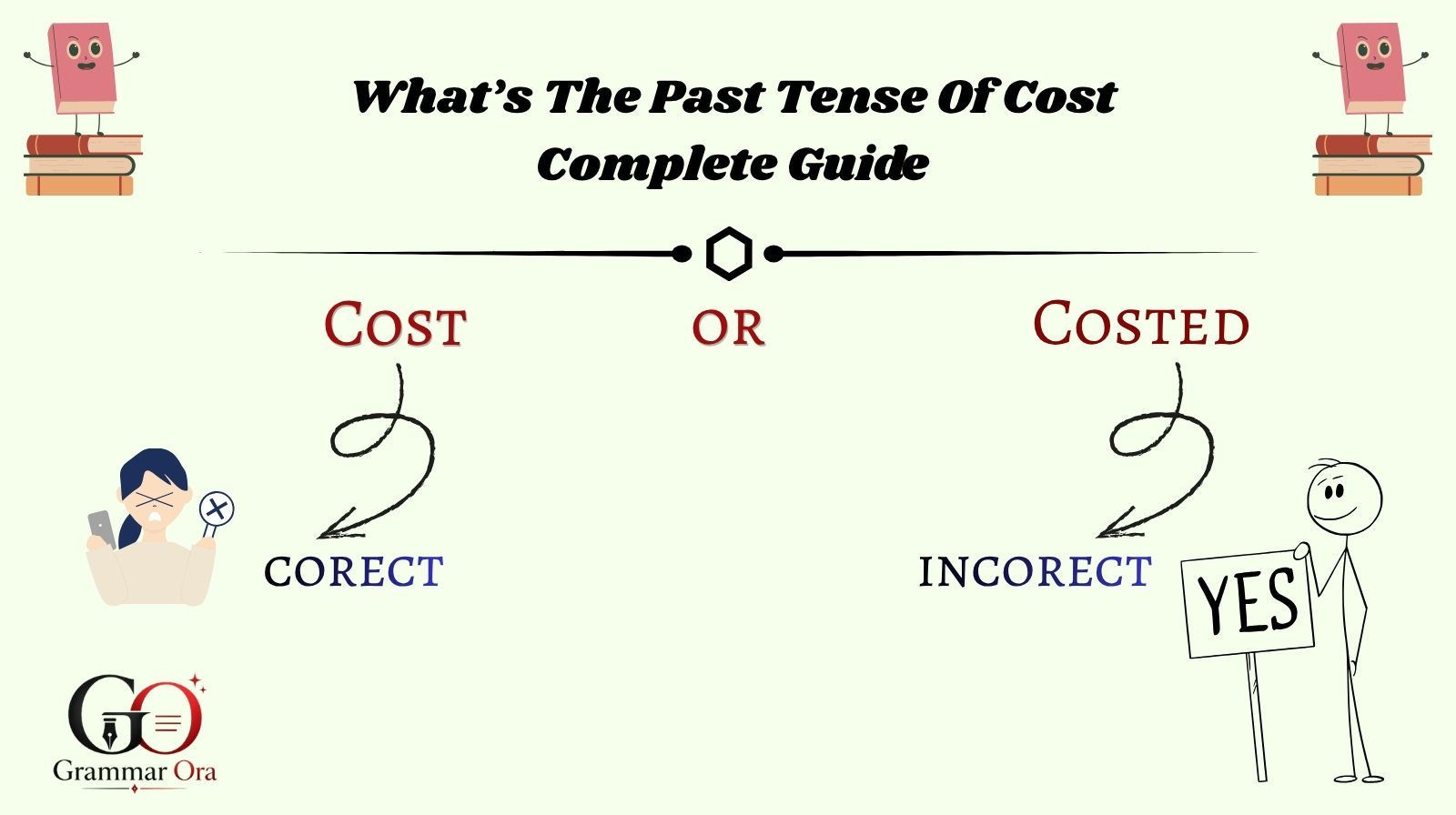
The standard past tense of cost is cost.
Quick Answer
| Verb Form | Example |
|---|---|
| Present | The laptop costs $800. |
| Past | The laptop cost $800. |
| Past Participle | The laptop has cost $800. |
Therefore, in most situations:
✅ The repairs cost me $500.
❌ The repairs costed me $500.
Why Is Cost an Irregular Verb?
Many English verbs follow predictable patterns:
- Walk → Walked
- Jump → Jumped
- Call → Called
However, cost belongs to a group of irregular verbs whose form remains unchanged.
Examples include:
- Cut → Cut
- Put → Put
- Hit → Hit
- Cost → Cost
Because of this rule, the verb looks identical in present and past tense.
Examples in Sentences
- The vacation cost more than we expected.
- The new car cost $25,000.
- Building the website cost several thousand dollars.
- The mistake cost the company a major client.
In all these examples, cost is the correct past-tense form.
Why Do People Say “Costed”?
One reason many people use costed is because English learners naturally apply regular grammar patterns.
Since most verbs form the past tense with -ed, writers assume:
- Work → Worked
- Start → Started
- Cost → Costed
Unfortunately, this assumption isn’t usually correct.
The Influence of Regular Verb Patterns
English contains thousands of regular verbs. As a result, learners become accustomed to adding -ed automatically.
For example:
The project costed $10,000.
Although this sounds logical, standard grammar considers it incorrect when referring to the price of something.
Confusion in Business and Accounting
Another reason for confusion is that costed does exist in English—but with a specialized meaning.
We’ll explore that distinction in detail later.
Common Incorrect Examples
❌ The trip costed us a fortune.
❌ The house costed more than expected.
❌ The repairs costed $2,000.
Correct Versions
✅ The trip cost us a fortune.
✅ The house cost more than expected.
✅ The repairs cost $2,000.
Understanding this difference immediately improves your grammar accuracy.
Cost vs Costed: Understanding the Difference
One of the most important things to know is that costed isn’t always wrong.
The key difference lies in meaning.
When “Cost” Is Correct
Use cost when referring to the price, expense, or amount paid for something.
Examples:
- The meal cost $50.
- The conference cost thousands of dollars.
- The mistake cost him his job.
In these cases, cost functions as an irregular verb.
When “Costed” Is Correct
In accounting, manufacturing, project management, and finance, costed means:
To estimate, calculate, or determine the cost of something.
Examples:
- The engineers costed the project before construction began.
- The proposal was carefully costed.
- The team costed every phase of the development process.
Here, costed refers to calculating expenses rather than describing the price paid.
Simple Rule to Remember
Ask yourself:
Am I talking about the actual price?
If yes → Use cost.
Am I talking about calculating expenses?
If yes → Costed may be correct.
Real-Life Example: How Businesses Use Costed
Consider a manufacturing company preparing to launch a new product.
Before production begins, financial analysts estimate material expenses, labor costs, transportation fees, and marketing budgets. During this planning stage, they create a detailed financial model.
The management team might say:
“We costed the entire project before approving production.”
In this sentence, costed means the company calculated projected expenses.
However, once the product is actually produced and sold, the wording changes:
“The first production run cost $500,000.”
Notice the difference.
The first sentence involves estimating costs.
The second sentence describes the actual amount spent.
Many multinational corporations use cost-analysis software to create fully costed project plans before investing significant resources. According to business management practices, detailed costing helps organizations forecast profitability, reduce waste, and improve budgeting accuracy.
This real-world distinction explains why professionals in accounting, finance, and project management sometimes use costed, while general English speakers usually use cost.
Grammar Rules for Using Cost Correctly
Understanding a few grammar rules makes using cost much easier.
Present Tense
Use cost for current situations.
Examples:
- The software costs $99 annually.
- A cup of coffee costs $4.
Past Tense
Use cost for past events.
Examples:
- The software cost $99 last year.
- The coffee cost $4 yesterday.
Present Perfect
Examples:
- The renovation has cost thousands of dollars.
- The delays have cost valuable time.
Future Tense
Examples:
- The upgrade will cost more money.
- The project will cost approximately $50,000.
Past Continuous Situations
Sometimes writers use costing.
Examples:
- The repairs were costing more than expected.
- The project was costing the company money every day.
These forms follow normal grammar conventions.
Common Mistakes Writers Make
Even experienced writers occasionally misuse cost.
Mistake #1: Adding -ed Automatically
❌ The event costed $2,000.
✅ The event cost $2,000.
Mistake #2: Mixing Business and General English
❌ The car costed $30,000.
✅ The car cost $30,000.
Mistake #3: Using Costed in Casual Conversation
While technically acceptable in accounting contexts, costed sounds unnatural in everyday speech.
Mistake #4: Forgetting the Irregular Pattern
Many learners remember irregular verbs like:
- Go → Went
- Eat → Ate
But forget that some irregular verbs never change.
Examples:
- Cut → Cut
- Put → Put
- Cost → Cost
Keeping these grouped together can improve retention.
Cost vs Costed Comparison Table
| Situation | Correct Word | Example |
|---|---|---|
| Talking about price paid | Cost | The laptop cost $900. |
| Talking about money spent | Cost | The renovation cost $20,000. |
| Describing estimated expenses | Costed | The proposal was costed before approval. |
| Financial planning | Costed | The department costed the project. |
| Everyday conversation | Cost | The trip cost too much. |
| Academic writing about price | Cost | The experiment cost $500. |
This table provides a quick reference whenever you’re unsure which form to use.
Statistics and Language Usage Trends (2025–2026)
Language analysis tools continue to show overwhelming preference for cost as the past tense form when discussing price.
Recent corpus studies and usage databases from major linguistic resources indicate that:
- Cost remains the dominant past-tense form in newspapers, books, academic journals, and professional writing.
- Searches related to “cost or costed” continue to generate millions of annual grammar-related queries.
- English-learning platforms report that irregular verbs remain among the most common grammar challenges worldwide.
- Grammar correction software consistently flags “costed” as a potential error when referring to actual prices.
Organizations such as Google Books Ngram data, major dictionary publishers, and educational platforms continue to recognize cost as the standard past tense in general English.
This widespread usage reinforces the importance of mastering the distinction between cost and costed.
FAQs
Q1: Is costed ever correct?
A: Yes. Costed is correct when referring to calculating or estimating expenses in business, accounting, manufacturing, or project planning.
Q2: What is the past tense of cost?
A: The standard past tense of cost is cost.
Example:
The repairs cost $1,000.
Q3: Why isn’t the past tense costed?
A: Because cost is an irregular verb that typically remains unchanged in the past tense.
Q4: Is “the project costed $5,000” correct?
No.
A: Correct:
The project cost $5,000.
Q5: What does a fully costed project mean?
A: A fully costed project has had all expected expenses calculated and documented before implementation.
Q6: Do native speakers use costed?
A: They do, but mostly in professional business contexts involving budgeting and financial planning.
Q7: Is cost both present and past tense?
AYes.
Examples:
- Present: The service costs $50.
- Past: The service cost $50.
Conclusion
So, what’s the correct past tense of cost: cost or costed?
In nearly all everyday situations, the answer is cost. Whether you’re talking about the price of a car, the expense of a vacation, or the amount spent on a project, the correct past tense remains unchanged.
Costed has a specialized role in accounting, finance, manufacturing, and project management, where it means to calculate or estimate expenses. Understanding this distinction helps you write more clearly, avoid common grammar mistakes, and communicate with confidence.
The next time you’re unsure, remember this simple rule:
If you’re talking about a price, use “cost.” If you’re talking about calculating expenses, “costed” may be correct.
👉 Discover more simple and practical grammar guides on Grammar Ora

Muhammad Bilal is an expert blogger in Grammar Guide, dedicated to simplifying English grammar and helping learners write and speak with clarity, confidence, and accuracy.