Have you ever paused while writing and wondered whether “she has” vs “she have” is correct? You’re not alone. This is one of the most common grammar mistakes made by English learners because both words sound familiar, yet only one is grammatically correct in most situations.
The good news is that the rule is surprisingly simple. Once you understand how the verb “have” changes with different subjects, you’ll never second-guess yourself again.
In this guide, you’ll learn the difference between she has vs she have, when each form is correct, real-life examples, common mistakes to avoid, and an easy trick to remember the rule forever.
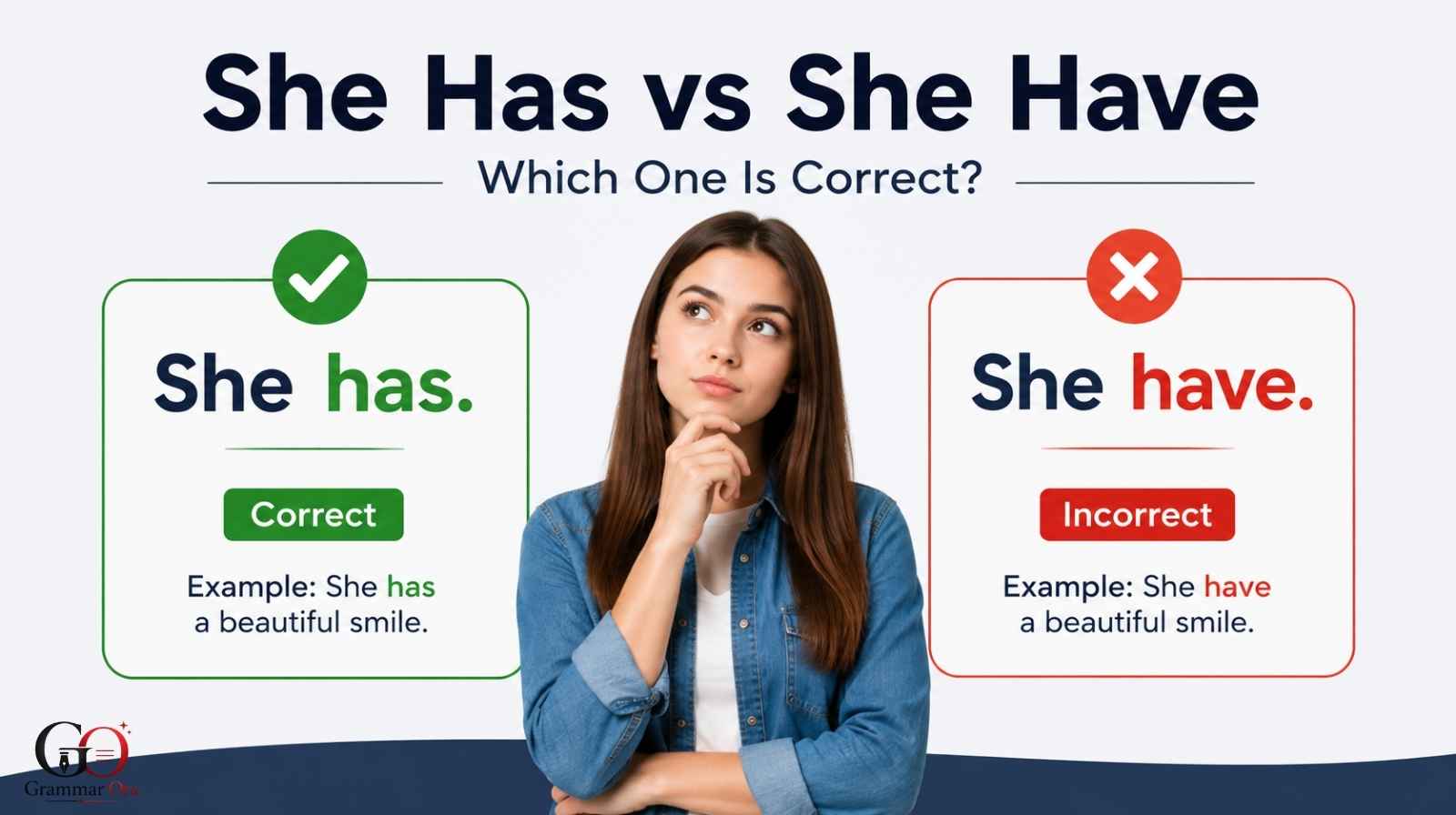
She Has vs She Have: Which One Is Correct?
The correct phrase is “she has.”
Because she is a third-person singular pronoun, it always takes has in the present tense.
✅ Correct:
- She has a beautiful smile.
- She has completed the project.
- She has two younger sisters.
❌ Incorrect:
- She have a beautiful smile.
- She have completed the project.
- She have two younger sisters.
The Simple Rule
Use this pattern:
| Subject | Correct Verb |
|---|---|
| I | have |
| You | have |
| We | have |
| They | have |
| She | has |
| He | has |
| It | has |
If the subject is she, choose has.
Why “She Has” Is Correct
English verbs change depending on the subject.
The verb have becomes has when used with singular third-person subjects.
Third-Person Singular Subjects
These include:
- She
- He
- It
- Emma
- The teacher
- My sister
- The company
Examples:
- She has a new laptop.
- Emma has excellent handwriting.
- The teacher has prepared today’s lesson.
- My sister has a doctor’s appointment.
Why People Say “She Have”
Many English learners remember that the base verb is have, so they accidentally use it with every subject.
This mistake is also influenced by:
- Direct translation from another language
- Informal online conversations
- Lack of grammar practice
- Confusion between singular and plural subjects
However, in standard English, she have is incorrect unless it appears in very specific grammatical structures discussed later.
When Can “She Have” Be Correct?
Although she have is usually incorrect, there are a few rare situations where have follows she.
After Modal Verbs
Modal verbs never use has.
Examples:
- She may have forgotten.
- She will have enough money.
- She should have called earlier.
- She could have arrived sooner.
- She might have misunderstood.
Notice that have comes after the modal verb not directly after she.
In the Subjunctive Mood
Formal English sometimes uses the base verb after expressions like:
- I suggest that she have another chance.
- The doctor recommended that she have surgery.
- It is important that she have enough rest.
This grammar is common in American English but much less frequent in everyday conversation.
She Has in Different Tenses
Present Simple
- She has a bicycle.
- She has many friends.
Present Perfect
- She has finished her homework.
- She has lived here for five years.
- She has already eaten lunch.
Present Perfect Continuous
- She has been studying since morning.
- She has been working remotely for months.
Notice that has works as a helping verb in perfect tenses.
Common Mistakes and How to Avoid Them
Many writers make predictable errors.
Mistake 1
❌ She have a car.
✅ She has a car.
Mistake 2
❌ She have finished her work.
✅ She has finished her work.
Mistake 3
❌ She have been waiting.
✅ She has been waiting.
Mistake 4
❌ She don’t have time.
✅ She doesn’t have time.
Mistake 5
❌ She hasn’t went home.
✅ She hasn’t gone home.
She Has vs She Have Comparison Table
| Feature | She Has | She Have |
|---|---|---|
| Standard grammar | ✅ Yes | ❌ No |
| Present simple | ✅ Yes | ❌ No |
| Present perfect | ✅ Yes | ❌ No |
| After modal verbs | ❌ No | ✅ Yes |
| Formal subjunctive | ❌ No | ✅ Rarely |
| Everyday English | ✅ Always | ❌ Almost never |
Real-Life Example: A Student’s Writing Improvement
A high school student preparing for an English proficiency exam consistently wrote sentences like “She have completed her assignment” and “She have a lot of experience.” Although the ideas were clear, these small grammar mistakes appeared throughout every practice essay. During feedback sessions, the teacher explained the third-person singular rule and encouraged the student to replace have with has whenever the subject was she, he, or it. The student also practiced by reading short articles aloud and correcting similar errors in sample paragraphs.
After several weeks of focused practice, the student naturally began writing “She has completed her assignment” and “She has a lot of experience.” The improvement was noticeable not only in grammar exercises but also in emails, essays, and classroom presentations. By mastering one simple rule, the student’s writing became more accurate, professional, and easier to understand. This example shows that even a small grammar correction can significantly improve overall English communication.
Grammar Usage Data and Trends (2025–2026)
Recent language-learning platforms and grammar tools continue to report that subject-verb agreement remains one of the most common challenges for English learners. Mistakes involving has and have frequently appear in beginner and intermediate writing, especially among learners whose native languages do not change verbs based on the subject.
Grammar checkers have become better at detecting these errors instantly, helping writers produce more accurate emails, assignments, and professional documents. Educational resources published during 2025–2026 also continue emphasizing subject-verb agreement as a foundational English grammar skill, showing that mastering this rule remains essential for clear communication.
Tips to Remember the Rule
Think of “S”
The words she, he, and has all end with the letter S.
Remember:
She → Has
This simple connection makes the rule much easier to remember.
Practice with Short Sentences
Read these aloud:
- She has a cat.
- She has a job.
- She has finished.
- She has arrived.
- She has helped everyone.
Repeating correct patterns helps build natural fluency.
FAQs
Q1: Is “she have” ever grammatically correct?
A: Yes, but only after modal verbs (such as may, will, or should) or in certain formal subjunctive constructions like “I suggest that she have more time.”
Q2: Why do we say “she has” instead of “she have”?
A: Because she is a third-person singular subject, which requires has in the present tense.
Q3: Is “she has” used in present perfect tense?
A: Yes. Examples include:
- She has finished.
- She has arrived.
- She has studied English for years.
Q4: Do native English speakers say “she have”?
A: Not in standard English. If you hear it, it is usually part of a regional dialect, informal speech, song lyrics, or a grammatical error.
Q5: What is the easiest way to remember the rule?
A: Remember this simple pattern:
- I have
- You have
- We have
- They have
- She has
- He has
- It has
Conclusion
Understanding she has vs she have is easier than it first appears. In standard English, “she has” is the correct choice because she is a third-person singular subject. The phrase “she have” is only appropriate after modal verbs or in a few formal grammatical structures.
Once you remember the simple subject-verb agreement rule, you’ll write with greater confidence and avoid one of the most common English grammar mistakes. Keep practicing with everyday sentences, and using she has will soon become second nature.
👉 Discover more simple and practical grammar guides on Grammar Ora

Muhammad Bilal is an expert blogger in Grammar Guide, dedicated to simplifying English grammar and helping learners write and speak with clarity, confidence, and accuracy.