Have you ever wondered whether extensible vs extendible is the correct word? If you’ve seen both terms in software documentation, technical articles, or dictionaries, you’re not alone. Many writers, developers, and students assume one spelling is wrong but the truth is a little more interesting.
While both extensible and extendible are correct English words, they aren’t used equally. In modern English, especially in technology and software development, extensible is overwhelmingly preferred. Knowing when to use each term will make your writing sound more professional and accurate.
In this guide, you’ll learn the difference between extensible vs extendible, discover why one is far more common than the other, see real-world examples, and avoid one of the most frequent vocabulary mistakes in technical writing.
Extensible vs Extendible: What’s the Difference?
Quick Answer
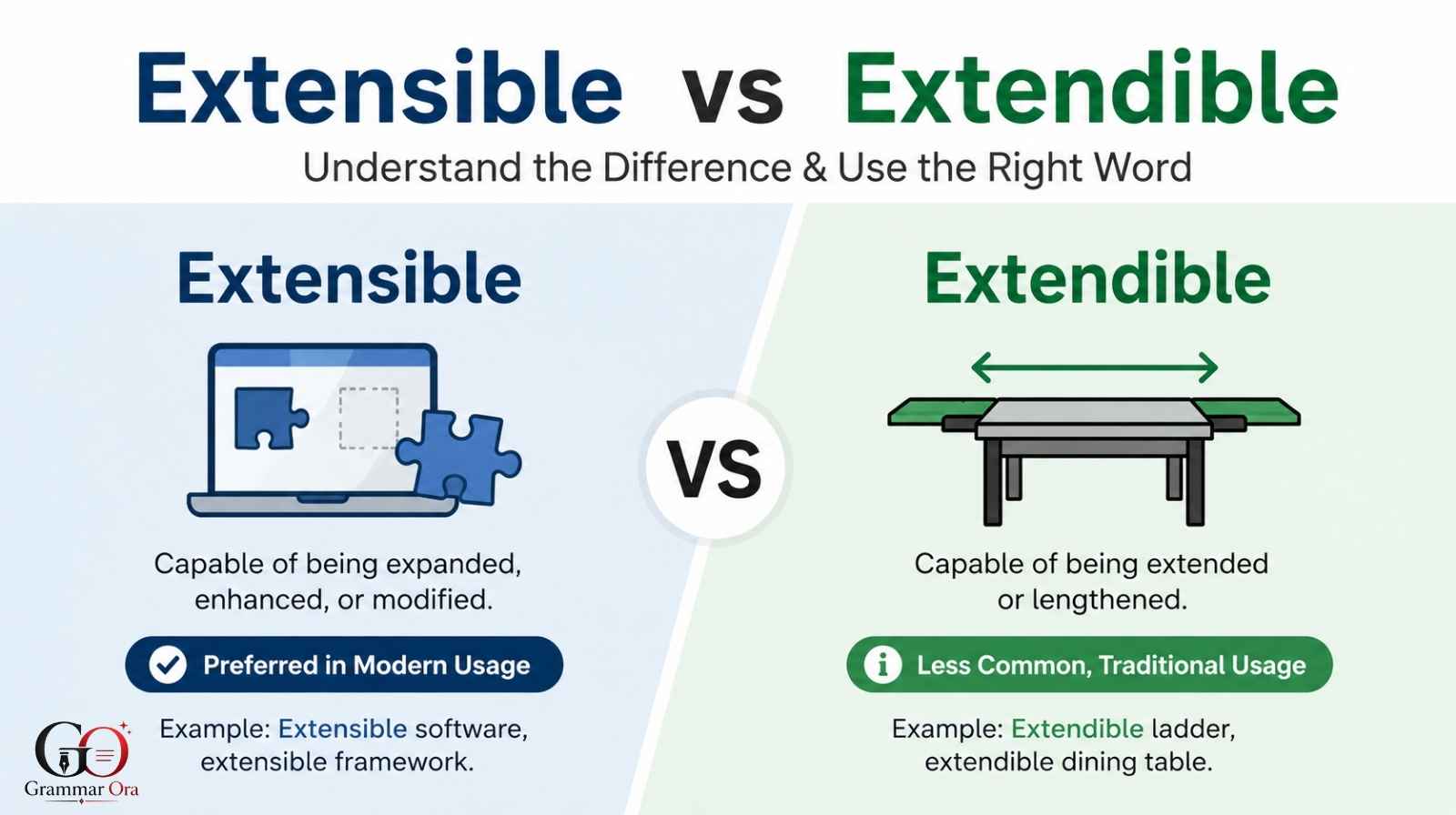
Extensible is the preferred and standard word in modern English, especially in computing, engineering, and business.
Extendible is also a valid word, but it’s much less common and usually appears in older dictionaries or traditional British writing.
In most situations, choose “extensible.”
Simple Comparison Table
| Feature | Extensible | Extendible |
|---|---|---|
| Correct English? | ✅ Yes | ✅ Yes |
| Modern usage | Very common | Rare |
| Preferred in programming | ✅ Yes | ❌ Rarely |
| Used in software documentation | Frequently | Almost never |
| Recommended for professional writing | ✅ Yes | Usually no |
What Does “Extensible” Mean?
The adjective extensible describes something that can be expanded, enhanced, or modified without changing its core structure.
This meaning has become especially important in software development, where systems are designed to grow over time.
Examples
- The framework has an extensible architecture.
- This plugin makes the application more extensible.
- Python is highly extensible through external libraries.
- The API was designed to remain extensible for future updates.
In Everyday English
Although it’s common in technology, you can also use it outside programming.
Examples:
- The company’s business model is extensible enough for international markets.
- The learning system is extensible and supports new courses easily.
What Does “Extendible” Mean?
The word extendible simply means capable of being extended.
Its definition is almost identical to extensible, but modern writers rarely choose it.
Examples
- The ladder is extendible.
- The dining table has an extendible design.
- The bridge includes extendible support arms.
Notice that these examples usually describe physical objects rather than software systems.
Why It’s Less Popular
Language naturally favors one form over another over time. Today, dictionaries recognize both spellings, but publishers, universities, and software companies almost always prefer extensible.
Why Is “Extensible” More Common?
Several factors explain why extensible became the dominant choice.
Software Industry Standards
Programming languages and development platforms consistently use extensible.
Examples include:
- Extensible Markup Language (XML)
- Extensible Authentication Protocol (EAP)
- Extensible Firmware Interface (EFI)
- Extensible Storage Engine
These widely recognized technologies reinforced the popularity of the word.
Professional Writing
Technical writers value consistency.
Because major documentation uses extensible, newer writers naturally follow the same convention.
Search Trends
Search engine data consistently shows that extensible receives significantly more searches than extendible, particularly in technology-related topics.
This makes extensible the better choice for SEO and online content.
Real-Life Example: Choosing the Right Word in Software Documentation
Imagine two software companies releasing identical developer guides.
Company A writes:
“Our platform is extendible, allowing developers to add new modules.”
Company B writes:
“Our platform is extensible, allowing developers to build custom integrations.”
Although both sentences are technically correct, developers are much more familiar with extensible because they’ve encountered it in documentation for Microsoft, Oracle, Java, Python, and countless open-source projects. As a result, Company B’s documentation feels more natural, professional, and trustworthy.
This small word choice also improves discoverability. Developers searching online almost always use the keyword extensible architecture, extensible software, or extensible framework. By matching the language users actually search for, Company B’s documentation has a better chance of appearing in search results and meeting readers’ expectations.
This example shows that choosing the commonly accepted term isn’t just about grammar it also improves clarity, user experience, and SEO performance.
Extensible vs Extendible in Programming
Extensible
Common phrases include:
- Extensible software
- Extensible framework
- Extensible API
- Extensible architecture
- Extensible database
- Extensible plugin system
Extendible
Rarely appears in programming documentation.
If you see it, it’s usually because an individual author prefers that spelling rather than following industry conventions.
Usage Statistics and Language Trends (2025–2026)
Language research and search behavior continue to show a clear preference for extensible over extendible.
According to usage patterns across technical documentation, software frameworks, developer resources, and major dictionaries:
- Extensible remains the dominant spelling in software engineering.
- Most programming languages use extensible in official documentation.
- Technical books overwhelmingly favor extensible.
- Professional style guides recommend using the more common modern form for consistency.
- Search interest for extensible continues to exceed extendible, especially in technology-related queries.
This trend has remained stable throughout 2025 and into 2026, making extensible the safest choice for nearly all technical and professional writing.
Common Mistakes to Avoid
Using “Extendible” in Technical Documentation
Although correct, it may look outdated to developers.
Assuming One Word Is Incorrect
Both words exist in English dictionaries.
The difference is popularity not correctness.
Mixing Both Spellings
Choose one spelling throughout your document.
For technical writing, use extensible consistently.
How to Remember the Difference
A simple memory trick is:
- Extensible = Expands systems and software.
- Extendible = Can physically extend, but is rarely used today.
Whenever you’re unsure, ask yourself:
“Am I writing about software, technology, or modern documentation?”
If yes, use extensible.
FAQs
Q1: Is extensible a real word?
A: Yes. Extensible is a standard English adjective recognized by major dictionaries and widely used in software development, engineering, and business.
Q2: Is extendible incorrect?
A: No. Extendible is also correct English, but it is much less common in modern writing.
Q3: Which spelling should I use?
A: In almost every professional situation, extensible is the recommended choice.
Q4: Why do programmers use extensible?
A: Because it has become the industry standard for describing systems that can be expanded through plugins, modules, APIs, or extensions.
Q5: Are extensible and extendible synonyms?
A: Yes. Their meanings are essentially the same, although extensible is far more common.
Q6: Is XML called Extensible Markup Language?
A: Yes. XML stands for Extensible Markup Language, not Extendible Markup Language.
Conclusion
Although extensible and extendible are both valid English words, they are not equally common. Modern English especially the technology industry strongly favors extensible because it aligns with industry standards, developer expectations, and official documentation.
If you’re writing about software, programming, business systems, or modern technology, extensible is almost always the better choice. While extendible isn’t wrong, using extensible will make your writing clearer, more professional, and more familiar to your audience.
By remembering this simple distinction, you’ll avoid confusion and confidently choose the word that fits today’s English usage.
👉 Discover more simple and practical grammar guides on Grammar Ora

Muhammad Bilal is an expert blogger in Grammar Guide, dedicated to simplifying English grammar and helping learners write and speak with clarity, confidence, and accuracy.