Have you ever seen the words apposed vs opposed and wondered whether they mean the same thing? Because they look and sound similar, many writers mistakenly use one when they actually mean the other.
The confusion is understandable. However, these words have very different meanings and are used in completely different contexts. Using the wrong one can make your writing unclear or even technically incorrect.
In this guide, you’ll learn the exact difference between apposed vs opposed, when to use each word, practical examples, common mistakes, and expert tips to remember the distinction forever.
What Is the Difference Between Apposed and Opposed?
The simplest way to understand the difference is this:
| Word | Meaning | Common Usage |
|---|---|---|
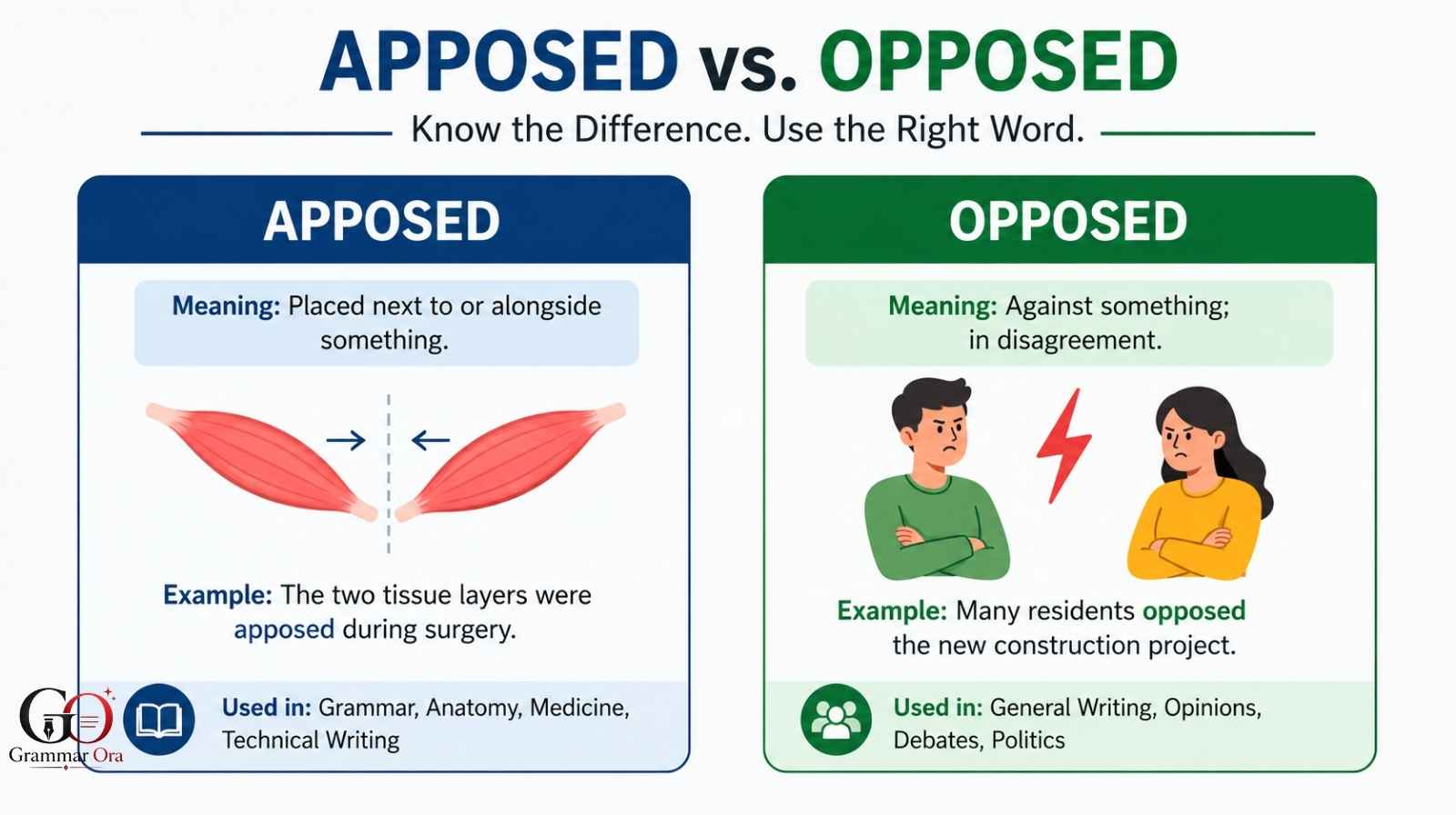
| Apposed | Placed next to or alongside something | Grammar, anatomy, medicine |
| Opposed | Against something; in disagreement | General writing, debates, opinions |
Quick Definition
- Apposed = Positioned beside another thing.
- Opposed = Against or contrary to something.
For example:
✅ The two tissue layers were apposed during surgery.
✅ Many residents opposed the new construction project.
Although only one letter separates these words, their meanings are completely different.
Understanding the Meaning of Apposed
The word apposed comes from the Latin word apponere, meaning “to place near.”
It is often used in technical, academic, grammatical, and medical contexts.
Apposed in Grammar
In grammar, an appositive is a noun or phrase placed next to another noun to explain it.
Example:
My brother, a software engineer, lives in Chicago.
Here, a software engineer is apposed to my brother because it provides additional information.
Apposed in Medicine
Medical professionals frequently use the term when describing tissues or body parts that are placed together.
Example:
The surgeon carefully apposed the edges of the wound.
Apposed in Anatomy
In anatomy, structures may be described as apposed when they are touching or closely aligned.
Example:
The membranes remained apposed during the procedure.
Key Characteristics of Apposed
- Indicates physical proximity
- Often used in technical writing
- Common in grammar and medicine
- Does not imply disagreement
Understanding the Meaning of Opposed
The word opposed refers to resistance, disagreement, or being in conflict with something.
It is far more common in everyday English than apposed.
Opposed in Opinions and Debates
People often use opposed when discussing viewpoints.
Examples:
- She opposed the proposal.
- Several organizations opposed the legislation.
- The committee remained opposed to the changes.
Opposed in Politics
Political discussions frequently involve opposing positions.
Example:
Two parties were opposed on tax policy.
Opposed in Everyday Communication
You can use opposed whenever someone disagrees with an idea, action, or belief.
Examples:
- I’m opposed to smoking indoors.
- Many employees opposed the decision.
- Parents opposed the budget cuts.
Key Characteristics of Opposed
- Indicates disagreement
- Common in everyday language
- Frequently used in politics and business
- Suggests conflict or resistance
Apposed vs Opposed: Side-by-Side Comparison
Meaning Comparison
| Feature | Apposed | Opposed |
|---|---|---|
| Primary Meaning | Positioned next to | Against or in disagreement |
| Context | Technical, medical, grammatical | Everyday, political, social |
| Indicates Conflict? | No | Yes |
| Indicates Proximity? | Yes | No |
| Common Usage Frequency | Rare | Very common |
Example Comparison
| Sentence | Correct Word |
|---|---|
| The tissue edges were carefully ___ during surgery. | Apposed |
| Residents ___ the new parking regulations. | Opposed |
| The two structures remained closely ___. | Apposed |
| Most voters ___ the proposal. | Opposed |
Memory Trick
A simple way to remember:
- Apposed → Think Adjacent (next to).
- Opposed → Think Opponent (against).
This association helps prevent confusion while writing.
Real-Life Example: How a Medical Report Can Change Meaning
Imagine a healthcare professional documenting a surgical procedure.
The surgeon writes:
“The wound edges were opposed successfully.”
Technically, this sentence may confuse readers because opposed suggests resistance or conflict. Medical professionals usually mean that the tissue edges were brought together and aligned. Therefore, the correct term would be:
“The wound edges were apposed successfully.”
In clinical settings, precision matters. A single word can affect interpretation, communication among healthcare providers, and documentation quality. Similar issues arise in academic writing and scientific publications where technical terminology must be exact.
Conversely, imagine a city council report stating:
“Several community groups apposed the proposal.”
This sentence is incorrect because the intended meaning is disagreement, not placement beside something. The correct sentence would be:
“Several community groups opposed the proposal.”
These examples show why understanding apposed vs opposed is important. Even experienced writers occasionally confuse them because of their similar spelling. Choosing the correct word ensures clarity and professionalism in both technical and everyday writing.
Usage Trends and Language Data (2025–2026)
Language analysis tools and major writing platforms continue to show a significant difference in the frequency of these terms.
What Recent Usage Data Shows
- Opposed appears millions of times annually in news articles, blogs, business communication, and academic publications.
- Apposed remains a specialized term primarily found in medical journals, anatomical studies, and grammar discussions.
- Search behavior in 2025–2026 indicates growing interest in commonly confused English words as users increasingly rely on digital writing tools and grammar checkers.
- Educational content focused on word distinctions continues to perform strongly because writers seek greater accuracy and clarity.
This trend highlights an important takeaway: most writers will use opposed far more often than apposed, but understanding both improves vocabulary precision.
Common Mistakes Writers Make
Mistake #1: Using Apposed for Disagreement
❌ Many citizens apposed the decision.
✅ Many citizens opposed the decision.
Mistake #2: Using Opposed in Medical Contexts
❌ The surgeon opposed the tissue edges.
✅ The surgeon apposed the tissue edges.
Mistake #3: Assuming They Are Interchangeable
Because the words look similar, some writers treat them as synonyms.
They are not interchangeable.
Always check whether the sentence refers to:
- Positioning something nearby → Apposed
- Disagreement or resistance → Opposed
How to Choose the Correct Word Every Time
Step 1: Identify the Context
Ask yourself:
Is this about placement or disagreement?
Step 2: Check the Meaning
If something is next to another thing → Apposed
If someone disagrees with something → Opposed
Step 3: Test the Replacement
Replace the word mentally.
- Near/adjacent → Apposed
- Against/disagreeing → Opposed
Step 4: Review Technical Writing Carefully
Medical, anatomical, and grammatical documents often require apposed, whereas most general content uses opposed.
FAQs
Q1: Is apposed a real word?
A: Yes. Apposed is a legitimate English word primarily used in medical, anatomical, and grammatical contexts to mean positioned next to something.
Q2: What is the difference between apposed and opposed?
A: Apposed means placed beside or adjacent to something, while opposed means against or in disagreement with something.
Q3: Which word is more common?
A: Opposed is significantly more common in everyday English and professional communication.
Q4: Can apposed mean against?
A: No. Apposed does not indicate disagreement or conflict. It specifically refers to proximity or placement.
Q5: Is apposed used in medicine?
A: Yes. Medical professionals frequently use apposed to describe tissues, membranes, or structures that are brought together.
Q6: How can I remember apposed vs opposed?
A: Think:
- Apposed = Adjacent
- Opposed = Opponent
Q7: Are apposed and opposed interchangeable?
A: No. They have different meanings and should never be substituted for one another.
Conclusion
Understanding apposed vs opposed is easier once you focus on their core meanings.
Apposed refers to something positioned next to or alongside another thing and is most commonly used in medical, anatomical, and grammatical contexts. Opposed, on the other hand, means against, resistant to, or in disagreement with something and appears frequently in everyday communication.
Whenever you’re unsure, remember the simple rule:
- Apposed = Adjacent
- Opposed = Opponent
Using the correct word improves clarity, accuracy, and professionalism in your writing. The next time you encounter apposed vs opposed, you’ll know exactly which one belongs in your sentence.
👉 Discover more simple and practical grammar guides on Grammar Ora

Muhammad Bilal is an expert blogger in Grammar Guide, dedicated to simplifying English grammar and helping learners write and speak with clarity, confidence, and accuracy.