Have you ever heard someone say, “That’s a fair decision,” while another person describes something as “good”? Although these words are often used in everyday conversations, they do not mean the same thing.
Understanding the difference between fair vs good is important because it affects how we evaluate people, decisions, actions, and outcomes. A choice can be fair without being good, and something good may not always be fair.
In this guide, you’ll learn what fair and good mean, how they differ, when to use each term, and how to judge situations more accurately. By the end, you’ll be able to recognize the distinction with confidence.
What Does Fair Mean?
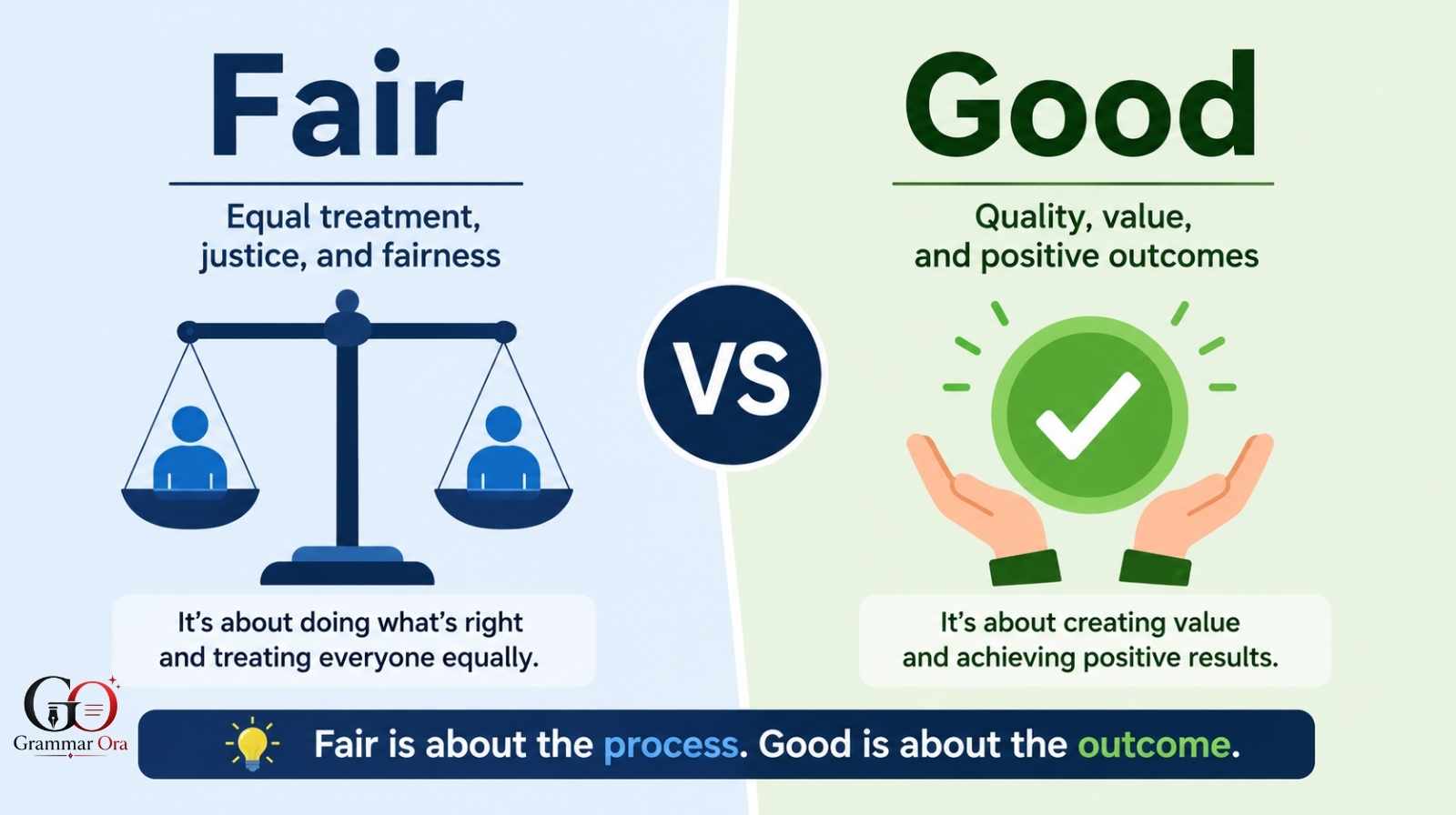
The word fair generally refers to equality, impartiality, and justice. When something is fair, it follows consistent rules and treats people without favoritism.
Fair Focuses on Process
Fairness is often concerned with how decisions are made, not necessarily whether the outcome is positive.
For example:
- A teacher gives every student the same amount of time to complete an exam.
- A referee applies the same rules to both teams.
- A company uses identical hiring criteria for all applicants.
In each case, the process is impartial and consistent.
Fair Does Not Guarantee Happiness
A fair decision may still disappoint someone.
For example:
A company promotes the most qualified employee. The process is fair, but other employees may feel unhappy about the result.
Common Situations Where Fairness Matters
- School grading
- Workplace promotions
- Legal decisions
- Sports competitions
- Resource allocation
What Does Good Mean?
The word good refers to quality, value, benefit, or positive outcomes.
Unlike fairness, goodness often focuses on the result or impact of an action.
Good Focuses on Outcomes
Something is considered good when it creates positive effects or provides value.
Examples:
- A good meal tastes great and is nutritious.
- A good teacher helps students learn effectively.
- A good product solves a customer’s problem.
Good Can Be Subjective
Different people may disagree about what is good.
For example:
One employee may think remote work is good because it offers flexibility. Another may prefer working in an office.
Therefore, goodness often depends on personal values and circumstances.
Examples of Good Outcomes
- Improved health
- Higher productivity
- Customer satisfaction
- Better education
- Stronger relationships
Fair vs Good: The Key Difference
The easiest way to understand fair vs good is to remember this:
Fair relates to justice and equal treatment, while good relates to quality and positive results.
Quick Comparison Table
| Aspect | Fair | Good |
|---|---|---|
| Main Focus | Equality and justice | Quality and positive outcomes |
| Concerned With | Process | Results |
| Objective or Subjective | More objective | Often subjective |
| Can People Disagree? | Less often | More frequently |
| Example | Everyone follows the same rules | The outcome benefits people |
Example
Imagine a teacher grades students strictly according to a rubric.
- The grading process is fair because everyone is evaluated equally.
- The grades may not feel good to students who performed poorly.
This demonstrates how fairness and goodness can exist independently.
When Something Is Fair but Not Good
Many real-world situations show that fairness and goodness do not always overlap.
Example 1: Job Layoffs
A company faces financial difficulties and must reduce staff.
Management uses objective criteria such as performance records and seniority. The process is fair.
However, employees still lose their jobs, which is not a good outcome for those affected.
Example 2: Strict Classroom Rules
A teacher applies the same penalty to every student who submits late assignments.
The policy is fair because everyone receives equal treatment.
Yet, a student dealing with a family emergency may experience a negative outcome.
Example 3: Sports Competition
A referee correctly applies the rules.
The losing team may not like the result, but the decision remains fair.
When Something Is Good but Not Fair
Sometimes positive outcomes come from processes that are unequal or biased.
Preferential Treatment
Suppose a manager gives a desirable project to a close friend.
The friend benefits significantly, making the outcome good for them.
However, other qualified employees were not given equal consideration, making the process unfair.
Unequal Distribution of Resources
A school invests most of its budget in one high-performing department.
Students in that department receive excellent resources.
While the outcome may be good for them, the allocation may not be fair to other departments.
Why This Distinction Matters
Confusing good with fair can lead to poor judgments.
A positive result for one group does not automatically mean the process was equitable.
Real-Life Case Study: School Scholarship Selection
Consider a high school scholarship program offering a single scholarship worth $10,000.
The school creates a transparent evaluation system based on:
- Academic performance
- Community service
- Leadership activities
- Personal essays
Every applicant receives the same information and is judged using identical standards.
After reviewing dozens of applications, the committee selects one student with the highest overall score.
Many students feel disappointed because they worked hard and needed financial assistance. Some even believe the outcome is unfair because they did not win.
However, an independent review confirms that the committee followed the published criteria consistently and evaluated every application objectively.
In this scenario, the process is clearly fair because all applicants received equal treatment.
Yet not everyone views the outcome as good. Several deserving students still miss out on financial support.
This example highlights an important lesson: fairness often concerns whether the rules were applied consistently, while goodness concerns whether the result creates the most beneficial outcome. Understanding this distinction helps people evaluate decisions more accurately and avoid confusing disappointment with injustice.
Fairness and Goodness in Modern Society
Organizations increasingly recognize the importance of balancing fairness and positive outcomes.
Workplace Decision-Making
According to research published by the Society for Human Resource Management (SHRM), employees are more likely to trust leadership when workplace decisions are perceived as fair and transparent.
Consumer Expectations
Recent surveys from PwC and Edelman Trust Barometer reports show that consumers increasingly expect companies to act ethically, treat stakeholders fairly, and deliver positive social impact.
Why Both Matter
Successful organizations strive to achieve:
- Fair processes
- Good outcomes
- Transparency
- Accountability
- Long-term trust
When both fairness and goodness exist together, people are more likely to view decisions as legitimate and beneficial.
How to Judge Whether Something Is Fair or Good
Step 1: Examine the Process
Ask:
- Were the rules clear?
- Were they applied consistently?
- Was everyone treated equally?
If yes, the process is likely fair.
Step 2: Evaluate the Outcome
Ask:
- Did the result create value?
- Did it solve a problem?
- Did it benefit those involved?
If yes, the outcome may be good.
Step 3: Consider Both Together
The best decisions are often both fair and good.
For example:
A company uses an unbiased hiring process and selects the most qualified candidate who performs exceptionally well.
Step 4: Look for Hidden Biases
Sometimes outcomes appear positive but result from unfair advantages.
Always evaluate both the process and the result before forming conclusions.
Common Mistakes People Make
Assuming Fair Means Equal Outcomes
Fairness does not always mean everyone gets the same result.
It means everyone receives equal opportunity and consistent treatment.
Assuming Good Means Fair
A positive result does not automatically indicate fairness.
The process matters just as much as the outcome.
Ignoring Context
Some situations require balancing fairness, compassion, and practicality.
Context often influences how people perceive decisions.
FAQs
Q1: Is fair the same as good?
A: No. Fair refers to justice and equal treatment, while good refers to quality, value, or positive outcomes.
Q2: Can something be fair but still disappointing?
A: Yes. A fair decision may follow all rules correctly while still producing an outcome that some people dislike.
Q3: Can something be good but unfair?
A: Absolutely. A positive outcome for one person or group may result from an unfair process.
Q4: Which is more important: fair or good?
A: Ideally, decisions should be both fair and good. Fairness builds trust, while goodness creates positive results.
Q5: How can I tell if a decision is fair?
A: Look at the process. If rules are transparent, consistent, and applied equally, the decision is likely fair.
Q6: Why do people confuse fair and good?
A: People often focus on outcomes. If they like the result, they may assume it was fair, even when the process was flawed.
Q7: Does fairness always lead to good outcomes?
A: Not necessarily. Fair processes can still produce outcomes that are undesirable for some individuals.
Conclusion
Understanding fair vs good helps you evaluate decisions more accurately in school, work, business, and everyday life. Fairness focuses on equal treatment and just processes, while goodness focuses on positive results and value.
A decision can be fair without being good, and something good may not be fair. The most effective judgments consider both factors together.
The next time you evaluate a situation, ask two simple questions: Was the process fair? Was the outcome good? Answering both will help you make smarter, more balanced assessments.
👉 Discover more simple and practical grammar guides on Grammar Ora

Muhammad Bilal is an expert blogger in Grammar Guide, dedicated to simplifying English grammar and helping learners write and speak with clarity, confidence, and accuracy.