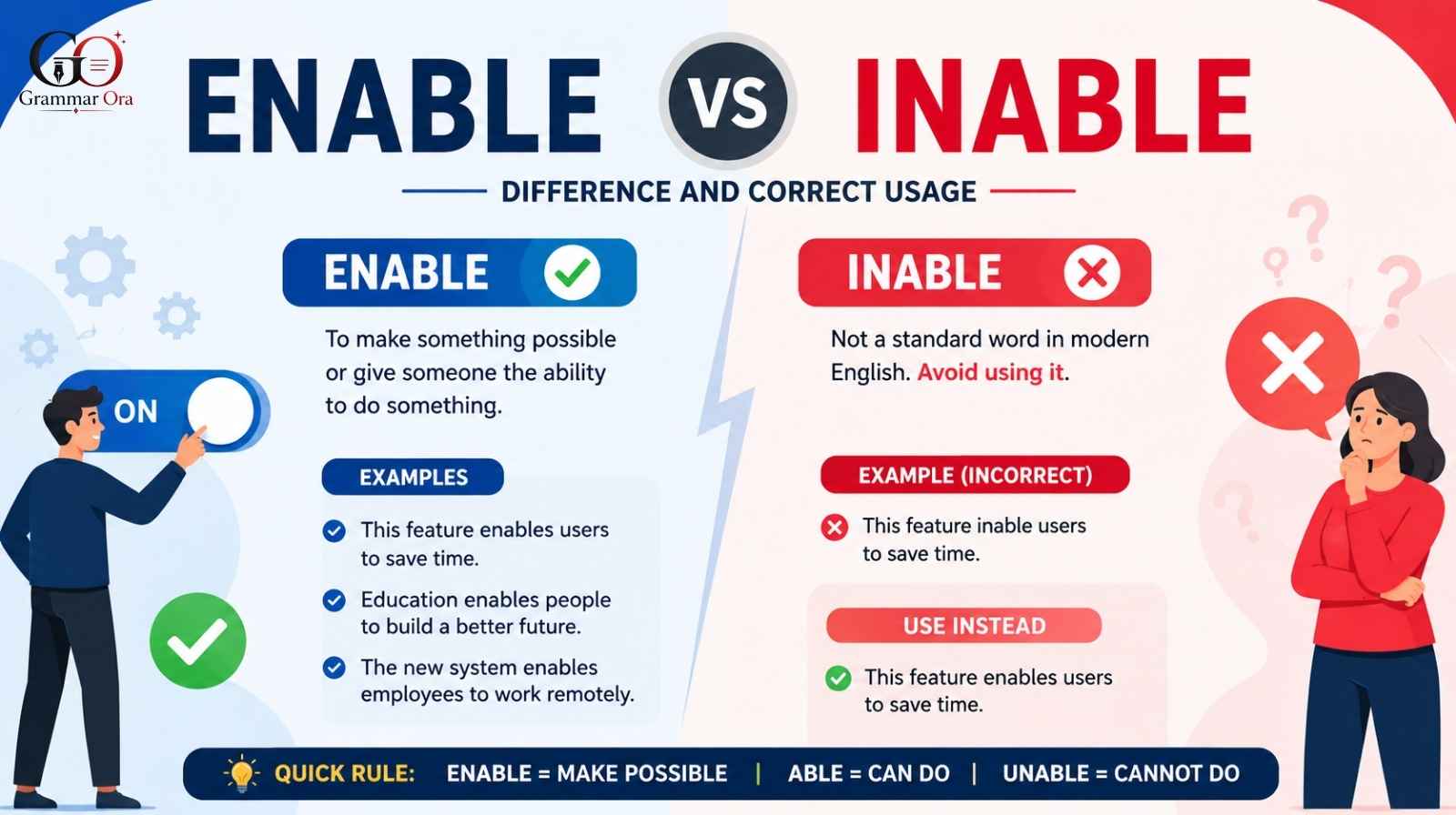
If you are confused about enable vs inable, you are not alone. These words look similar, but they do not have the same status in modern English. Enable is the standard English word, while inable should generally not be used in modern standard writing. If you mean “make someone or something able to do something,” enable is the correct choice.
In this guide, you will learn the enable meaning, why “inable” causes confusion, how to use enable correctly, and what word to use when you mean the opposite.
What Is the Difference Between Enable vs Inable?

Enable is the correct standard word
Enable is a verb meaning to make something possible, provide the means to do something, or give someone the ability or permission to perform an action. Merriam-Webster lists meanings including “to provide with the means or opportunity” and “to make possible, practical, or easy.”
Examples:
- This software enables users to manage their accounts.
- Good education enables people to develop valuable skills.
- The new feature enables customers to pay online.
- A strong internet connection enables faster communication.
Inable is not the normal modern English choice
Inable is not the standard word you should use in modern English when you mean “make able.” In everyday, academic, business, and professional writing, replace it with enable.
For example:
❌ The new system will inable employees to work remotely.
✅ The new system will enable employees to work remotely.
The confusion often comes from assuming that English can simply add in- to “able” to create its opposite. However, English word formation does not always work that way.
What should you use instead?
If you want to express a lack of ability, the correct word is usually unable.
- Enable = make able or make possible
- Able = having the ability
- Unable = not having the ability
- Inable = avoid in modern standard English
Enable Meaning and Correct Usage
What does enable mean?
The basic enable definition is “to make someone or something able to do something” or “to make something possible.” Cambridge Dictionary gives essentially this meaning and commonly uses the structure enable + object + to + verb.
For example:
The training enabled the employees to perform their jobs more effectively.
Here, the training provided employees with the ability or means to perform the task.
How to use enable in a sentence
A common grammatical structure is:
enable + someone/something + to + verb
Examples:
- The scholarship enabled her to attend university.
- The new software enables businesses to process orders faster.
- This device enables users to access important information.
- Better planning enabled the team to finish the project early.
You can also use enable when talking about technology or features:
- Enable notifications.
- Enable dark mode.
- Enable location services.
- Enable two-factor authentication.
Merriam-Webster also gives technology-related examples in which software or systems enable particular functions.
Enable does not simply mean “turn on”
In technology, enable can mean to activate or make a feature available. However, its broader meaning is much wider.
For example:
Education enables people to find better opportunities.
Here, “enable” does not mean “turn on.” It means provide the ability or opportunity.
Why Is “Inable” Confused With Enable?
The problem with English prefixes
The spelling inable may look logical because English uses prefixes such as in- to create negative meanings in words like:
- inaccurate
- incomplete
- inactive
- invisible
Therefore, someone might assume:
able → inable
But that is not the standard English formation.
The established negative form is:
able → unable
So:
❌ inable to attend
✅ unable to attend
Enable vs Unable
This is an especially important distinction.
Enable describes something that makes an action possible:
The scholarship enabled him to study abroad.
Unable describes a person or thing that cannot perform an action:
He was unable to attend the meeting.
Notice that these words express almost opposite ideas.
| Word | Meaning | Example |
|---|---|---|
| Enable | Make possible or give ability | The tool enables users to work faster. |
| Able | Having the ability | She is able to solve the problem. |
| Unable | Not having the ability | She was unable to solve the problem. |
| Inable | Not standard modern usage | Avoid using it. |
Enable vs Inable: Real-Life Case Study

A workplace communication example
Imagine a company introducing a new online employee portal. During an internal meeting, a manager wants to explain how the portal will improve productivity.
The manager writes:
“The new portal will inable employees to submit requests online.”
At first glance, the sentence may look reasonable. The writer probably thinks “inable” means “make able.” However, a grammar review would replace inable with enable:
“The new portal will enable employees to submit requests online.”
This small spelling correction makes the sentence standard and professional.
Now imagine that the manager wants to describe an employee who cannot use the system because their account has not been activated. The correct word changes:
“The employee is unable to access the portal.”
This example demonstrates why enable, able, and unable should not be treated as interchangeable forms. Enable focuses on creating an opportunity or ability, while unable describes the absence of ability.
The lesson is useful beyond workplace writing. The same distinction applies to emails, essays, websites, reports, instructions, academic assignments, and everyday communication. When you mean “make possible,” choose enable. When you mean “not capable of,” choose unable.
Common Examples of Enable in Everyday English

Examples in education and work
- Online courses enable students to learn from home.
- Training enables employees to improve their skills.
- The scholarship enabled her to continue her education.
- Good communication enables teams to work together effectively.
Examples in technology
- The update enables users to customize their profiles.
- Please enable notifications in your settings.
- This feature enables automatic backups.
- The application enables customers to track their orders.
Examples with unable
When the intended meaning is negative, use unable:
- I was unable to attend the meeting.
- She was unable to complete the task.
- The computer was unable to connect to the server.
- They were unable to find the required information.
Enable vs Inable: Quick Data and Dictionary Check
What current dictionary evidence shows
For a word-choice question like this, reputable dictionaries are more useful than arbitrary usage statistics. Current dictionary evidence strongly supports enable as the standard modern verb.
Merriam-Webster’s current entry defines enable as a verb meaning, among other things, “to provide with the means or opportunity” and “to make possible, practical, or easy.” Its entry was updated in 2026.
Cambridge Dictionary currently lists enable as a verb meaning to make someone able to do something or make something possible. It also gives the common grammatical pattern enable someone to do something.
Therefore, for modern English writing in 2025–2026 and beyond, the practical rule is straightforward:
Use “enable” when you mean make possible. Use “unable” when you mean not capable. Avoid “inable” in standard writing.
A simple three-word rule
Remember:
Enable → makes possible
Able → can do it
Unable → cannot do it
That simple pattern eliminates most confusion.
How to Remember the Correct Word

Use the “make possible” test
Whenever you are unsure about enable vs inable, replace the word mentally with make possible.
If the sentence still makes sense, use enable.
For example:
This feature will ___ users to save documents automatically.
“Make possible” works:
This feature will make it possible for users to save documents automatically.
Therefore:
This feature will enable users to save documents automatically.
Use “unable” for the negative meaning
If your sentence means someone cannot do something, choose unable.
For example:
I was ___ to finish the assignment.
The intended meaning is “I could not finish it.”
Therefore:
I was unable to finish the assignment.
Not:
❌ I was inable to finish the assignment.
FAQs
Q1: Is “inable” a correct English word?
A: Inable is not the standard modern English word you should use in normal writing. If you mean “make possible,” use enable. If you mean “not capable,” use unable.
Q2: Is it enable or inable?
A: The correct modern word is enable. For example:
The program enables users to edit files.
Q3: What does enable mean?
A: Enable means to make something possible, provide someone with the ability or means to do something, or allow something to operate.
Q4: Is “unable” the opposite of “enable”?
A: Not exactly grammatically, because enable is a verb and unable is an adjective. However, their meanings can contrast:
- Enable = make possible
- Unable = not capable of doing something
Q5: Can I say “inable to”?
A: No. In standard modern English, use unable to.
❌ I am inable to complete the work.
✅ I am unable to complete the work.
Q6: What is the difference between able and enable?
A: Able describes having the ability:
She is able to swim.
Enable means to give someone or something the ability or opportunity:
The training enabled her to swim safely.
Q7: Is “enable” used in technology?
A: Yes. Enable is extremely common in technology. It can mean making a feature or function available or operational, such as enable notifications, enable Bluetooth, or enable automatic updates. Merriam-Webster specifically includes technology-related examples of the word.
Q8: Which is correct: “enabled me to” or “inabled me to”?
A: Enabled me to is correct.
The scholarship enabled me to complete my studies.
Conclusion:
The difference between enable vs inable is simple once you know the correct forms. Enable is the standard English verb meaning to make something possible, provide the means to do something, or give someone the ability to act.
Inable should be avoided in modern standard English. If you want to express a lack of ability, use unable instead.
Remember this quick rule:
Enable = make possible
Able = can do
Unable = cannot do
Inable = avoid
Using the correct word will make your emails, essays, articles, and professional writing clearer and more polished. When in doubt, choose enable for possibility and unable for lack of ability.
👉 Discover more simple and practical grammar guides on Grammar Ora

Muhammad Bilal is an expert blogger in Grammar Guide, dedicated to simplifying English grammar and helping learners write and speak with clarity, confidence, and accuracy.