If you are confused about comming vs coming, you are not alone. Many English learners accidentally write “comming” when they mean “coming.” However, there is a simple answer: coming is the correct spelling, while comming is an incorrect spelling in modern standard English.
The word coming is the present participle of come and can describe someone moving toward a place, arriving, or something that is going to happen soon. Cambridge specifically explains that when come is changed into its -ing form, the final e is removed: come → coming, not comming.
In this guide, you’ll learn the Comming vs Coming difference, the spelling rule behind it, common examples, and an easy way to remember which form to use.
Comming vs Coming: Which One Is Correct?

Coming Is the Correct Spelling
Coming is the standard and correct spelling.
It comes from the verb come:
come + ing → coming
Examples:
- She is coming to my house.
- Are you coming with us?
- The weekend is coming soon.
- I am looking forward to coming back.
- The coming year could bring many opportunities.
Major dictionaries recognize coming as a standard English word. Merriam-Webster lists coming as the form of come and also uses it as a noun and adjective.
Comming Is Incorrect
Comming is not the standard spelling of the word.
For example:
❌ I am comming to your office tomorrow.
✅ I am coming to your office tomorrow.
The mistake usually happens because English has many words in which a final consonant is doubled before -ing, such as:
- run → running
- sit → sitting
- stop → stopping
However, come does not follow that pattern. Its final e is removed before -ing, giving us coming.
Why Is Coming Spelled With One M?
The Rule Behind “Coming”
The spelling becomes easier when you start with the base verb:
COME → COMING
The word come ends in a silent e. When -ing is added, the silent e is normally removed:
- come → coming
- make → making
- take → taking
- give → giving
- write → writing
So there is no reason to add another m.
Cambridge’s grammar guidance directly identifies “comming” and “comeing” as incorrect forms and gives “coming” as the correct -ing form of come.
Why People Write “Comming”
The confusion often comes from consonant-doubling rules.
For example:
run → running
Here, the n is doubled.
But:
come → coming
Here, the final e disappears instead.
A useful memory trick is:
Come loses the e; it does not double the m.
Meaning and Usage of Coming
Coming as a Verb Form
Coming is commonly used as the present participle of come. It can appear with forms of be in continuous tenses.
Examples:
- I am coming home.
- She is coming to the meeting.
- They are coming tomorrow.
- We were coming back from school.
In these sentences, coming describes an action or movement.
Coming as an Adjective
Coming can also describe something that is approaching or expected to happen soon.
Examples:
- We are preparing for the coming winter.
- The coming election will be important.
- I am excited about the coming holiday.
- The coming months may be challenging.
Cambridge defines coming as an adjective for something happening soon, while Merriam-Webster gives meanings including something immediately due or approaching in sequence or development.
Coming as a Noun
Coming can also function as a noun, particularly in expressions such as “the coming of…”
For example:
- The coming of spring brought warmer weather.
- The coming of the new leader changed the organization.
- Everyone celebrated the coming of a new era.
Merriam-Webster recognizes coming as a noun meaning an act or instance of arriving.

Comming vs Coming Examples
Seeing the two spellings side by side makes the difference much easier to understand.
| Incorrect | Correct |
|---|---|
| I am comming home. | I am coming home. |
| Are you comming with us? | Are you coming with us? |
| The train is comming soon. | The train is coming soon. |
| Thank you for comming today. | Thank you for coming today. |
| The comming year will be exciting. | The coming year will be exciting. |
| She is comming to school. | She is coming to school. |
More Correct Examples
- Are you coming to the party tonight?
- My brother is coming home tomorrow.
- Winter is coming soon.
- Thank you for coming to my birthday.
- The coming months will be busy.
- She is coming with us to the restaurant.
- We are looking forward to coming back.
- The coming year may bring new opportunities.
A Simple Way to Remember Coming

Use This Three-Step Rule
When you want to write the -ing form of come, follow these steps:
Step 1: Start with come
Step 2: Remove the final silent e
Step 3: Add -ing
So:
come → com → coming
The result is:
✅ COMING
Not:
❌ COMMING
Not:
❌ COMEING
Quick Memory Trick
Remember this sentence:
“Come loses E, but keeps one M.”
That gives you:
COME → COMING
This simple rule can prevent the spelling mistake whenever you write emails, essays, school assignments, blog posts, or social media posts.
A Real-Life Example of the Comming vs Coming Mistake
Imagine a student writing an email to a teacher:
“Dear Professor, I am sorry, but I will not be comming to class tomorrow because I have an appointment.”
The meaning is understandable, but comming is still a spelling mistake. In formal writing, the student should write:
“Dear Professor, I am sorry, but I will not be coming to class tomorrow because I have an appointment.”
This small mistake can be especially noticeable because coming is a very common English word. The student may have remembered that words such as running and swimming double their final consonants before -ing, so they incorrectly assumed that come should become commming. But the spelling rule is different.
The correct transformation is come → coming. Cambridge’s grammar guidance specifically uses come as an example of a verb whose final e is removed before adding -ing.
This distinction matters in professional emails, academic assignments, applications, websites, and everyday messages. Although readers will usually understand comming, using coming shows correct standard English and makes your writing look more polished.
2025–2026 Data and Reference Check
What Current Dictionary Evidence Shows
A useful way to verify a spelling question is to check authoritative dictionaries rather than relying on autocorrect or informal websites.
For this 2026 reference check, two major English dictionary sources were reviewed:
- Cambridge Dictionary identifies coming as the correct form of come and explicitly warns against comming.
- Merriam-Webster lists coming as the form of come and provides its noun and adjective meanings.
Reference result: 2 out of 2 major dictionary sources support “coming” as the standard form.
This is not a claim about how frequently people make the spelling error; rather, it is a current 2026 dictionary verification of the standard spelling.
Common Mistakes to Avoid
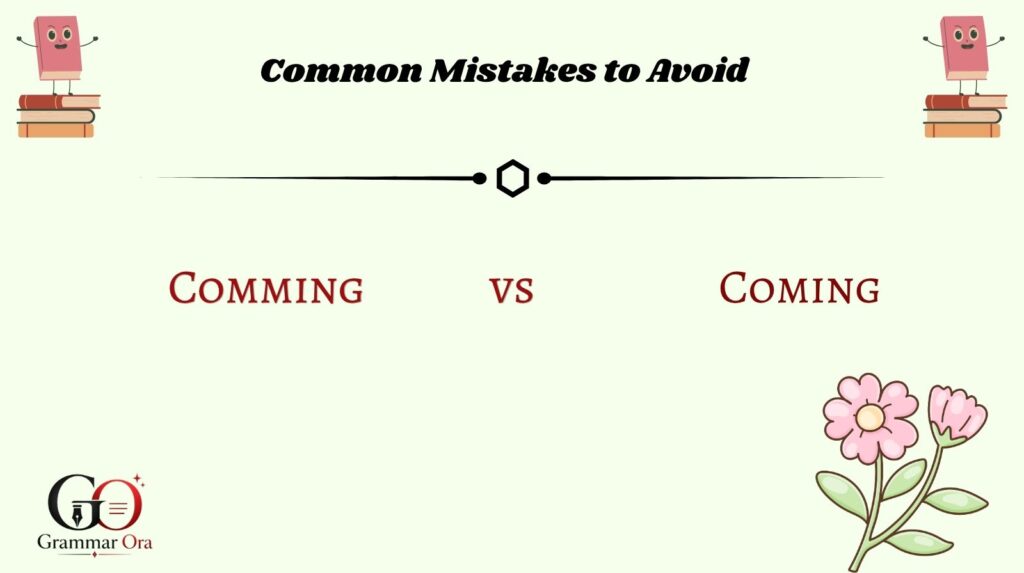
Mistake 1: Writing Comming
❌ I am comming tomorrow.
Correct:
✅ I am coming tomorrow.
Mistake 2: Writing Comeing
Some people know that come needs -ing but forget to remove the final e.
❌ She is comeing home.
✅ She is coming home.
Mistake 3: Confusing It With Doubling Rules
Don’t automatically double the final consonant of every verb.
For example:
- run → running
- sit → sitting
- stop → stopping
But:
- come → coming
- make → making
- take → taking
Understanding the spelling pattern is better than simply memorizing individual words.
FAQs
Q1: Is “comming” a correct word?
A: No. Comming is an incorrect spelling in modern standard English. The correct spelling is coming. Cambridge specifically lists comming as an incorrect form.
Q2: Is it coming or comming?
A: The correct form is coming with one m.
✅ coming
❌ comming
Q3: Why isn’t coming spelled comming?
A: Because the base verb is come. When -ing is added, the final silent e is removed:
come + ing = coming
The m is not doubled.
Q4: What does coming mean?
A: Coming can mean moving or traveling toward someone or somewhere. It can also describe something that will happen soon.
Examples:
- She is coming home.
- The coming year will be exciting.
Cambridge and Merriam-Webster both recognize these uses.
Q5: Is “comming” ever acceptable?
A: For modern standard English, you should use coming, not comming. Historical or specialized texts may contain unusual older spellings, but they are not appropriate for normal modern writing.
Q6: How do you spell the -ing form of come?
A: The correct spelling is:
come → coming
Not:
come → comming
Not:
come → comeing
Q7: What is the easiest way to remember coming?
A: Remember:
“Come loses the E and keeps one M.”
Therefore:
COME → COMING
Conclusion:
The difference between comming vs coming is straightforward: coming is the correct spelling, while comming is a spelling error in standard modern English.
The correct formation is:
COME + ING → COMING
Use coming when talking about movement, arrival, an ongoing action, or something that will happen soon. For example, “I am coming home,” “Are you coming with us?”, and “The coming year will be important.”
If you often confuse coming with comming, remember the simple rule: remove the silent “e” from come and add “-ing” never double the “m.”
For more clear explanations of confusing English words, spelling differences, and grammar rules, keep exploring Grammar Ora and improve your English one word at a time.
👉 Discover more simple and practical grammar guides on Grammar Ora

Muhammad Bilal is an expert blogger in Grammar Guide, dedicated to simplifying English grammar and helping learners write and speak with clarity, confidence, and accuracy.