Have you ever wondered whether you should write nosy or nosey? Many English speakers use both spellings interchangeably, which often creates confusion in writing, editing, and professional communication.
The truth is that both words exist, but one is generally considered the preferred spelling in modern English. Understanding the difference can help you write more confidently and avoid common language mistakes.
In this guide, you’ll learn the meaning of nosy vs nosey, discover which spelling is more common, explore real-life examples, and see how dictionaries and language experts treat these terms.
What Does Nosy Mean?
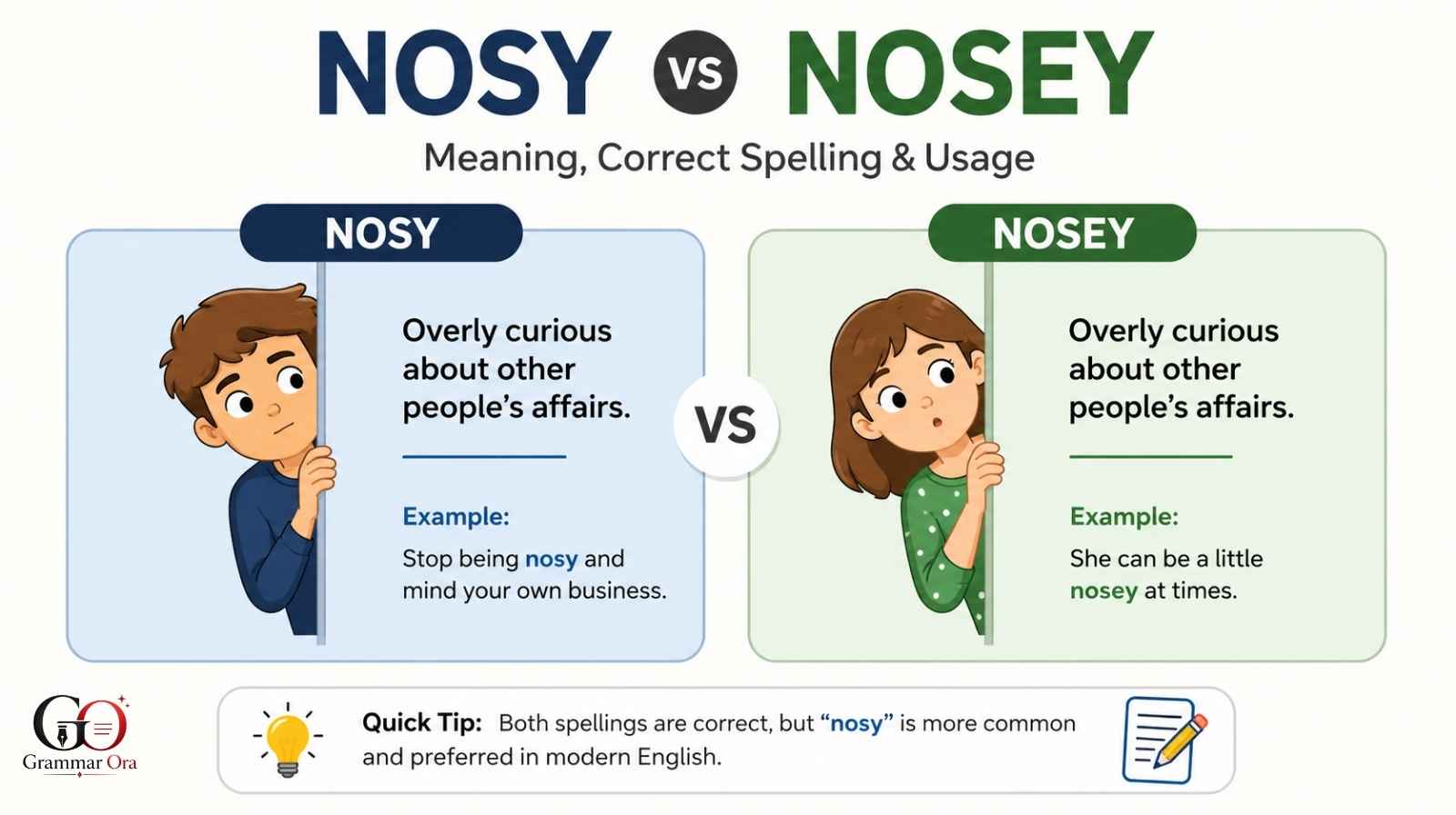
The word nosy is an adjective used to describe someone who is overly curious about other people’s private matters.
Definition of Nosy
A nosy person tends to ask questions, seek information, or involve themselves in situations that do not concern them.
Common Characteristics of a Nosy Person
- Frequently asks personal questions
- Wants details about others’ lives
- Interferes in private matters
- Enjoys gossip or rumors
Examples of Nosy in Sentences
- My neighbor is extremely nosy and always asks about my visitors.
- Stop being nosy and let them handle the situation themselves.
- The reporter’s nosy questions made the celebrity uncomfortable.
In modern English, nosy is generally the preferred spelling in dictionaries and style guides.
Nosey vs Nosy: Is There a Difference?
Many people assume that nosey and nosy have different meanings. However, they actually mean the same thing.
Quick Answer
Nosy and nosey are alternative spellings of the same adjective.
Why Two Spellings Exist
The term originated from the noun nose, suggesting someone who “sticks their nose” into other people’s business.
Over time, two spellings developed:
- Nosy (more common)
- Nosey (less common but accepted)
Comparison Table
| Feature | Nosy | Nosey |
|---|---|---|
| Meaning | Overly curious | Overly curious |
| Modern Usage | More common | Less common |
| Dictionary Acceptance | Yes | Yes |
| Preferred by Editors | Usually | Sometimes |
| Professional Writing | Recommended | Less preferred |
For most writing situations, choosing nosy is the safest option.
Which Spelling Is Correct: Nosy or Nosey?
The Preferred Modern Spelling
Most major dictionaries list nosy as the primary spelling.
Why Editors Prefer Nosy
Professional editors often recommend nosy because:
- It appears more frequently in published content.
- It aligns with modern style conventions.
- It is widely recognized by readers.
When Nosey Is Acceptable
You may still encounter nosey in:
- Older books
- Regional publications
- Informal writing
- Personal correspondence
Although acceptable, it is generally less common than nosy.
Real-Life Example: How a Single Word Affected Professional Communication
A content marketing agency conducted an internal review of customer emails and support messages to identify common writing mistakes. During the review, editors noticed inconsistent spelling of the word “nosy.”
Some employees used nosy, while others preferred nosey. Although both spellings were technically correct, the inconsistency created confusion in published content and customer-facing materials.
The editorial team consulted major dictionaries and style resources. After comparing recommendations, they adopted nosy as the company’s standard spelling. They then updated their style guide and trained writers to follow the same convention.
Within a few months, content consistency improved significantly. More importantly, editors spent less time correcting minor spelling variations during the publishing process.
This example demonstrates why understanding the distinction between accepted spellings can improve professionalism, maintain brand consistency, and streamline editorial workflows.
Usage Examples of Nosy and Nosey
Using Nosy Correctly
- My little brother is incredibly nosy about everyone’s plans.
- She asked several nosy questions during the interview.
- Their nosy behavior annoyed the entire neighborhood.
Using Nosey Correctly
- The children were nosey about the surprise party.
- He became nosey after hearing part of the conversation.
- Her nosey nature often led to awkward situations.
Which Example Sounds More Natural Today?
Most readers and editors find these versions more natural:
✅ The neighbor is nosy.
❌ The neighbor is nosey.
While both are understandable, the first version aligns with modern usage trends.
Nosy vs Nosey in Modern English Usage Statistics (2025–2026)
Language databases and digital publishing trends continue to show that nosy dominates modern English usage.
Recent Usage Trends
According to data from major language corpora and dictionary frequency analyses:
- Nosy appears significantly more often in modern publications.
- Digital content creators overwhelmingly prefer nosy.
- Educational resources typically teach nosy as the standard spelling.
- Search engine queries for “nosy meaning” exceed searches for “nosey meaning.”
These trends indicate that nosy remains the dominant form in contemporary English writing.
What This Means for Writers
If your goal is clarity, professionalism, and consistency, use nosy unless a specific style guide recommends otherwise.
How to Remember the Correct Spelling
Simple Memory Trick
Think of this rule:
Modern writing = Nosy
Since most dictionaries and editors favor nosy, it is easier to remember as the default choice.
Quick Checklist
Before publishing your writing, ask:
✔ Am I writing for a professional audience?
✔ Do I want the most widely accepted spelling?
✔ Am I following modern style conventions?
If the answer is yes, choose nosy.
FAQs
Q1: Is nosy or nosey correct?
A: Both spellings are correct, but nosy is generally the preferred spelling in modern English.
Q2: Why do some people spell it nosey?
A: The word comes from nose, which led some writers to retain the spelling nosey over time.
Q3: Do nosy and nosey have different meanings?
A: No. They carry the same meaning and describe someone who is overly curious about other people’s affairs.
Q4: Which spelling should I use in professional writing?
A: Use nosy because it is more common and widely accepted in modern publications.
Q5: Is nosey considered wrong?
A: No. It is an accepted alternative spelling, although it appears less frequently today.
Q6: Which spelling do dictionaries prefer?
A: Most major dictionaries list nosy as the primary or more common spelling.
Conclusion
Understanding nosy vs nosey is simpler than many people think. Both spellings are correct and share the same meaning: someone who is excessively interested in other people’s private affairs. However, nosy has become the preferred spelling in modern English and is the version most editors, publishers, and style guides recommend.
If you’re writing for school, work, blogging, or professional communication, choosing nosy is usually the safest option. By using the standard spelling consistently, you’ll improve clarity, maintain professionalism, and avoid unnecessary confusion.
When in doubt, remember this simple rule: use nosy for modern writing and you’ll rarely go wrong.
👉 Discover more simple and practical grammar guides on Grammar Ora

Muhammad Bilal is an expert blogger in Grammar Guide, dedicated to simplifying English grammar and helping learners write and speak with clarity, confidence, and accuracy.