Have you ever come across the words elegy vs eulogy and wondered whether they mean the same thing? Since both terms are connected to death, remembrance, and honoring someone who has passed away, many people use them interchangeably. However, doing so can lead to misunderstandings.
Understanding the difference between elegy vs eulogy is important for students, writers, public speakers, and anyone involved in memorial events. While both express respect and remembrance, they serve very different purposes.
In this guide, you’ll learn exactly what each term means, when to use it, common mistakes to avoid, and real-world examples that make the distinction easy to remember.
What Is the Difference Between Elegy vs Eulogy?
The simplest way to understand elegy vs eulogy is this:
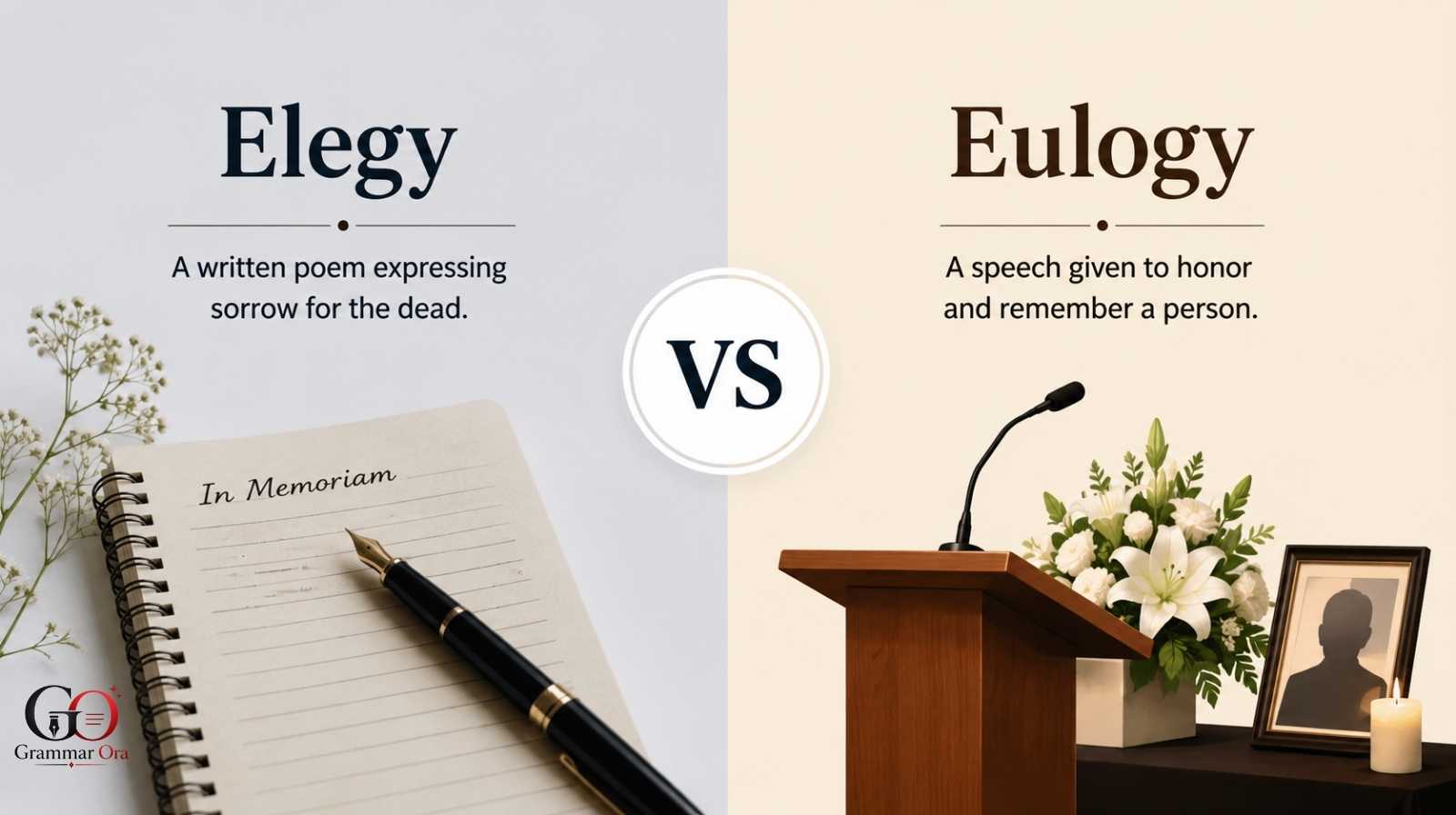
An elegy is a written poem or literary work expressing sorrow for someone who has died, while a eulogy is a speech delivered to honor and remember a deceased person.
Quick Comparison Table
| Feature | Elegy | Eulogy |
|---|---|---|
| Format | Poem or literary composition | Speech or spoken tribute |
| Purpose | Express grief and reflection | Honor and celebrate a person’s life |
| Delivered At | Literature, publications, memorial writings | Funerals and memorial services |
| Tone | Reflective, emotional, sorrowful | Respectful, personal, celebratory |
| Audience | Readers | Funeral attendees |
| Example | A poem mourning a loved one | A speech given by a family member |
Why People Confuse Them
Both words relate to remembrance after death. Additionally, they share similar emotional themes such as loss, respect, and tribute. However, their format and usage are entirely different.
What Is an Elegy?
An elegy is a poem or literary work written to mourn someone who has died. Traditionally, elegies express sadness, reflection, and acceptance of loss.
Characteristics of an Elegy
- Written rather than spoken
- Focuses on grief and remembrance
- Often poetic and symbolic
- May discuss life, death, and mortality
Famous Examples of Elegies
Several renowned writers have created famous elegies throughout history:
- In Memoriam A.H.H. by Alfred Lord Tennyson
- Lycidas by John Milton
- When Lilacs Last in the Dooryard Bloom’d by Walt Whitman
These works explore loss while also reflecting on broader themes of life and human experience.
Example of Elegy in a Sentence
The poet wrote an elegy to honor his late mentor and express his grief.
When Should You Use “Elegy”?
Use elegy when referring to:
- A poem about loss
- Literary tributes
- Written reflections on death
- Artistic expressions of mourning
What Is a Eulogy?
A eulogy is a speech delivered during a funeral or memorial service that honors the life of a deceased person.
Unlike an elegy, a eulogy focuses less on grief and more on celebrating achievements, character, and cherished memories.
Characteristics of a Eulogy
- Spoken aloud
- Delivered at a funeral or memorial service
- Includes personal stories and memories
- Celebrates a person’s life and legacy
Common Elements of a Eulogy
Personal Memories
Speakers often share meaningful experiences with the deceased.
Achievements and Contributions
A eulogy frequently highlights accomplishments and positive qualities.
Comfort for Family and Friends
The speech provides emotional support and helps attendees remember the person’s impact.
Example of Eulogy in a Sentence
Her brother delivered a heartfelt eulogy that brought both tears and smiles to the audience.
When Should You Use “Eulogy”?
Use eulogy when discussing:
- Funeral speeches
- Memorial tributes
- Spoken remembrances
- Public expressions of respect
Elegy vs Eulogy: Side-by-Side Examples
Understanding real-world examples can make the distinction much clearer.
Example 1
❌ Incorrect:
Sarah read an elegy during the funeral service.
✅ Correct:
Sarah delivered a eulogy during the funeral service.
Reason: She gave a speech rather than writing a poem.
Example 2
❌ Incorrect:
The poet published a moving eulogy about his late friend.
✅ Correct:
The poet published a moving elegy about his late friend.
Reason: A published poem is an elegy, not a eulogy.
Example 3
✅ Correct:
The memorial service included both a eulogy and an elegy.
Reason: Someone may give a speech while another person reads a poem.
Real-Life Example: How Elegies and Eulogies Serve Different Purposes
When a respected teacher passed away in a small community, former students organized a memorial service to celebrate her life. During the ceremony, one student delivered a heartfelt eulogy. He spoke about her kindness, dedication, and the countless lives she influenced over three decades of teaching. The audience laughed at funny classroom memories and reflected on her lasting impact.
Later in the service, another former student shared a poem she had written after learning of the teacher’s passing. The poem described feelings of loss, gratitude, and remembrance. Rather than recounting personal stories, it explored the emotional experience of grief through imagery and symbolism.
The speech was a eulogy because it publicly honored the teacher’s life. The poem was an elegy because it expressed sorrow and reflection through written verse.
This example demonstrates that although both forms commemorate a person’s life, they achieve that goal in very different ways.
Why Understanding Elegy vs Eulogy Matters
Choosing the correct term improves communication and demonstrates language precision.
For Students
Literature and language exams often test distinctions between similar words.
For Writers
Using accurate terminology strengthens credibility and professionalism.
For Public Speakers
Knowing the difference helps avoid confusion when preparing memorial tributes.
For General Communication
Precise language makes conversations clearer and more effective.
Language Trends and Usage Statistics (2025–2026)
According to search trend data from language-learning platforms and online dictionaries, searches for commonly confused words continue to increase as digital learning expands. Terms related to grammar, vocabulary, and word distinctions receive millions of monthly searches worldwide. Educational publishers have also reported growing interest in content explaining similar-sounding words, including literary and ceremonial terms. This trend reflects a broader demand for clear language guidance among students, professionals, and content creators. Sources such as the Google Trends and Merriam-Webster Dictionary regularly show strong engagement with word-definition and usage-related searches.
What This Means
As more people learn online, understanding distinctions like elegy vs eulogy has become increasingly valuable for academic and professional communication.
Common Mistakes People Make
Confusing Written and Spoken Tributes
The most frequent mistake is assuming both terms refer to speeches.
Assuming They Are Synonyms
Although related, they are not interchangeable.
Using Elegy for Funeral Speeches
Funeral speeches are eulogies unless they are specifically poems.
Ignoring Context
The surrounding situation usually reveals which word is appropriate.
How to Remember the Difference
Think of “E” for Elegy = Expression in Poetry
Elegies are literary expressions of grief.
Think of “U” for Eulogy = Uttered Speech
Eulogies are spoken tributes delivered aloud.
Simple Memory Trick
Elegy = Written Poetry
Eulogy = Spoken Praise
This quick reminder helps many learners avoid confusion.
FAQs
Q1: Is an elegy always a poem?
A: Traditionally, yes. An elegy is generally a poetic or literary composition expressing grief and remembrance.
Q2: Can a eulogy be written?
A: Yes. Many people write a eulogy beforehand, but it is intended to be delivered as a speech.
Q3: Can a funeral include both an elegy and a eulogy?
A: Absolutely. A memorial service may feature a eulogy along with poems or readings that qualify as elegies.
Q4: Which is more emotional: an elegy or a eulogy?
A: Both can be highly emotional. However, elegies often focus more deeply on grief and reflection, while eulogies frequently balance sadness with celebration.
Q5: Is a eulogy only for funerals?
A: Most commonly, yes. However, the term can occasionally refer to any speech praising a person.
Q6: Why do people confuse elegy and eulogy?
A: Because both involve honoring someone who has died and sound somewhat similar in meaning and usage.
Conclusion
Understanding elegy vs eulogy becomes simple once you remember their core difference: an elegy is a written poem expressing grief, while a eulogy is a spoken tribute celebrating a person’s life. Although both honor the deceased, they serve different purposes and appear in different contexts.
Whether you’re studying literature, preparing a memorial speech, or improving your vocabulary, knowing when to use each term will help you communicate more accurately and confidently.
The next time you encounter these words, you’ll immediately know whether you’re dealing with a poem of mourning or a speech of remembrance. For more language guides and commonly confused word comparisons, continue exploring grammar and vocabulary resources from trusted educational sources like Oxford Learner’s Dictionaries and Merriam-Webster Dictionary.
👉 Discover more simple and practical grammar guides on Grammar Ora

Muhammad Bilal is an expert blogger in Grammar Guide, dedicated to simplifying English grammar and helping learners write and speak with clarity, confidence, and accuracy.