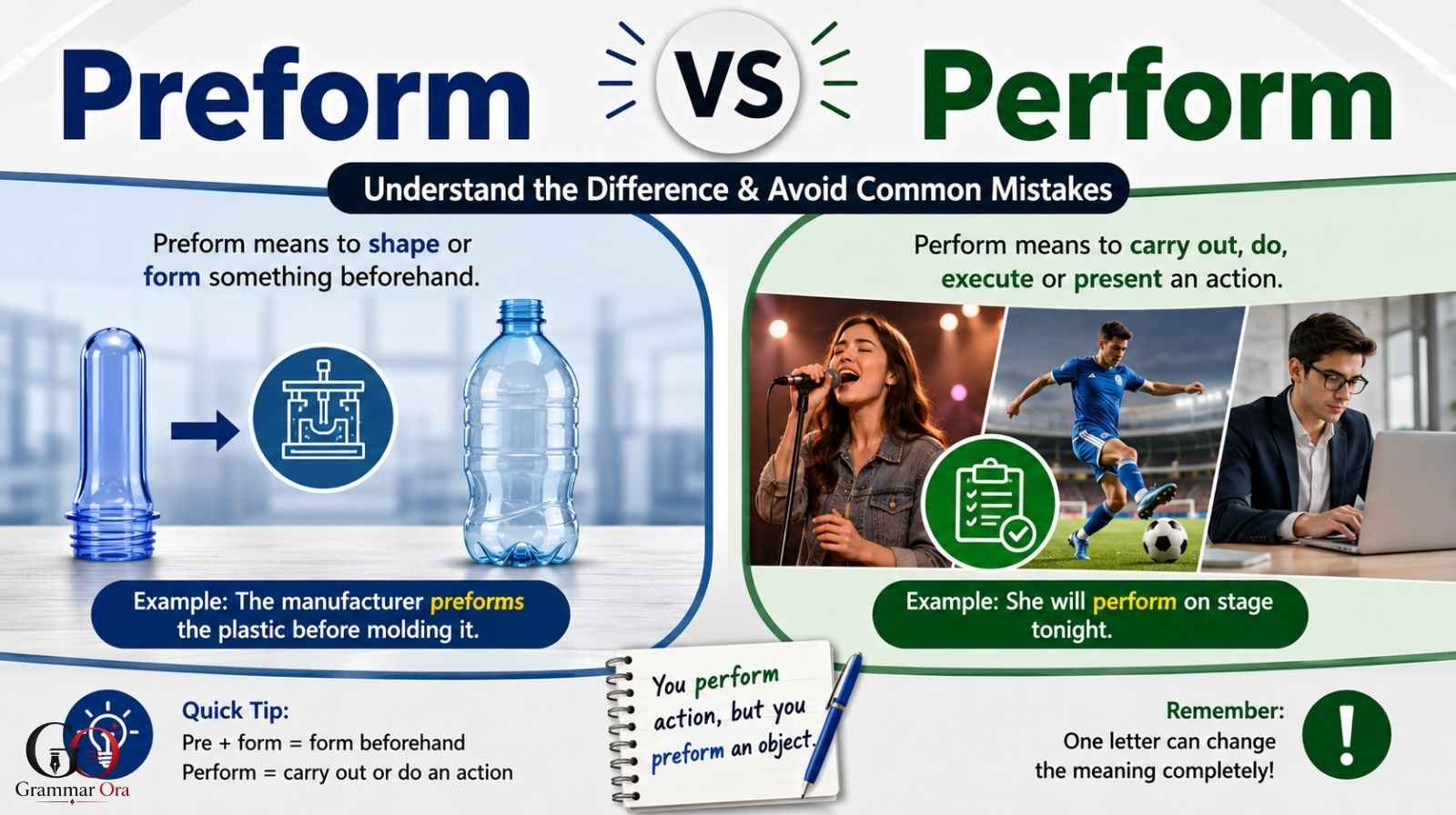
Preform vs Perform is a common spelling confusion because the two words look and sound very similar. However, they have completely different meanings.
Perform is the everyday word used when someone carries out a task, action, duty, or performance. Preform is a real English word too, but it has a much narrower meaning: to shape or form something beforehand, usually in a technical or manufacturing context.
So, if you want to say that someone did or carried out something, use perform. If you’re talking about shaping something before its final form, use preform.
What Does Perform Mean?
Perform Meaning and Definition
Perform is a verb meaning to carry out, do, execute, fulfill, or present something. It can describe everyday tasks, professional duties, medical procedures, entertainment, sports, and many other actions. Merriam-Webster lists meanings including carrying out an action, fulfilling an obligation, and giving a performance.
Examples:
- The doctor will perform the procedure tomorrow.
- She performed well in the competition.
- The employees must perform their duties carefully.
- The band will perform tonight.
- The computer can perform several tasks at once.
When Should You Use Perform?
Use perform when the sentence is about:
- Doing a task
- Carrying out an action
- Completing a duty
- Giving a performance
- Showing a skill
- Operating or functioning
For example:
Correct: The students performed the experiment carefully.
Here, the students are carrying out an experiment, so perform is the correct word.
What Does Preform Mean?
Preform Meaning and Definition
Preform is also a legitimate English word, but it isn’t simply another spelling of perform. As a verb, it means to form or shape something beforehand. As a noun, it can refer to an object that has undergone preliminary shaping before reaching its final form.
The word is particularly useful in manufacturing, engineering, plastics, glass production, fiber optics, and other technical fields.
Examples:
- The manufacturer preforms the material before molding it.
- The plastic preform is heated before it becomes a bottle.
- Engineers inspected each glass preform.
- The carbon-fiber pieces were preformed before assembly.
Preform as a Noun
Unlike perform, preform can also function as a noun.
For example:
The factory inspected every plastic preform before the molding stage.
Here, preform refers to the partially shaped object that will later be processed into its final form.
Merriam-Webster similarly defines a preform as an object given a preliminary shape or size, including examples such as rough gemstones and tubes intended for molding.
Preform vs Perform: Key Differences
Perform vs Preform at a Glance
| Word | Meaning | Typical Use | Example |
|---|---|---|---|
| Perform | Carry out or do something | Everyday, academic, business, sports, entertainment | She will perform the task. |
| Preform | Shape something beforehand | Manufacturing, engineering, technical fields | Workers preform the material. |
The easiest distinction is:
Perform = do or carry out
Preform = shape beforehand
A Simple Memory Trick
Think of pre- as meaning before.
So:
Pre + form = form beforehand
On the other hand:
Perform = carry out or do
Try this simple reminder:
You perform an action, but you preform an object.
This isn’t an absolute grammatical rule preform can be used as a verb too but it’s a very useful shortcut for avoiding the most common mistake.
Preformed vs Performed
The same distinction continues in their past-tense forms.
Performed means something was done or carried out.
The singer performed three songs.
Preformed means something was shaped beforehand.
The plastic components were preformed before molding.
One letter can completely change the meaning.
Common Preform vs Perform Mistakes
Mistake 1: Using Preform for an Action
❌ She will preform at the concert.
✅ She will perform at the concert.
A concert involves presenting or doing something in front of an audience, so perform is correct.
Mistake 2: Saying Someone Preformed Well
❌ The athlete preformed well today.
✅ The athlete performed well today.
The athlete carried out the activity or competed, so the correct word is performed.
Mistake 3: Using Perform for a Physical Preform
❌ The factory inspected every bottle perform.
✅ The factory inspected every bottle preform.
In this context, preform is a partially shaped manufacturing component.
Mistake 4: Assuming Preform Is Always Wrong
It’s easy to think preform is simply a spelling mistake. That’s not true.
Preform is a valid word. The problem occurs when it’s used in a context where perform is required.
Preform vs Perform in Real-Life Writing
In School and Academic Writing
Use perform when discussing actions or activities.
- Students perform experiments.
- Researchers perform statistical analysis.
- Students perform well on examinations.
- Scientists perform tests.
For example:
The researchers performed several tests before publishing their findings.
In Business and Professional Writing
Perform is also the normal choice for workplace activities.
- Employees perform their duties.
- Managers perform evaluations.
- Companies perform quality checks.
- Analysts perform financial reviews.
For example:
The accounting team performed a detailed review of the records.
In Manufacturing and Engineering
This is where preform becomes useful.
- The factory produced a plastic preform.
- Engineers preformed the composite material.
- The glass preform was inspected.
- The preformed component was ready for assembly.
In these sentences, the focus is on preliminary shaping, not simply doing an activity.
A Real-Life Case Study: Why Context Matters
Imagine a company that manufactures plastic bottles.
During production, workers first create a small, partially shaped plastic component called a preform. This component isn’t yet the finished bottle. It is later heated and molded into the final shape.
An engineer might write:
“The team inspected each PET preform before the molding stage.”
Here, preform is exactly right because the word describes an object that has already received an initial shape but still needs additional processing.
Now imagine the same engineer writing about the production team:
“The technicians performed a quality inspection before production began.”
In this sentence, performed is correct because the technicians carried out an inspection.
The two words can therefore appear in the same manufacturing environment, but they perform different jobs. One describes an intermediate physical object or the act of shaping something beforehand; the other describes carrying out an action.
This example shows why simply relying on spelling or sound isn’t enough. You need to look at the meaning of the sentence. If you’re describing an action, task, duty, test, or presentation, perform is generally the right choice. If you’re describing something being shaped in advance, preform may be the appropriate technical term.
2025–2026 Usage and Reference Snapshot
What Current Dictionary Evidence Shows
Current 2025–2026 dictionary references confirm that both words remain valid English words, but their functions are very different.
Merriam-Webster’s current entries identify perform as a verb meaning to carry out, fulfill, act, function, or give a performance. Its current preform entry defines the word around preliminary shaping and identifies both verb and noun uses.
The dictionary records also show a major difference in historical usage:
- Perform: first known use in the 14th century
- Performance: first known use in the 15th century
- Preform: first known use as a verb in the 17th century and as a noun in the 20th century
Recent 2026 examples from dictionary databases continue to show perform in ordinary contexts such as music, work, sports, and public duties, while preform appears in specialized manufacturing and engineering contexts.
Important: There isn’t a reliable public statistic showing an exact percentage of people who misspell perform as preform. Claims such as “99% of the time” shouldn’t be presented as hard statistical facts without a credible corpus or search-volume source.
How to Choose the Correct Word Every Time
Step 1: Ask What Is Happening
Ask yourself:
Am I talking about doing something?
If yes, choose perform.
The technician performed the inspection.
Am I talking about shaping something beforehand?
If yes, choose preform.
The technician preformed the material before assembly.
Step 2: Look at the Noun
Words connected with actions often take perform:
- perform a task
- perform an operation
- perform an experiment
- perform a duty
- perform a function
- perform a song
Technical objects may use preform:
- plastic preform
- glass preform
- fiber preform
- preformed material
- preformed component
Step 3: Replace the Word Mentally
Try replacing the word with do.
She will ___ at the event.
“She will do at the event” isn’t natural, but the context is clearly about a performance. Therefore:
✅ She will perform at the event.
Now try:
The material was ___ before molding.
“Shaped beforehand” fits perfectly.
✅ The material was preformed before molding.
Quick Checklist for Preform vs Perform
- Does the word mean carry out or do? → Perform
- Does it mean give a show or presentation? → Perform
- Does it describe completing a task or duty? → Perform
- Does it mean shape beforehand? → Preform
- Is it a partially shaped technical object? → Preform
- Is the context manufacturing or engineering? → Check whether preform fits the technical meaning.
FAQs
Q1: Is “preform” a correct English word?
A: Yes. Preform is a legitimate English word. It means to shape something beforehand and can also refer to an object that has been given a preliminary shape.
Q2: Is preform the same as perform?
A: No. Preform and perform are different words. Perform means to carry out an action, while preform relates to preliminary shaping.
Q3: Should I say “perform a task” or “preform a task”?
A: You should say perform a task.
✅ She performed the task successfully.
Preform a task is incorrect because a task is something you carry out, not something you shape beforehand.
Q4: Should I say “perform surgery” or “preform surgery”?
A: The correct phrase is perform surgery.
✅ The surgeon performed the procedure successfully.
Q5: What does “preformed” mean?
A: Preformed means something was shaped or formed before a later stage of processing.
The preformed parts were sent to the assembly line.
Q6: What does “performed” mean?
A: Performed is the past tense of perform. It means someone or something carried out an action, task, duty, or presentation.
The team performed the inspection yesterday.
Q7: Why do people confuse preform and perform?
A: The words have nearly identical spelling and both contain form, so they can be easy to mix up. The key difference is their meaning: perform = carry out, while preform = form beforehand.
Q8: Are preform and perform interchangeable?
A: No. They aren’t interchangeable. Substituting one for the other can change the meaning of a sentence or make the sentence incorrect.
Final Verdict:
The Preform vs Perform confusion becomes easy once you focus on meaning rather than spelling.
Use perform when you’re talking about doing, carrying out, completing, presenting, or executing something.
Use preform when you’re talking about shaping something beforehand, especially in manufacturing, engineering, or other technical contexts.
Remember:
Perform = do it.
Preform = shape it beforehand.
If you’re writing an email, essay, website article, report, or professional document, checking this small distinction can make your writing much clearer and more accurate.
For more helpful guides on commonly confused English words and spelling mistakes, explore Grammar Ora and keep improving your everyday English one word at a time.
👉 Discover more simple and practical grammar guides on Grammar Ora

Muhammad Bilal is an expert blogger in Grammar Guide, dedicated to simplifying English grammar and helping learners write and speak with clarity, confidence, and accuracy.