Have you ever paused before sending a text or email because you weren’t sure whether to write Good Morning vs Goodmorning? It may seem like a small detail, but using the correct greeting can make your writing look more polished and professional.
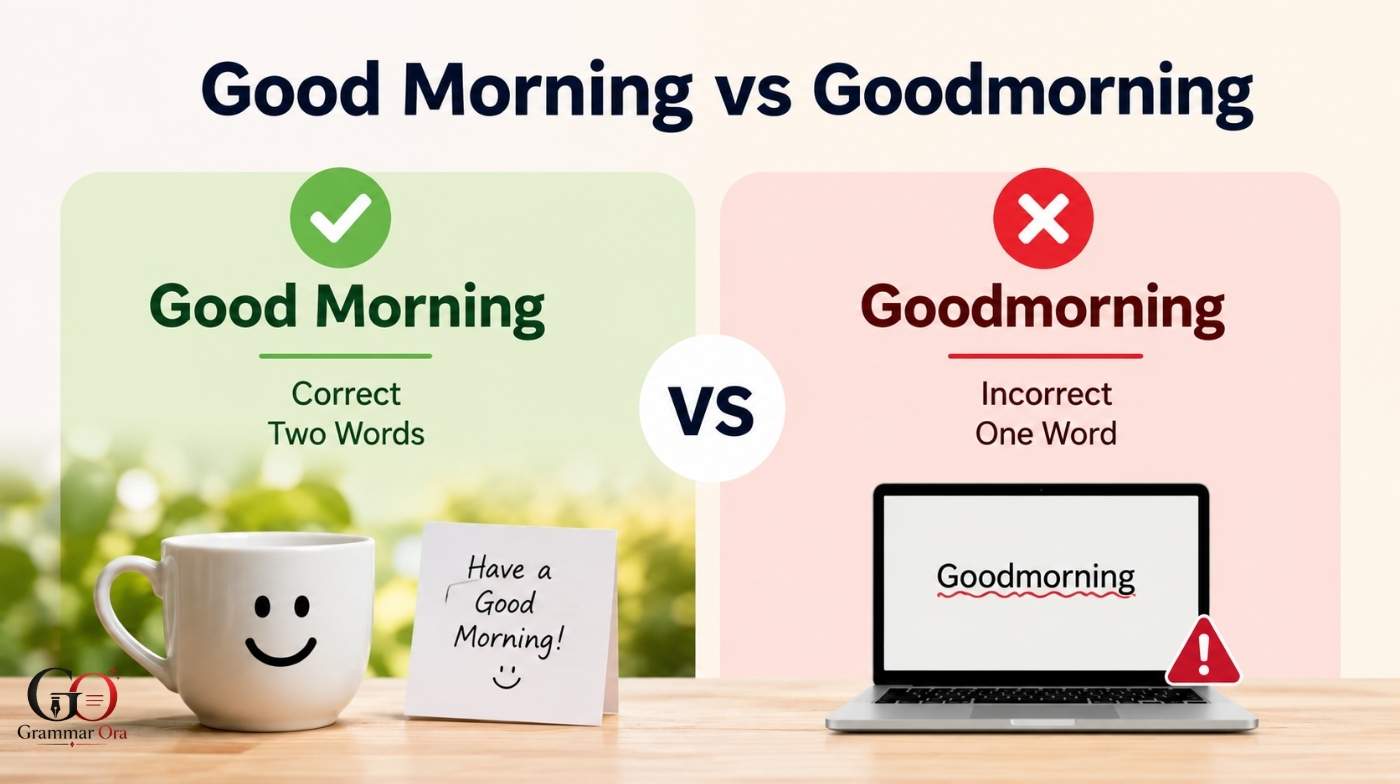
The short answer is simple: Good Morning (two words) is correct. Goodmorning (one word) is not considered standard English and should be avoided in formal and everyday writing.
In this guide, you’ll learn the difference between Good Morning vs Goodmorning, why one is correct, when to use it, common mistakes to avoid, and real-life examples that make the rule easy to remember.
Good Morning vs Goodmorning: The Quick Answer
If you’re looking for the short answer, here it is:
| Phrase | Correct? | Usage |
|---|---|---|
| Good Morning | ✅ Yes | Standard English greeting used in speech and writing. |
| Goodmorning | ❌ No | Not recognized as a standard English spelling. |
Correct examples:
- Good Morning, Sarah! How are you today?
- I hope you have a Good Morning.
- Good Morning, everyone. Welcome to today’s meeting.
Incorrect examples:
- Goodmorning, Sarah!
- Wishing you a Goodmorning.
Featured Snippet Answer:
Good Morning is the correct spelling because it consists of the adjective good and the noun morning. Standard English grammar keeps them as two separate words when used as a greeting.
Why Is “Good Morning” Written as Two Words?
English greetings often combine an adjective with a noun.
For example:
- Good afternoon
- Good evening
- Good night
In each case, good describes the time of day. The words remain separate because they serve different grammatical functions.
Similarly:
- Good = adjective
- Morning = noun
Together, they form the greeting Good Morning.
Writing Goodmorning as one word breaks this grammatical pattern and is considered incorrect.
Grammar Breakdown
The phrase follows a simple structure:
Good + Morning = Adjective + Noun
Because the words have separate meanings, dictionaries and grammar guides treat them as two individual words rather than a compound word.
When Should You Use “Good Morning”?
Good Morning is appropriate in almost every situation before noon.
In Professional Emails
Examples:
- Good Morning, Mr. Smith.
- Good Morning, Team.
Beginning an email this way creates a polite and respectful tone.
In Everyday Conversations
Examples:
- Good Morning! Did you sleep well?
- Good Morning, everyone!
In Formal Speeches
Public speakers often begin with:
Good Morning, ladies and gentlemen.
This greeting sounds natural, respectful, and professional.
Common Mistakes People Make
Many people accidentally write Goodmorning because smartphones, fast typing, or social media habits encourage combining words.
Here are a few common mistakes:
- ❌ Goodmorning everyone.
- ❌ Have a Goodmorning.
- ❌ Goodmorning sir.
Correct versions:
- ✅ Good Morning, everyone.
- ✅ Have a good morning.
- ✅ Good Morning, Sir.
A simple proofreading check can help you avoid this mistake.
Good Morning vs Goodmorning: Side-by-Side Comparison
| Feature | Good Morning | Goodmorning |
|---|---|---|
| Standard English | ✅ Yes | ❌ No |
| Accepted in dictionaries | ✅ Yes | ❌ No |
| Professional writing | ✅ Recommended | ❌ Avoid |
| Academic writing | ✅ Correct | ❌ Incorrect |
| Emails | ✅ Correct | ❌ Incorrect |
| Text messages | ✅ Preferred | ❌ Still incorrect |
Real-Life Example
Imagine two job applicants sending interview confirmation emails.
Applicant A writes:
Good Morning, Ms. Johnson. Thank you for scheduling my interview. I look forward to meeting you tomorrow.
Applicant B writes:
Goodmorning Ms. Johnson. Thank you for scheduling my interview.
Although both emails communicate the same message, the first immediately creates a stronger impression. The greeting follows standard English grammar, appears polished, and demonstrates attention to detail. The second email contains a noticeable spelling error that may distract the reader or make the writer seem less careful.
This example shows how a small grammatical choice can influence professionalism, especially in business communication, college applications, customer service, and networking.
What Do Dictionaries Say?
Major English dictionaries consistently list Good Morning as the standard greeting.
Style guides and grammar references also recommend writing it as two separate words because it follows normal English sentence structure.
If you’re writing for school, work, blogging, or professional communication, always choose Good Morning.
FAQs
Q1: Is Goodmorning one word?
A: No. Goodmorning is not standard English. The correct form is Good Morning.
Q2: Is Good Morning grammatically correct?
A: Yes. It is the standard greeting used before noon in both formal and informal situations.
Q3: Can I write Good Morning in an email?
A: Absolutely. It is one of the most common and professional email greetings.
Q4: Why do some people write Goodmorning?
A: Usually because of typing habits, autocorrect errors, or confusion about compound words.
Q5: Is Good Morning capitalized?
A: Capitalize both words when used as a greeting at the beginning of a sentence or email, such as “Good Morning, John.” Within a sentence, lowercase is also acceptable when appropriate, for example: “I hope you have a good morning.”
Conclusion
When comparing Good Morning vs Goodmorning, the correct choice is clear. Good Morning is the accepted spelling in modern English because it combines an adjective (good) with a noun (morning) as two separate words. In contrast, Goodmorning is not recognized as standard English and should be avoided in professional, academic, and everyday writing.
Whether you’re writing an email, sending a text message, greeting colleagues, or creating content for your website, using Good Morning helps your communication appear clear, accurate, and professional. Paying attention to small grammar details like this can make a lasting positive impression on your readers.
👉 Discover more simple and practical grammar guides on Grammar Ora

Muhammad Bilal is an expert blogger in Grammar Guide, dedicated to simplifying English grammar and helping learners write and speak with clarity, confidence, and accuracy.