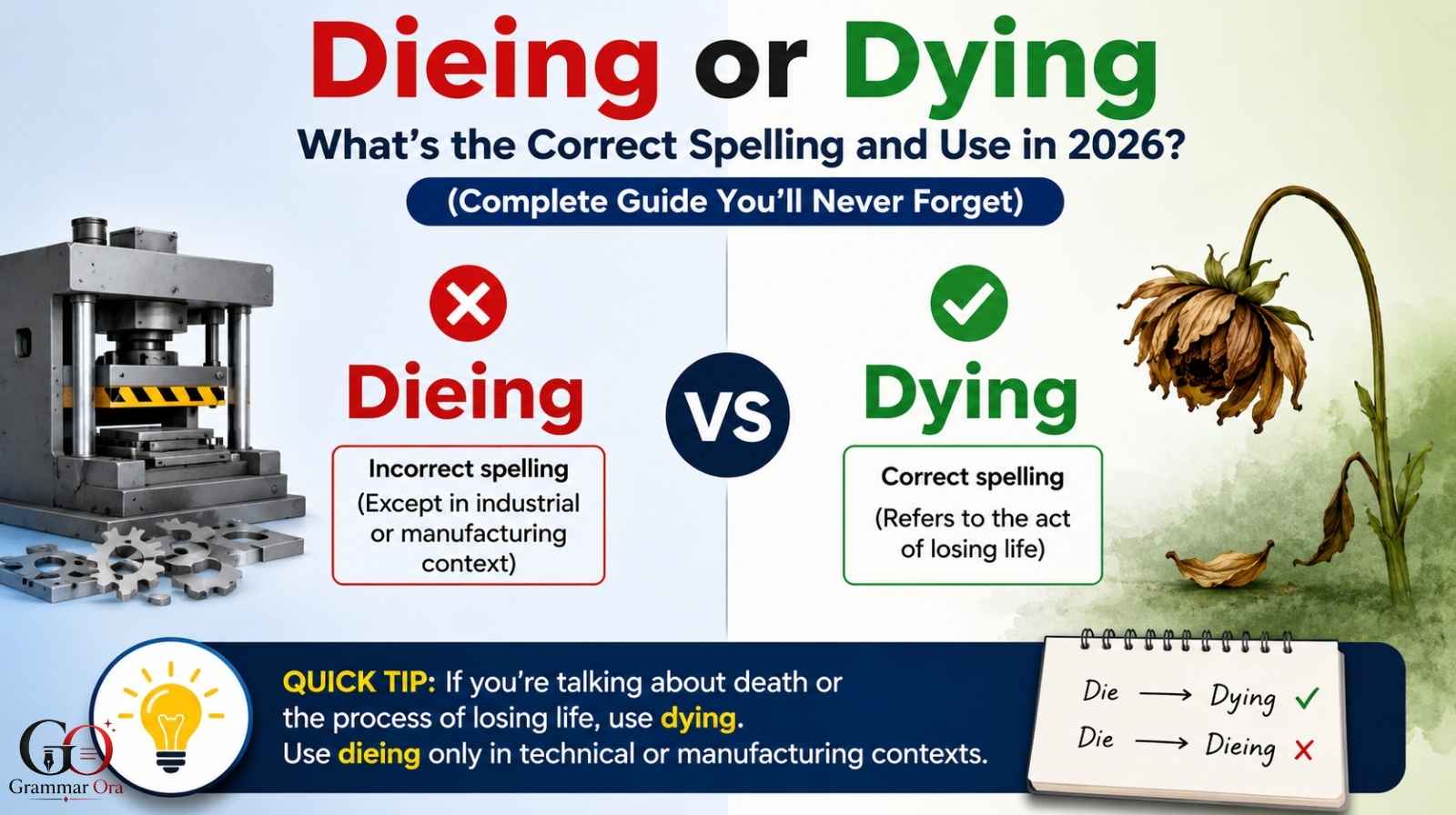
Have you ever paused while writing and wondered whether it should be dieing or dying? You’re not alone. This is one of the most common English spelling mistakes, and even experienced writers occasionally hesitate before choosing the correct form.
The confusion usually comes from English spelling rules. At first glance, dieing seems logical because it looks like the verb die with -ing added. However, that’s not how English grammar works in this case. The correct spelling is dying, while dieing is only used in a rare technical sense related to manufacturing.
In this complete 2026 guide, you’ll learn the difference between dieing or dying, understand the grammar rule behind the spelling, see real-life examples, discover when dieing is actually correct, and learn an easy trick to remember the right word every time. By the end, you’ll never confuse these two spellings again.
Why Do People Confuse “Dieing” and “Dying”?
The confusion between dieing and dying happens because English spelling rules are not always straightforward. Many verbs ending in -ie simply replace the e before adding -ing. For example:
- Tie → Tying
- Lie → Lying
- Die → Dying
Because learners often expect the word to remain die + ing, they mistakenly write dieing. However, English follows a special spelling rule for verbs ending in -ie: the ie changes to y before adding -ing.
The Spelling Rule Explained
When a verb ends in -ie, change ie to y before adding -ing.
| Base Verb | Correct -ing Form |
|---|---|
| Die | Dying |
| Lie | Lying |
| Tie | Tying |
This rule keeps pronunciation smooth and avoids awkward spellings.
Is “Dieing” Ever Correct?
Technically, dieing can exist, but not as the present participle of die.
Instead, dieing refers to using a die a specialized tool used to cut, shape, stamp, or thread materials such as metal, paper, or plastic. This usage is common in manufacturing and engineering.
For example:
- The factory upgraded its dieing equipment to improve production.
- Precision dieing ensures every metal component has identical dimensions.
Outside these industrial contexts, dieing is almost always considered a spelling mistake.
Real-Life Example: How One Simple Spelling Error Changed the Meaning
Imagine a university student submitting an essay on environmental conservation. One sentence reads:
“Many species are dieing because of habitat destruction.”
Although the teacher understands the intended meaning, the word dieing immediately stands out as a spelling error. Grammar-checking tools such as Microsoft Word, Grammarly, and Google Docs all flag it and suggest dying instead.
Now imagine the same word appearing on a business website:
“We specialize in precision metal dieing.”
In this case, dieing is completely correct because the company manufactures metal parts using industrial dies.
This example shows why context matters. A single extra letter can completely change what a sentence means. Writers, students, bloggers, and professionals should always consider whether they’re discussing death (dying) or manufacturing (dieing) before choosing the spelling.
Common Mistakes to Avoid
Many writers accidentally make the same spelling errors repeatedly. Here are the most common ones:
❌ Dieing instead of dying
❌ He is dieing.
✅ He is dying.
❌ My grandfather is dieing peacefully.
✅ My grandfather is dying peacefully.
❌ Several trees are dieing because of drought.
✅ Several trees are dying because of drought.
❌ People are dieing every day.
✅ People are dying every day.
2025–2026 Data: Why Correct Spelling Matters Online
Correct spelling isn’t just about grammar it also affects readability, professionalism, and search visibility.
Recent studies continue to highlight the importance of accurate writing:
| Statistic | Source |
|---|---|
| Over 90% of users notice grammar and spelling mistakes on websites before trusting the content. | Grammarly (2025) |
| Google continues emphasizing helpful, people-first content that demonstrates accuracy and expertise. | Google Search Central (2025–2026) |
| Clear, error-free writing improves user engagement and reduces bounce rates. | HubSpot Content Marketing Research (2025) |
These findings reinforce a simple truth: using dying correctly helps readers trust your content and improves the overall user experience.
FAQs
Q1: Is dying always the correct spelling?
A: Yes, whenever you’re referring to death or the process of dying, dying is the correct spelling.
Q2: Why isn’t it spelled dieing?
A: Because English spelling rules change ie to y before adding -ing for verbs like die, lie, and tie.
Q3: Is dieing a real English word?
A: Yes, but only in specialized manufacturing contexts involving a die, a tool used to cut or shape materials.
Q4: Which spelling should students use in essays?
A: Students should almost always use dying, unless they’re writing about industrial manufacturing.
Q5: How can I remember the correct spelling?
Remember this simple phrase:
A: Die becomes dying, just like lie becomes lying and tie becomes tying.
Conclusion
If you’ve ever wondered whether dieing or dying is correct, the answer is simple:
- Dying is the correct spelling when referring to death or the process of dying.
- Dieing is a rare technical term used in manufacturing when working with a die.
Understanding this distinction helps you avoid one of the most common English spelling mistakes and makes your writing clearer, more professional, and more trustworthy.
Whenever you’re writing about people, animals, or plants losing life, always choose dying. Save dieing only for discussions involving industrial tools and manufacturing processes.
With this rule in mind, you’ll never confuse dieing and dying again.
👉 Discover more simple and practical grammar guides on Grammar Ora

Muhammad Bilal is an expert blogger in Grammar Guide, dedicated to simplifying English grammar and helping learners write and speak with clarity, confidence, and accuracy.