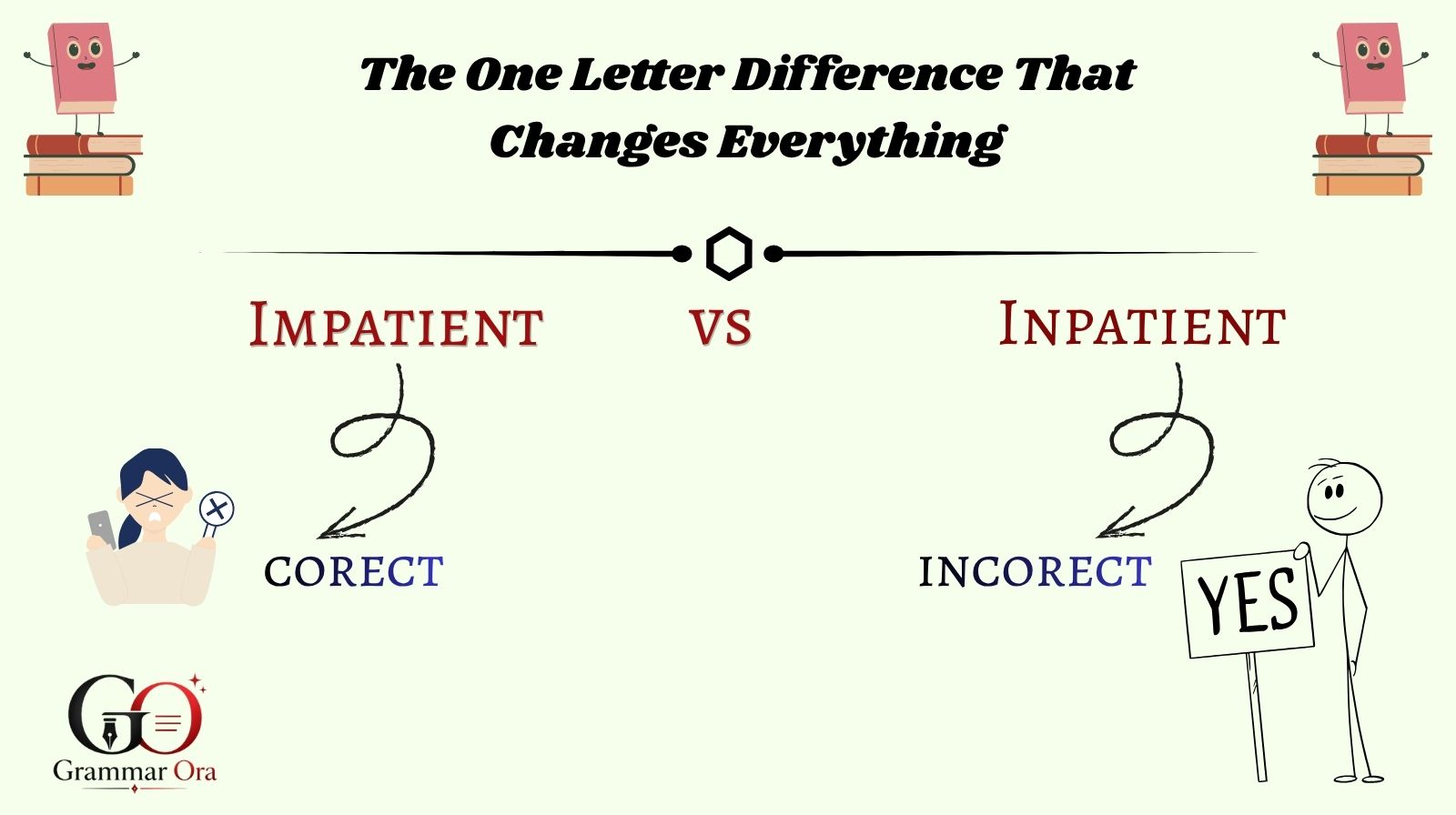
English is full of words that look almost identical but have completely different meanings. One excellent example is impatient vs inpatient. At first glance, the difference appears minor just a single letter. However, that small change can dramatically alter the meaning of a sentence.
Many writers, students, healthcare professionals, and English learners accidentally confuse these words because they sound somewhat similar and share a nearly identical spelling pattern. Yet using the wrong term can create confusion, especially in professional or medical communication.
In this guide, you’ll learn exactly what impatient vs inpatient means, how to use each word correctly, common mistakes to avoid, real-world examples, and practical memory tricks that make remembering the difference easy.
Understanding the Difference Between Impatient and Inpatient
The simplest way to understand these words is to remember that they belong to completely different contexts.
| Word | Meaning | Common Context |
|---|---|---|
| Impatient | Unable to wait calmly | Everyday communication |
| Inpatient | A patient admitted to a hospital | Healthcare and medical settings |
Although they differ by only one letter, they serve entirely different purposes.
What Does Impatient Mean?
Impatient is an adjective that describes someone who becomes annoyed, restless, or frustrated when waiting for something.
People often become impatient when:
- Waiting in long lines
- Experiencing delays
- Waiting for results
- Expecting quick responses
Examples of Impatient
- Sarah became impatient while waiting for her package.
- The children grew impatient during the long car ride.
- He was impatient to hear the exam results.
- Customers became impatient after waiting for an hour.
In each example, the person is struggling to wait calmly.
What Does Inpatient Mean?
Inpatient is a noun or adjective used in healthcare. It refers to a person who stays in a hospital or medical facility overnight or for an extended period while receiving treatment.
Examples of Inpatient
- The hospital admitted the patient as an inpatient.
- She received inpatient care following surgery.
- The inpatient unit was fully occupied.
- Doctors monitored the inpatient for several days.
Unlike “impatient,” this word has nothing to do with emotions or waiting.
Why People Confuse Impatient and Inpatient
The confusion typically happens because the words:
- Differ by only one letter
- Look visually similar
- Are pronounced somewhat similarly
- Often appear in written communication
However, their meanings are completely unrelated.
The Role of Context
Context usually reveals which word is correct.
For example:
Correct: I became impatient waiting for customer support.
Incorrect: I became inpatient waiting for customer support.
The second sentence is wrong because “inpatient” refers to a hospital patient, not frustration.
Likewise:
Correct: The doctor recommended inpatient treatment.
Incorrect: The doctor recommended impatient treatment.
Here, the medical setting clearly requires “inpatient.”
Common Typing Errors
Autocorrect tools do not always catch these mistakes because both words are legitimate English terms. Therefore, proofreading remains essential.
Impatient Meaning in Everyday Communication
Most people encounter the word “impatient” far more frequently than “inpatient.”
Signs of Impatience
Someone may be impatient if they:
- Interrupt conversations
- Become frustrated by delays
- Rush decision-making
- Show irritation while waiting
Personal Relationships
Impatience often affects communication.
For example:
- A parent may become impatient when a child takes too long to get ready.
- Friends may become impatient when plans repeatedly change.
- Managers may become impatient if deadlines are missed.
Professional Settings
In the workplace, impatience can influence productivity and teamwork.
Examples include:
- Becoming impatient during lengthy meetings.
- Feeling impatient while waiting for approvals.
- Getting impatient with slow project progress.
Although occasional impatience is normal, excessive impatience can harm relationships and decision-making.
Synonyms of Impatient
Common alternatives include:
- Restless
- Eager
- Irritable
- Anxious
- Agitated
- Frustrated
Each synonym carries slightly different nuances, but all relate to difficulty waiting.
Inpatient Meaning in Healthcare
The word “inpatient” is essential within medical and healthcare environments.
What Is an Inpatient?
An inpatient is someone admitted to a healthcare facility for treatment that requires overnight observation or ongoing medical supervision.
Types of Inpatient Care
Hospitals provide inpatient services for:
- Major surgeries
- Serious illnesses
- Rehabilitation programs
- Mental health treatment
- Intensive medical monitoring
Inpatient vs Outpatient Care
Many people also confuse inpatient with outpatient care.
| Inpatient Care | Outpatient Care |
|---|---|
| Requires hospital stay | No overnight stay |
| Continuous monitoring | Limited monitoring |
| More intensive treatment | Less intensive treatment |
| Higher healthcare costs | Lower healthcare costs |
Examples of Inpatient Treatment
Common situations include:
- Heart surgery recovery
- Stroke rehabilitation
- Severe infections
- Psychiatric treatment programs
- Complex orthopedic procedures
Healthcare providers use the term daily because it helps determine treatment plans, insurance coverage, and patient management.
Real-Life Example: How One Letter Created a Major Communication Problem
Consider a real-world workplace scenario.
A hospital administrator was preparing internal reports regarding patient admissions. While compiling information, a staff member accidentally wrote:
“Several impatient patients were admitted following surgery.”
At first glance, the sentence seemed harmless. However, during review, management interpreted the phrase as describing patient behavior rather than admission status.
The intended sentence was:
“Several inpatient patients were admitted following surgery.”
The mistake generated confusion because readers initially believed the report referred to patients who were frustrated or difficult to manage.
Correcting the report required additional clarification meetings and revisions. Although the error involved only one letter, it changed the entire meaning of the statement.
This example demonstrates why precision matters in professional writing. In healthcare, legal documentation, insurance forms, and medical records, using the correct term is critical.
The same issue occurs outside medicine. A student writing an essay about emotions could accidentally write “inpatient” instead of “impatient,” making the sentence nonsensical.
Small spelling differences can have significant consequences.
Statistics and Language Trends (2025–2026)
Language analysis tools and digital writing platforms continue to identify commonly confused words as a major source of writing errors.
Recent studies from grammar and editing platforms indicate that homophone and near-homophone mistakes remain among the most frequent editing issues in English writing.
Key findings include:
- Confused-word errors account for millions of corrections annually.
- Medical terminology mistakes are particularly common among non-specialist writers.
- Spellcheck software often misses correctly spelled but contextually incorrect words.
- Professional editors report that word confusion remains a leading cause of clarity problems in business documents.
Healthcare industry reports also show increasing emphasis on accurate medical documentation due to patient safety and compliance requirements.
As digital communication expands, understanding distinctions like impatient vs inpatient becomes increasingly important.
Impatient vs Inpatient: Side-by-Side Comparison
Quick Comparison Checklist
| Feature | Impatient | Inpatient |
|---|---|---|
| Part of Speech | Adjective | Noun/Adjective |
| Related to Emotions | Yes | No |
| Related to Hospitals | No | Yes |
| Means Difficulty Waiting | Yes | No |
| Means Hospital Admission | No | Yes |
| Common Usage | Daily conversation | Medical settings |
Quick Test
Which sentence is correct?
- The child became impatient during the wait. ✅
- The child became inpatient during the wait. ❌
Which sentence is correct?
- She received inpatient treatment after surgery. ✅
- She received impatient treatment after surgery. ❌
Memory Tricks to Remember the Difference
Simple memory devices can help prevent mistakes.
Remember the Letter “M”
Impatient contains the letter “M.”
Think:
M = Mood
Impatience describes a person’s mood or emotional state.
Remember the Word “Patient”
Inpatient contains the complete word “patient.”
Think:
Patient = Hospital Patient
This connection immediately points to healthcare.
Visual Memory Method
Imagine:
- An impatient person tapping their foot while waiting.
- An inpatient lying in a hospital bed receiving care.
The visual contrast makes the distinction easy to remember.
Common Mistakes Writers Make
Mistake #1: Using Inpatient for Frustration
Incorrect:
- I was inpatient waiting for my food.
Correct:
- I was impatient waiting for my food.
Mistake #2: Using Impatient in Medical Contexts
Incorrect:
- The doctor recommended impatient care.
Correct:
- The doctor recommended inpatient care.
Mistake #3: Trusting Spellcheck Alone
Because both words are valid English terms, spellcheck software may not flag misuse.
Always review the sentence context.
Mistake #4: Ignoring Audience Expectations
Professional healthcare documents require especially careful proofreading because terminology errors can affect interpretation.
How to Use Impatient and Inpatient Correctly Every Time
Follow these simple steps:
Step 1: Identify the Context
Ask yourself:
Is the sentence about emotions or healthcare?
Step 2: Check the Meaning
If it involves frustration or waiting:
Use impatient.
If it involves hospital admission:
Use inpatient.
Step 3: Read the Sentence Aloud
Reading aloud often reveals awkward wording and incorrect word choices.
Step 4: Verify Professional Documents
Medical, legal, and business documents should receive extra review before publication.
FAQs
Q1: Is impatient the same as inpatient?
A: No. Impatient describes someone who struggles to wait calmly, while inpatient refers to a hospital patient receiving overnight or extended care.
Q2: What is an example of impatient?
Example:
A: I became impatient while waiting for the interview results.”
Q3: What is an example of inpatient?
Example:
A: The hospital kept him as an inpatient after surgery.”
Q4: Can inpatient be used as an adjective?
Yes. For example:
A: She received inpatient treatment.”
Q5: Why do people confuse impatient and inpatient?
A: The words differ by only one letter and look very similar, making them easy to mistype or misread.
Q6: What is the opposite of impatient?
A: Common opposites include:
- Patient
- Calm
- Tolerant
- Understanding
Q7: Is inpatient always related to hospitals?
A: Generally yes. The term refers to healthcare facilities where patients stay overnight or longer for treatment.
Conclusion
Understanding impatient vs inpatient is surprisingly important because a single letter completely changes the meaning of a sentence. Impatient refers to frustration, restlessness, or difficulty waiting, while inpatient describes a person receiving treatment within a hospital or healthcare facility.
Although the words look similar, their contexts are entirely different. By focusing on whether the sentence involves emotions or medical care, you can choose the correct word every time.
The next time you encounter these terms, remember: an impatient person is frustrated, while an inpatient person is receiving hospital treatment. Mastering this distinction will improve your writing accuracy, strengthen communication, and help you avoid embarrassing mistakes in both everyday and professional settings.
👉 Discover more simple and practical grammar guides on Grammar Ora

Muhammad Bilal is an expert blogger in Grammar Guide, dedicated to simplifying English grammar and helping learners write and speak with clarity, confidence, and accuracy.