Have you ever read a sentence with two options and suddenly wondered what “former” or “latter” actually refers to? You are not alone. Many English learners, students, writers, and even native speakers get confused by these two words.
The confusion usually happens because both words are used to refer back to something mentioned earlier in a sentence. As a result, using the wrong one can completely change the meaning of what you are trying to say. However, once you understand the simple rule behind former vs latter, using them correctly becomes much easier.
In this guide, you will learn the meaning of former and latter, how to use them correctly, common mistakes to avoid, grammar tips, and plenty of real-life examples. By the end, you will confidently know when to use each word in everyday writing and conversation.
What Does Former vs Latter Mean?
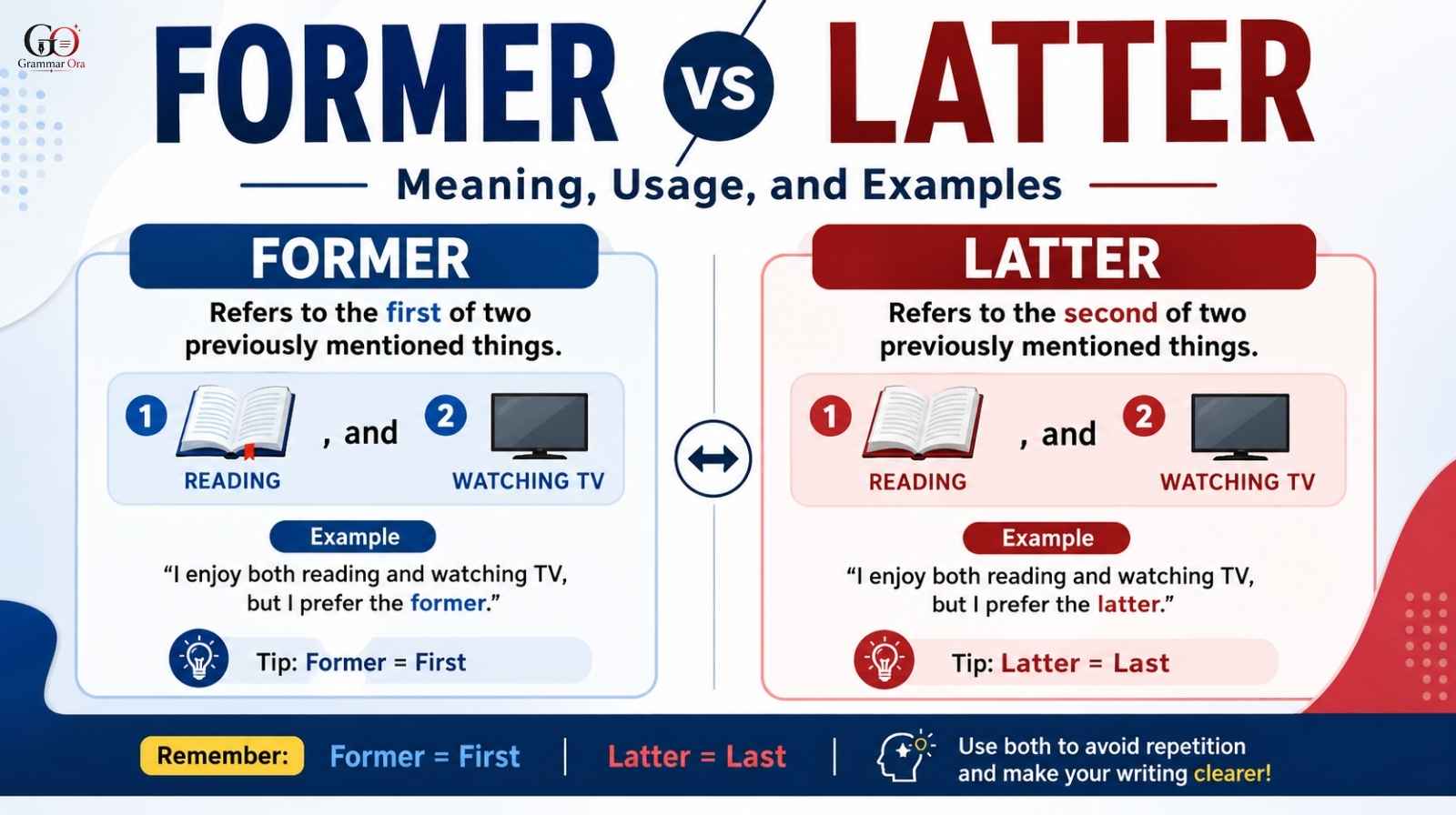
The words “former” and “latter” are used to refer to two things that were mentioned previously.
- Former = the first item mentioned
- Latter = the second item mentioned
For example:
I enjoy both tea and coffee, but I prefer the latter.
Here:
- Tea = first item
- Coffee = second item
- “Latter” refers to coffee.
Similarly:
Between reading and watching TV, I prefer the former.
Here:
- Reading = first item
- Watching TV = second item
- “Former” refers to reading.
These words help avoid repetition and make writing smoother and more professional.
Why Do People Confuse Former and Latter?
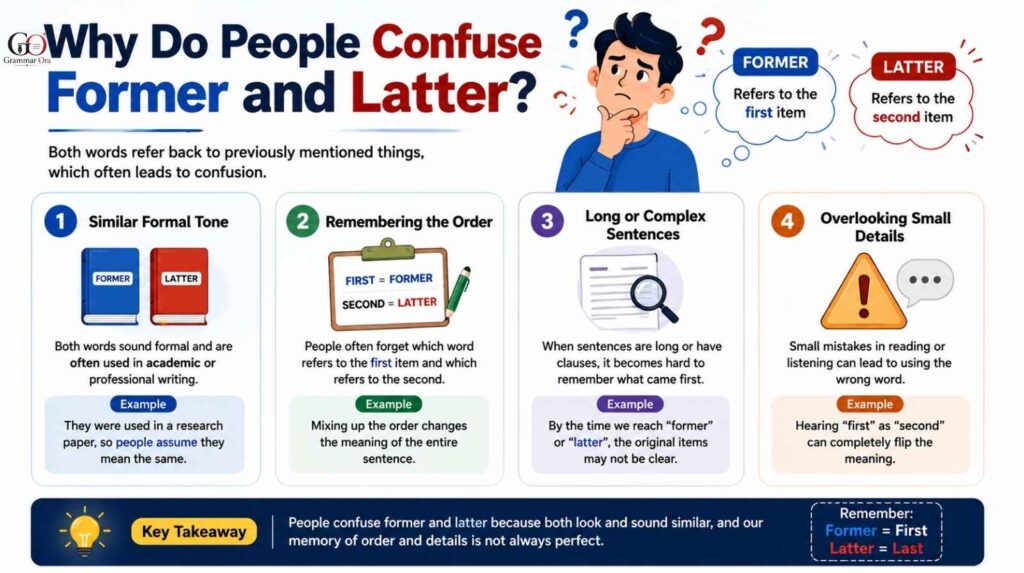
Many people confuse former vs latter because both words refer back to earlier ideas instead of directly naming them again. If the sentence is long or complicated, readers may forget which item came first.
Common Reasons for Confusion
Similar Formal Tone
Both words sound formal and are often seen in academic or professional writing.
Remembering the Order
People sometimes forget:
- Former = first
- Latter = last/second
Long Sentences
When too many items appear in a sentence, tracking references becomes harder.
For example:
The manager discussed marketing strategies and employee training during the meeting, but the latter received more attention.
Here, “latter” refers to employee training because it was mentioned second.
Former Meaning and Usage Explained
The word “former” refers to the first of two previously mentioned things.
When to Use Former
Use “former” when:
- Talking about the first option
- Comparing two ideas
- Avoiding repetition
Examples of Former in Sentences
- Between summer and winter, I prefer the former.
- Sarah considered studying medicine or law, but she eventually chose the former.
- We discussed remote work and office work; the former offers more flexibility.
Former in Professional Writing
Business and academic writing often use “former” because it sounds concise and polished.
Example:
The company compared online advertising and traditional advertising, finding the former more cost-effective.
Former as an Adjective
“Former” can also mean previous or past.
Example:
He is a former teacher.
In this case, “former” means the person used to be a teacher in the past.
Latter Meaning and Usage Explained
The word “latter” refers to the second of two previously mentioned items.
When to Use Latter
Use “latter” when:
- Referring to the second option
- Comparing two subjects
- Avoiding repeated wording
Examples of Latter in Sentences
- I enjoy both action and comedy movies, but I usually watch the latter.
- Between pizza and burgers, she chose the latter.
- The teacher discussed grammar and vocabulary, focusing mainly on the latter.
Latter in Academic Writing
Academic articles often use “latter” to connect ideas clearly.
Example:
Researchers examined both online and offline learning, concluding that the latter improved engagement.
Latter and Time
Sometimes “latter” can also refer to the later part of a period.
Example:
In the latter half of the year, sales increased significantly.
Here, “latter” means the later portion of the year.
Former vs Latter: Key Differences
The easiest way to remember former vs latter is this:
| Word | Meaning | Refers To |
|---|---|---|
| Former | First mentioned item | Beginning |
| Latter | Second mentioned item | End/last |
Quick Memory Trick
- Former = First
- Latter = Last
Both start with the same letter:
- F → Former → First
- L → Latter → Last
This simple trick helps many learners remember the difference instantly.
Real-Life Example of Former vs Latter
A university student named Ahmed was writing an essay comparing online classes and traditional classroom learning. In one sentence, he wrote:
Online classes are flexible, while traditional classroom learning provides direct interaction. I prefer the former.
However, his teacher pointed out that Ahmed actually preferred classroom learning, not online learning. The mistake happened because “former” refers to the first option mentioned.
The corrected sentence became:
Online classes are flexible, while traditional classroom learning provides direct interaction. I prefer the latter.
After understanding the rule, Ahmed began using former and latter correctly in all his assignments. His writing became clearer and more professional because he no longer repeated the same nouns again and again.
This example shows how a small grammar misunderstanding can completely change the meaning of a sentence. Therefore, knowing the difference between former vs latter is important for students, bloggers, business professionals, and anyone who writes in English regularly.
Former vs Latter in Modern Writing (2025–2026 Trends)
Recent language-learning studies and writing platform reports show that grammar clarity remains one of the top priorities for readers in 2025.
According to language education insights published by universities and online learning platforms, readers prefer concise writing that avoids unnecessary repetition. Words like “former” and “latter” help improve sentence flow when used correctly.
However, modern readability studies also suggest that overusing these terms in digital content may confuse casual readers. Because of this, many SEO writers and content creators now balance formal grammar with simpler wording.
For example, instead of writing:
The former was more effective than the latter.
Some writers prefer:
Online marketing was more effective than television advertising.
This trend shows that while former and latter are still grammatically correct, writers should use them carefully for readability and clarity.
Common Mistakes When Using Former and Latter
Many learners make similar mistakes with these words.
Using Them for More Than Two Items
Incorrect:
We discussed apples, bananas, and oranges, but I preferred the latter.
This becomes unclear because there are three items.
Correct:
Use former and latter only when discussing two things.
Forgetting the Order
Incorrect:
Between math and science, she liked the former.
(But she actually liked science.)
Always double-check the order.
Overusing Formal Language
Using former and latter too frequently can make writing sound overly formal or robotic.
Instead of:
The latter option was selected.
You can sometimes write:
The second option was selected.
How to Use Former and Latter Correctly
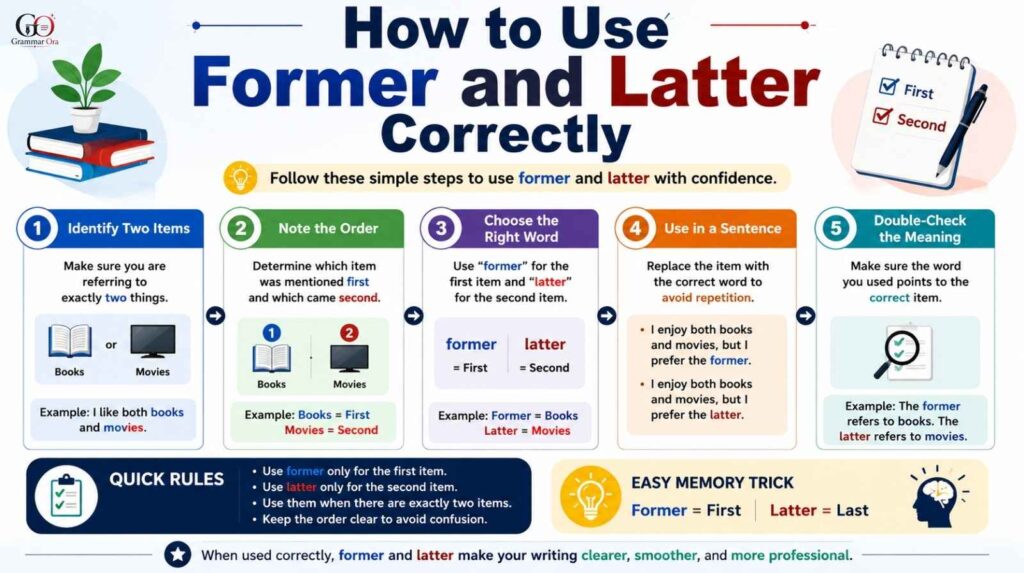
Here is a simple step-by-step method.
Step 1: Identify Two Items
Example:
- Cats
- Dogs
Step 2: Find Their Order
- Cats = first
- Dogs = second
Step 3: Choose the Correct Word
- Former = cats
- Latter = dogs
Example
I like both cats and dogs, but I prefer the latter.
“Latter” refers to dogs.
Former vs Latter Examples in Everyday English
Casual Conversation
- We can watch Netflix or YouTube. I prefer the former.
- Should we order pasta or rice? I’ll take the latter.
Workplace Examples
- The company considered hiring new staff or outsourcing work. The latter seemed cheaper.
- We discussed remote work and hybrid schedules. Employees preferred the former.
Academic Examples
- The article compared climate change and pollution, focusing mainly on the latter.
- Students studied poetry and prose, but the former was easier to analyze.
Should You Avoid Former and Latter in SEO Writing?
In SEO writing, readability is extremely important. Therefore, many modern writers use former and latter carefully.
When They Help
Use them when:
- Comparing only two things
- Avoiding repetition
- Writing formal educational content
When They Hurt Readability
Avoid overusing them when:
- Sentences are long
- Readers may forget the original items
- Simpler wording sounds clearer
SEO Best Practice
Instead of repeatedly using “former” and “latter,” combine them naturally with direct nouns for better readability.
For example:
Between blogging and video marketing, blogging requires stronger writing skills. Video marketing, however, demands editing expertise.
This version feels more conversational and easier to understand.
FAQs
Q1: Is former first or second?
A: Former refers to the first of two previously mentioned items.
Q2: What does latter mean?
A: Latter means the second or last of two mentioned items.
Q3: Can former and latter be used for three things?
A: No. Former and latter should only be used when discussing two items.
Q4: Is it okay to use former and latter in everyday conversation?
A: Yes, but they sound more formal. Many people use simpler wording in casual speech.
Q5: What is an easy way to remember former vs latter?
A: Remember:
Former = First
Latter = Last
Q6: Are former and latter common in academic writing?
A: Yes. Academic and professional writing often use these terms to avoid repetition and improve sentence flow.
Q7: Can latter mean later in time?
A: Yes. For example:
In the latter part of the movie, the story became emotional.
Here, “latter” refers to the later section of the movie.
Conclusion
Understanding former vs latter is much easier once you remember one simple rule: former refers to the first item, while latter refers to the second. These words can make your writing cleaner, more professional, and less repetitive when used correctly.
However, clarity always matters most. In modern writing, especially online content, it is important to balance formal grammar with readability. Therefore, use former and latter naturally instead of forcing them into every comparison.
Whether you are a student, blogger, professional writer, or English learner, mastering these two words will help you communicate more clearly and confidently.
👉 Discover more simple and practical grammar guides on Grammar Ora

Muhammad Bilal is an expert blogger in Grammar Guide, dedicated to simplifying English grammar and helping learners write and speak with clarity, confidence, and accuracy.


