If you’ve ever wondered about convertor vs converter, you’re not alone. The two spellings look almost identical, and both can be found in English writing. So, which one should you actually use?
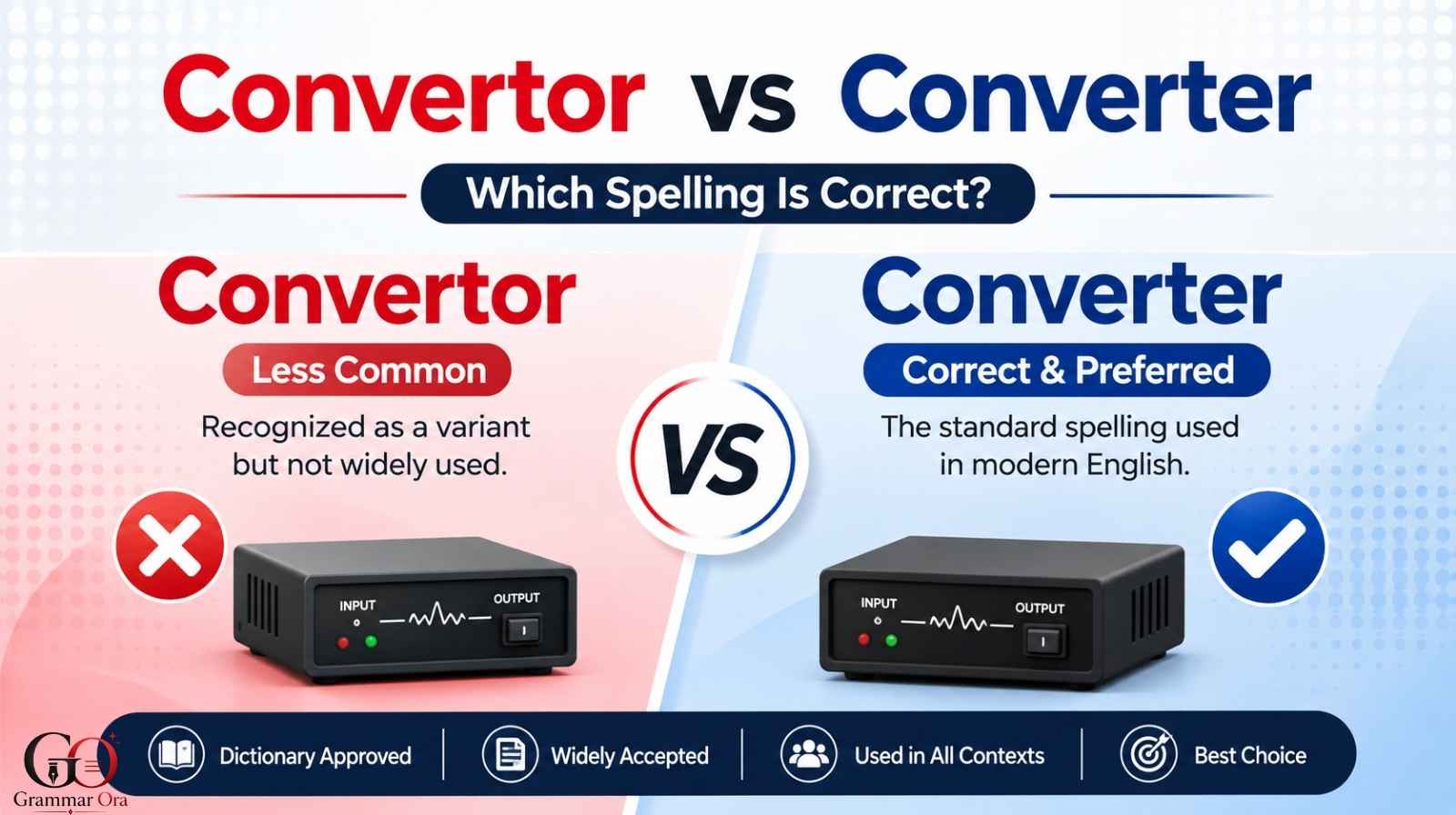
The short answer is converter is the standard and preferred spelling in modern English. However, convertor isn’t simply an invented word. Major dictionaries, including Cambridge and Merriam-Webster, recognize it as a variant in certain contexts.
In this guide, you’ll learn the difference between convertor and converter, what each word means, which spelling is best for everyday and professional writing, and how to remember the correct form.
Convertor vs Converter: Which Spelling Is Correct?
Converter is the safest and most widely preferred spelling for general English writing.
Convertor is also recognized as a variant, but it’s much less common. Cambridge lists convertor as an alternative form of converter, while Merriam-Webster includes convertor as a variant in one of its technical definitions.
Converter Is the Standard Choice
Use converter when you’re writing an article, email, school assignment, technical explanation, product description, or business document.
Examples:
- I bought a power converter for my trip.
- This website has a useful currency converter.
- The technician replaced the damaged voltage converter.
- I used a PDF converter to change the file format.
Convertor Is a Recognized Variant
Convertor can appear in dictionaries and technical contexts, so calling it an absolute “non-word” isn’t accurate.
The American Heritage Dictionary, for example, defines convertor as a variant of converter.
Therefore, the most accurate rule is:
Use “converter” by default. Treat “convertor” as a less common variant rather than the normal spelling.
What Does Converter Mean?
A converter is a person, machine, device, or program that changes something from one form into another.
Cambridge defines a converter as a machine or device that changes something into a different form. Its examples include electrical and digital applications.
Converter Meaning in Everyday English
The word can describe many different things.
For example:
- Currency converter — changes one currency value into another.
- Unit converter — changes measurements from one unit to another.
- File converter — changes a file from one format to another.
- Video converter — changes video files into different formats.
- Power converter — changes electrical energy from one form to another.
- Catalytic converter — helps reduce harmful emissions from vehicle exhaust.
Examples of Converter in Sentences
Here are some natural examples:
- I used an online currency converter before exchanging money.
- The technician installed a new power converter.
- This software includes a built-in PDF converter.
- The car needs a replacement catalytic converter.
- Use a unit converter to change kilometers into miles.
In each example, the word describes something that performs a conversion.
Why Do People Confuse Convertor and Converter?
The confusion mainly comes from English word formation. Both -er and -or can appear in nouns describing people or things that perform an action.
The “-er” Pattern
English has many common nouns ending in -er:
| Verb | Noun |
|---|---|
| teach | teacher |
| drive | driver |
| write | writer |
| build | builder |
| printer | |
| convert | converter |
Because converter follows a familiar English pattern, it has become the normal spelling.
The “-or” Pattern
English also contains many words ending in -or:
- actor
- creator
- generator
- operator
- translator
- instructor
That can make convertor look perfectly reasonable at first glance.
However, spelling isn’t determined simply by choosing -er or -or. Established usage matters. In the case of this word, converter is the dominant standard form.
A Simple Memory Trick
Remember:
Convert + er = Converter
Think of other familiar words:
Drive → Driver
Write → Writer
Convert → Converter
If you’re unsure while writing, converter is the better default.
Convertor vs Converter: Key Differences
Although the two words can refer to the same basic idea, their usage isn’t equal.
| Feature | Converter | Convertor |
|---|---|---|
| Meaning | Something that converts | Variant of converter |
| Standard modern spelling | Yes | Less common |
| General writing | Recommended | Usually avoided |
| Technical contexts | Very common | Sometimes appears |
| Dictionary recognition | Yes | Yes, as a variant |
| Best choice for SEO content | Yes | Usually no |
| Professional writing | Preferred | Use only when appropriate |
Is Convertor Wrong?
Not necessarily.
This is an important distinction. Merriam-Webster lists converter as the main entry and gives convertor as a variant for a technical sense. Cambridge likewise lists also convertor.
So saying that convertor can never be correct would be too absolute.
A better statement is:
Converter is the preferred standard spelling, while convertor is an accepted but less common variant.
Is Convertor British English?
No. It’s not accurate to treat converter vs convertor as a simple American-versus-British spelling difference.
For example:
- American English: converter
- British English: converter
The alternative convertor exists in dictionary usage, but it isn’t the normal British equivalent of an American converter. Cambridge’s entry itself uses converter as the main form in both UK and US pronunciation sections and lists convertor as an alternative.
Converter in Technology and Everyday Life
The word converter is especially common in technology because digital systems constantly transform information, signals, measurements, and formats.
Digital and File Converters
A file converter changes information from one file format into another.
For example:
I used a file converter to change the document into PDF format.
Other examples include:
- image converter
- video converter
- audio converter
- PDF converter
- document converter
Electrical Converters
In electronics and engineering, a converter can change electrical energy from one form to another.
Examples include:
- AC-to-DC converter
- DC-to-DC converter
- DC-to-AC converter
- voltage converter
- frequency converter
Merriam-Webster specifically includes electrical, radio, data, and catalytic applications under its definition of converter.
Conversion Tools
You also encounter the word outside engineering.
For example:
I opened a currency converter to check the exchange rate.
Or:
The online unit converter changed 10 kilometers into miles.
This broad usage is one reason converter is such a familiar word in modern English.
Real-Life Example: Choosing the Right Spelling
Imagine you’re writing instructions for an international travel website.
Your sentence says:
“You may need a voltage convertor when using electronic devices abroad.”
A reader will probably understand what you mean. However, voltage converter is the more familiar and standard-looking phrase.
An editor reviewing the article would likely change it to:
“You may need a voltage converter when using electronic devices abroad.”
Now imagine the same issue appears throughout a 2,000-word technical article. If the writer uses convertor in some places and converter in others, the inconsistency can make the content look poorly edited.
A better workflow is to choose converter from the beginning and use it consistently.
This is particularly useful for bloggers, students, businesses, and technical writers. When your goal is clear communication, the familiar spelling removes an unnecessary distraction.
There is one important exception. Suppose you’re quoting an old engineering document or reproducing an official product name that specifically uses convertor. In that situation, changing the spelling may alter the original wording or name. Keep the original form when accuracy requires it.
For ordinary modern writing, however, converter is the practical choice.
2025–2026 Dictionary and Usage Evidence
Rather than relying only on spelling websites, it’s useful to check established dictionaries.
What Current Dictionaries Show
Cambridge’s current dictionary entry lists converter as the headword and explicitly gives convertor as an alternative.
Merriam-Webster’s current converter entry defines the word as something that converts and includes convertor as a variant within its technical senses. The entry also gives a first known use of converter dating to 1533.
Merriam-Webster’s related convert entry confirms the underlying verb means, among other things, to change something from one form, function, or unit to another.
What This Evidence Tells Us
The 2025–2026 dictionary evidence supports three useful conclusions:
- Converter is an established English noun.
- Convertor is recognized as a variant rather than a completely unrelated word.
- Converter should be the default choice when you’re writing for a broad audience.
This distinction matters because a dictionary listing doesn’t necessarily mean that two spellings are equally common or equally advisable.
For SEO writers and editors, converter is therefore the safer primary spelling.
Common Mistakes to Avoid
Mistake 1: Using Convertor Everywhere
Using convertor isn’t necessarily incomprehensible, but it can look unusual to readers.
Prefer:
The software includes a converter.
Mistake 2: Calling Convertor a British Spelling
Don’t write:
“Convertor is British English and converter is American English.”
That’s misleading.
Both major English varieties use converter as the standard form.
Mistake 3: Mixing Both Forms
Avoid writing:
This convertor is faster than the new converter.
Unless you’re intentionally distinguishing two names or quoting different sources, consistency is better.
Use:
This converter is faster than the new converter.
Or rewrite the sentence naturally to avoid repetition.
Mistake 4: Assuming Every “-or” Word Needs -or
English doesn’t work that way.
You can’t automatically create a correct noun by changing -er to -or. Established vocabulary determines which form is standard.
Converter vs Convertor: Quick Checklist
Before publishing your article, report, or assignment, check these points:
- Use converter as the default spelling.
- Use convertor only when a specific source or name requires it.
- Don’t describe convertor as a British spelling.
- Keep your spelling consistent throughout the document.
- Use converter in general SEO content.
- Check a reputable dictionary when you’re dealing with specialized terminology.
FAQs
Q1: Is converter or convertor correct?
A: Converter is the preferred standard spelling in modern English. Convertor is also recognized as a variant by major dictionaries, but it’s much less common.
Q2: Is convertor a real word?
A: Yes. Convertor is a recognized variant of converter. The American Heritage Dictionary identifies it as a variant, while Cambridge also lists it as an alternative form.
Q3: What is the meaning of converter?
A: A converter is a person, machine, device, or program that changes something from one form into another. It can refer to file, currency, electrical, digital, or mechanical conversion.
Q4: What is the correct spelling: convertor vs converter?
A: For normal writing, choose converter. It’s the spelling readers are most likely to expect.
Q5: Is convertor the British spelling?
A: No. Convertor isn’t simply the British version of converter. Converter is the standard spelling in both American and British English.
Q6: Should I use converter in academic writing?
A: Yes. Converter is the safest choice for academic, professional, business, and general-purpose writing unless you’re reproducing a specific term or quotation that uses convertor.
Q7: Which spelling should I use for SEO?
A: Use converter as your primary spelling. It is the more familiar standard form and appears naturally in common phrases such as currency converter, PDF converter, unit converter, and voltage converter.
Q8: Can converter and convertor have the same meaning?
A: Yes. In many contexts, they refer to something that performs a conversion. The main difference is usage and spelling preference, rather than meaning.
Conclusion:
When it comes to convertor vs converter, the easiest rule is simple: use converter in normal modern English writing.
Converter is the standard headword in major dictionaries and is widely used for devices, machines, software, electrical systems, file tools, and other things that perform a conversion. Convertor is recognized as a variant, but it’s considerably less common.
So, if you’re writing a blog post, school assignment, business document, technical guide, or website page, choose converter.
Remember: Convert → Converter.
If you often get confused by similar English spelling pairs, bookmark this guide and check the word before publishing. A small spelling choice can make your writing clearer, more consistent, and more professional.
👉 Discover more simple and practical grammar guides on Grammar Ora

Muhammad Bilal is an expert blogger in Grammar Guide, dedicated to simplifying English grammar and helping learners write and speak with clarity, confidence, and accuracy.