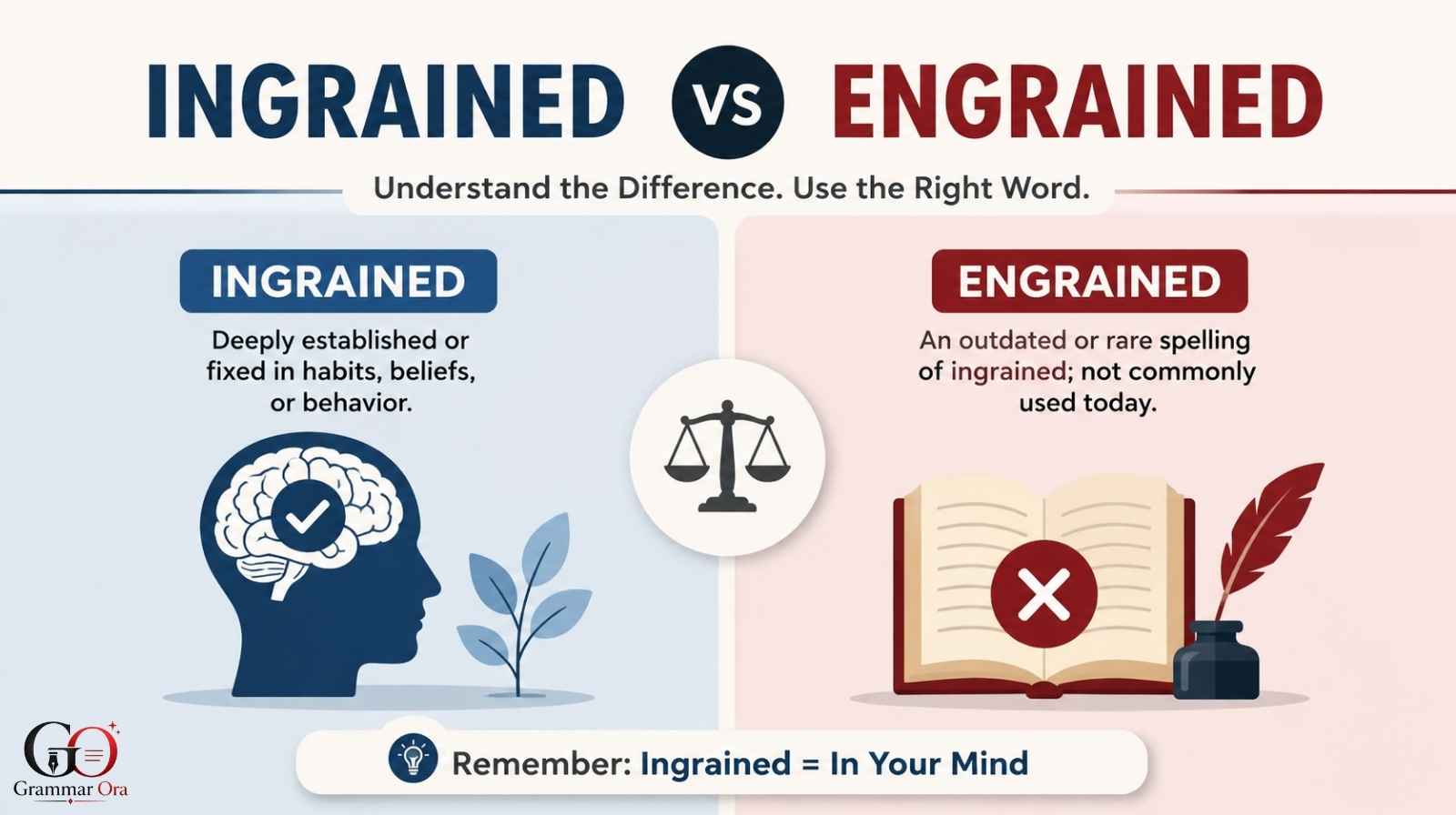
Have you ever written “engrained habit” and wondered if it should actually be “ingrained habit”? You’re not alone. Many English speakers even experienced writers mix up these two words because they sound almost identical.
The confusion becomes even greater because you’ll occasionally see engrained in books, websites, or historical texts. So, which spelling is correct? Are both acceptable? Or is one simply outdated?
This guide explains everything you need to know about ingrained vs engrained, including their meanings, origins, modern usage, examples, historical background, and when each word is appropriate. By the end, you’ll know exactly which term to use with confidence.
What Is the Difference Between Ingrained and Engrained?
The biggest difference is simple:
| Word | Meaning | Modern Usage |
|---|---|---|
| Ingrained | Deeply fixed, firmly established, difficult to change | ✅ Standard and preferred |
| Engrained | Historical variant of ingrained; occasionally used but uncommon | ⚠ Rare and mostly outdated |
Today, ingrained is the accepted spelling in nearly every style guide, dictionary, and professional publication.
Ingrained Meaning
Something that is ingrained has become part of someone’s character, habits, beliefs, or behavior through long experience.
Examples:
- Good manners become ingrained during childhood.
- Years of practice made the technique ingrained.
- Trust is deeply ingrained in successful teams.
Engrained Meaning
Historically, engrained referred to something dyed with grain-based dye or deeply fixed. Over time, some writers used it interchangeably with ingrained.
Today, however, it is considered an uncommon or historical spelling.
Is “Ingrained” or “Engrained” Correct?
The correct choice in modern English is ingrained.
Major dictionaries, educational institutions, and style guides recommend ingrained for both American and British English.
Use “Ingrained” When Talking About:
- Habits
- Beliefs
- Values
- Traditions
- Behaviors
- Skills
- Attitudes
- Cultural practices
Examples
✔ Reading every morning is an ingrained habit.
✔ Safety procedures are ingrained in every employee.
✔ Respect for others became ingrained from childhood.
Using engrained in these examples would usually look unusual to modern readers.
Why Do People Confuse Ingrained and Engrained?
Several factors contribute to the confusion.
They Sound Nearly Identical
Both words are pronounced almost the same.
As a result, many people assume they are interchangeable.
“Engrave” Creates Confusion
People naturally associate engrained with engrave, imagining something carved deeply into a surface.
That mental image makes the spelling seem logical.
Older Books Used Both Forms
If you read historical literature from the 18th or 19th centuries, you may occasionally encounter engrained.
Modern publishers rarely use it today.
The History of Ingrained vs Engrained
Understanding the history makes the difference much easier to remember.
The Origin of “Grain”
The word originally referred to a type of red dye made from insects known as kermes.
Cloth dyed with this expensive color was called grain-dyed.
Eventually, ingrained described color that soaked deeply into fabric.
Later, the meaning expanded to describe ideas, habits, and beliefs that became deeply rooted.
How Engrained Appeared
Some writers gradually adopted engrained because it resembled the word engrave, suggesting something permanently fixed.
Although this alternative spelling appeared in historical writing, ingrained became the dominant standard over time.
Ingrained Meaning in Everyday English
Today, ingrained almost always describes something firmly established over time.
Ingrained Habits
Examples:
- Brushing your teeth every night.
- Looking both ways before crossing the street.
- Saving money each month.
Ingrained Beliefs
Examples:
- Cultural traditions
- Religious practices
- Personal values
- Family customs
Ingrained Skills
Examples:
- Driving a car
- Typing without looking
- Playing the piano
- Riding a bicycle
These skills become automatic through repetition.
Real-Life Example: How Ingrained Habits Shape Workplace Safety
Imagine a manufacturing company where every employee begins each shift by checking safety equipment before operating machinery. Initially, new employees must consciously remember each step, often relying on printed checklists and supervisor reminders. However, after several months of consistent training and daily repetition, these actions become second nature.
The company notices that experienced workers automatically inspect protective gear without being reminded. Even during busy production periods, they instinctively follow safety procedures because those behaviors have become ingrained. As a result, workplace accidents decrease, equipment lasts longer, and new employees learn by observing experienced colleagues.
This example shows why businesses invest heavily in repeated training rather than one-time instruction. An ingrained habit is much more reliable than a habit someone only remembers occasionally. Whether in education, sports, healthcare, or aviation, organizations aim to make essential behaviors deeply rooted so they occur naturally under pressure.
Ingrained vs Engrained Comparison
| Feature | Ingrained | Engrained |
|---|---|---|
| Modern English | ✅ Yes | Rare |
| Dictionaries Recommend | ✅ Yes | Occasionally listed as variant |
| Academic Writing | ✅ Preferred | Avoid |
| Professional Writing | ✅ Standard | Rarely used |
| Everyday Conversation | ✅ Common | Uncommon |
| SEO-Friendly Writing | ✅ Recommended | Not recommended |
How to Remember the Correct Spelling
A simple memory trick is:
Ingrained = In your mind.
Both words begin with “In.”
If an idea or habit is in your mind, it is ingrained.
Avoid connecting it with engrave, even though the meanings seem similar.
Data & Usage Trends (2025–2026)
Language usage data from leading dictionaries and writing tools continues to show a strong preference for ingrained over engrained. Corpus-based language databases and search trend analyses indicate that ingrained appears overwhelmingly more often in newspapers, academic journals, business writing, and online publications.
Key observations for 2025–2026 include:
- Ingrained is the standard form recognized by major English dictionaries.
- Most grammar checkers automatically recommend ingrained when users type engrained in modern contexts.
- Educational websites and university writing centers consistently teach ingrained as the preferred spelling.
- The use of engrained is now largely limited to historical texts or discussions about language history.
This widespread preference reflects how modern English has standardized the spelling over time.
Common Mistakes to Avoid
Using “Engrained” in Professional Writing
Unless you’re quoting historical material, use ingrained.
Assuming Both Are Equally Common
They’re not.
Ingrained overwhelmingly dominates modern English.
Confusing Literal and Figurative Meanings
Remember:
- Engrave = carve into metal, stone, or wood.
- Ingrain = fix deeply into habits, beliefs, or character.
FAQs
Q1: Is engrained a real word?
A: Yes. It exists as a historical or alternative spelling but is rarely used in modern English.
Q2: Which spelling should I use?
A: Use ingrained in nearly all writing situations.
Q3: Is ingrained correct in British English?
A: Yes. British English also prefers ingrained.
Q4: Why does engrained still appear online?
A: Some older publications, historical texts, and personal writing continue to use it.
Q5: Can grammar checkers flag engrained?
A: Yes. Most modern grammar tools recommend replacing engrained with ingrained unless you’re quoting historical sources.
Q6: Does ingrained only describe habits?
A: No. It can also describe beliefs, traditions, attitudes, values, skills, and behaviors that become deeply established.
Conclusion
When comparing ingrained vs engrained, the answer is straightforward. While engrained has historical roots and occasionally appears in older texts, ingrained is the standard spelling accepted in modern English. It accurately describes habits, beliefs, traditions, and behaviors that become deeply established over time.
Whether you’re writing an academic paper, a business email, a blog post, or everyday content, choosing ingrained ensures your writing aligns with current English usage and professional style standards. The next time you’re unsure, remember this simple rule: if something is deeply rooted in your mind or behavior, it’s ingrained.
👉 Discover more simple and practical grammar guides on Grammar Ora

Muhammad Bilal is an expert blogger in Grammar Guide, dedicated to simplifying English grammar and helping learners write and speak with clarity, confidence, and accuracy.