Have you ever paused while writing and wondered whether afterward vs afterwards is the correct word? You’re not alone. This small spelling difference confuses many English learners and even native speakers because both words seem to mean exactly the same thing.
The good news is that there’s no complicated grammar rule to memorize. The main difference comes down to regional English, not meaning.
In this guide, you’ll learn the meaning of afterward vs afterwards, discover when to use each form, see real examples, avoid common mistakes, and understand which version is better for American or British English.
What Is the Difference Between Afterward and Afterwards?
The short answer is simple:
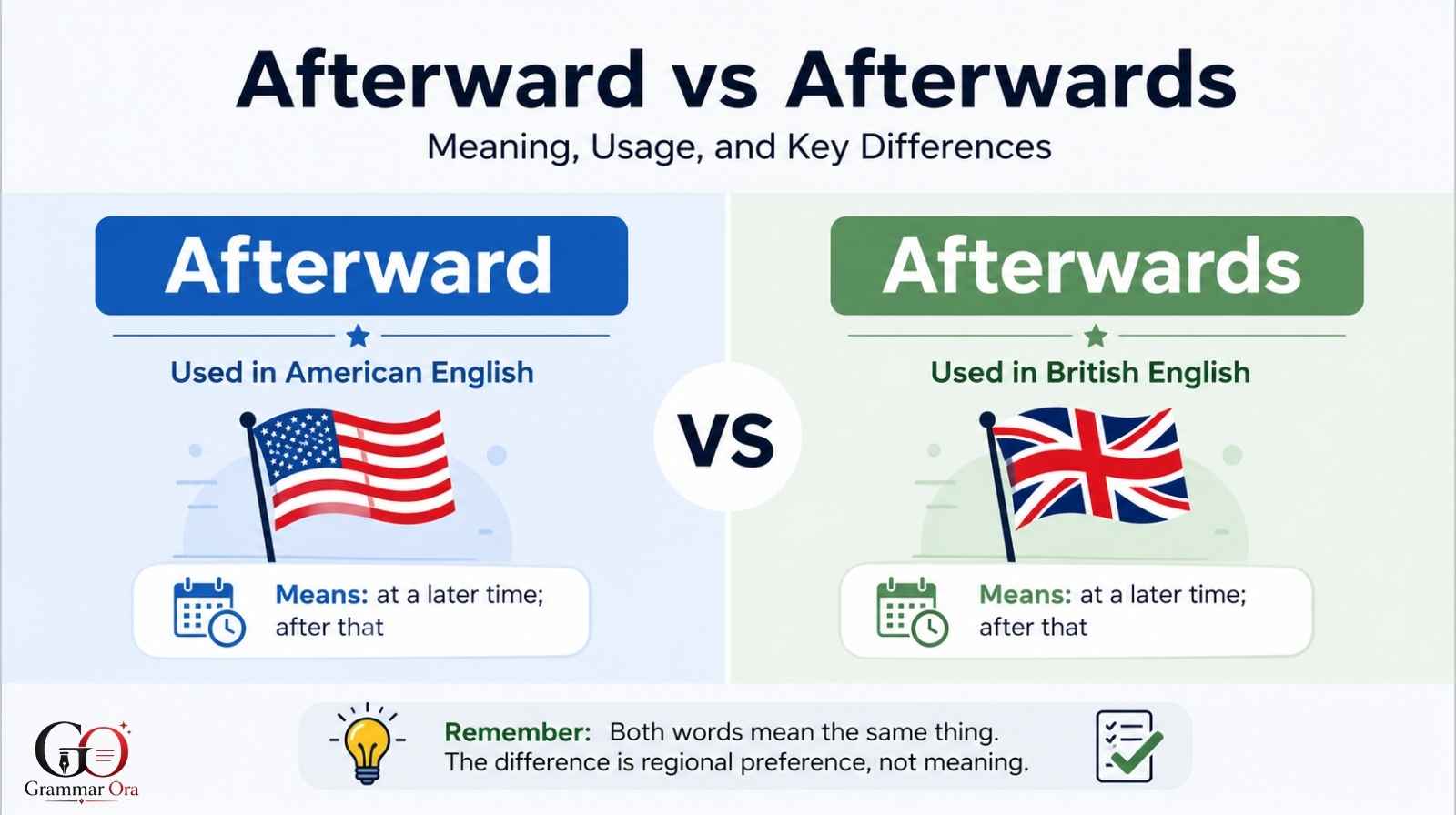
- Afterward is the preferred spelling in American English.
- Afterwards is the preferred spelling in British English.
Both words are adverbs that mean:
- Later
- At a later time
- Following an event
Neither spelling changes the meaning of the sentence.
Afterward Meaning
Afterward means later or at a later time.
Examples:
- We went to dinner, and afterward we watched a movie.
- Finish your homework first. You can play afterward.
- She apologized afterward.
Afterwards Meaning
Afterwards carries exactly the same meaning but is more common in British English.
Examples:
- We visited the museum and afterwards had lunch.
- He called me afterwards.
- They left shortly afterwards.
Is One More Correct Than the Other?
No.
Both spellings are considered grammatically correct.
The only difference is where they’re commonly used.
| English Variety | Preferred Spelling |
|---|---|
| American English | Afterward |
| British English | Afterwards |
| Canadian English | Both (Afterwards is slightly more common) |
| Australian English | Afterwards |
Tip: Use one spelling consistently throughout your article, essay, or report.
Afterward vs Afterwards in American and British English
American English
Most American newspapers, universities, businesses, and style guides recommend afterward.
Examples:
- We met afterward to discuss the results.
- Call me afterward.
British English
British publications usually favor afterwards.
Examples:
- We had tea afterwards.
- She spoke afterwards.
Which Should International Writers Use?
If your audience is mainly American, choose afterward.
If you’re writing for the UK, Australia, or many international readers, afterwards often feels more natural.
The key is consistency.
Common Examples of Afterward vs Afterwards
Here are everyday examples showing both versions.
| Afterward | Afterwards |
|---|---|
| I’ll see you afterward. | I’ll see you afterwards. |
| We talked afterward. | We talked afterwards. |
| He left afterward. | He left afterwards. |
| They celebrated afterward. | They celebrated afterwards. |
| Read the instructions afterward. | Read the instructions afterwards. |
Notice that only the spelling changes not the meaning.
Common Mistakes to Avoid
Many learners make these mistakes.
Mixing American and British English
❌ The report uses American spelling but ends with “afterwards.”
✔ Keep your language style consistent.
Thinking One Is Wrong
Some people assume the version with -s is incorrect.
It isn’t.
Both are accepted by dictionaries.
Using Them as Adjectives
These words are adverbs, not adjectives.
Correct:
- We talked afterward.
Incorrect:
- The afterward meeting.
Real-Life Example: Why Consistency Matters
Emma, a freelance content writer in Canada, regularly created blog posts for clients in both the United States and the United Kingdom. Early in her career, she often mixed American and British spellings within the same article. For example, she wrote color, organize, and afterwards in one post, then switched to afterward in another paragraph.
Although the information was accurate, one of her U.S.-based clients requested revisions because the writing didn’t match their brand’s American English style guide. Another UK client later asked her to replace every instance of afterward with afterwards to keep the article consistent with British English.
After adopting separate editing checklists for American and British projects, Emma significantly reduced revision requests. Her editors also noted that the articles appeared more professional and trustworthy because the language style remained consistent from beginning to end.
The lesson is simple: both words are correct, but choosing the spelling that matches your audience improves readability, professionalism, and user experience.
Afterward vs Afterwards: Quick Checklist
Before publishing, ask yourself:
- ✔ Who is my target audience?
- ✔ Am I writing in American English?
- ✔ Am I writing in British English?
- ✔ Have I used the same spelling throughout?
- ✔ Does my style match the rest of the document?
If the answer is yes, you’re using the correct version.
Language Usage Statistics (2025–2026)
Recent language trends continue to show a clear regional preference rather than a difference in meaning.
- Afterward remains the dominant spelling in American English publications.
- Afterwards continues to be the preferred form in British English newspapers, educational materials, and publishing.
- Search interest for both spellings remains steady because learners frequently compare them before writing.
- Style guides consistently recommend matching the spelling to your chosen variety of English instead of treating one as universally correct.
These patterns reflect current usage across digital publishing, education, and professional writing through 2025–2026.
FAQs
Q1: Is afterward grammatically correct?
A: Yes. Afterward is completely correct and is the preferred spelling in American English.
Q2: Is afterwards incorrect?
A: No. Afterwards is equally correct and is preferred in British English.
Q3: Which is more common?
A: It depends on the country. Americans generally use afterward, while British speakers usually write afterwards.
Q4: Can I use both in one article?
A: It’s better not to. Choose one spelling and stay consistent.
Q5: Does adding “s” change the meaning?
A: No. The meaning stays exactly the same.
Q6: Which spelling should I use for SEO?
A: Use the version your audience searches for. If your readers are primarily in the U.S., afterward is usually the better choice. For UK audiences, afterwards is more appropriate.
Conclusion
The debate over afterward vs afterwards is much simpler than it appears. Both words mean later or at a later time, and both are grammatically correct. The only real difference is regional preference: afterward is standard in American English, while afterwards is favored in British English.
If you’re writing for a specific audience, match their variety of English and use the same spelling consistently throughout your content. Doing so will make your writing look more polished, professional, and trustworthy.
👉 Discover more simple and practical grammar guides on Grammar Ora

Muhammad Bilal is an expert blogger in Grammar Guide, dedicated to simplifying English grammar and helping learners write and speak with clarity, confidence, and accuracy.