Have you ever paused while writing because you weren’t sure whether to use well deserved or well-deserved?
You’re not alone. This small punctuation difference confuses students, bloggers, professionals, and even experienced writers. While both forms are correct, they are not always interchangeable. Using the wrong version can make your writing look less polished and even change how a sentence reads.
In this guide, you’ll learn the difference between well deserved or well-deserved, discover the grammar rule behind each form, see plenty of real-life examples, avoid common mistakes, and know exactly which version to use every time.
What Is the Difference Between Well Deserved and Well-Deserved?
The difference comes down to how the phrase functions in a sentence.
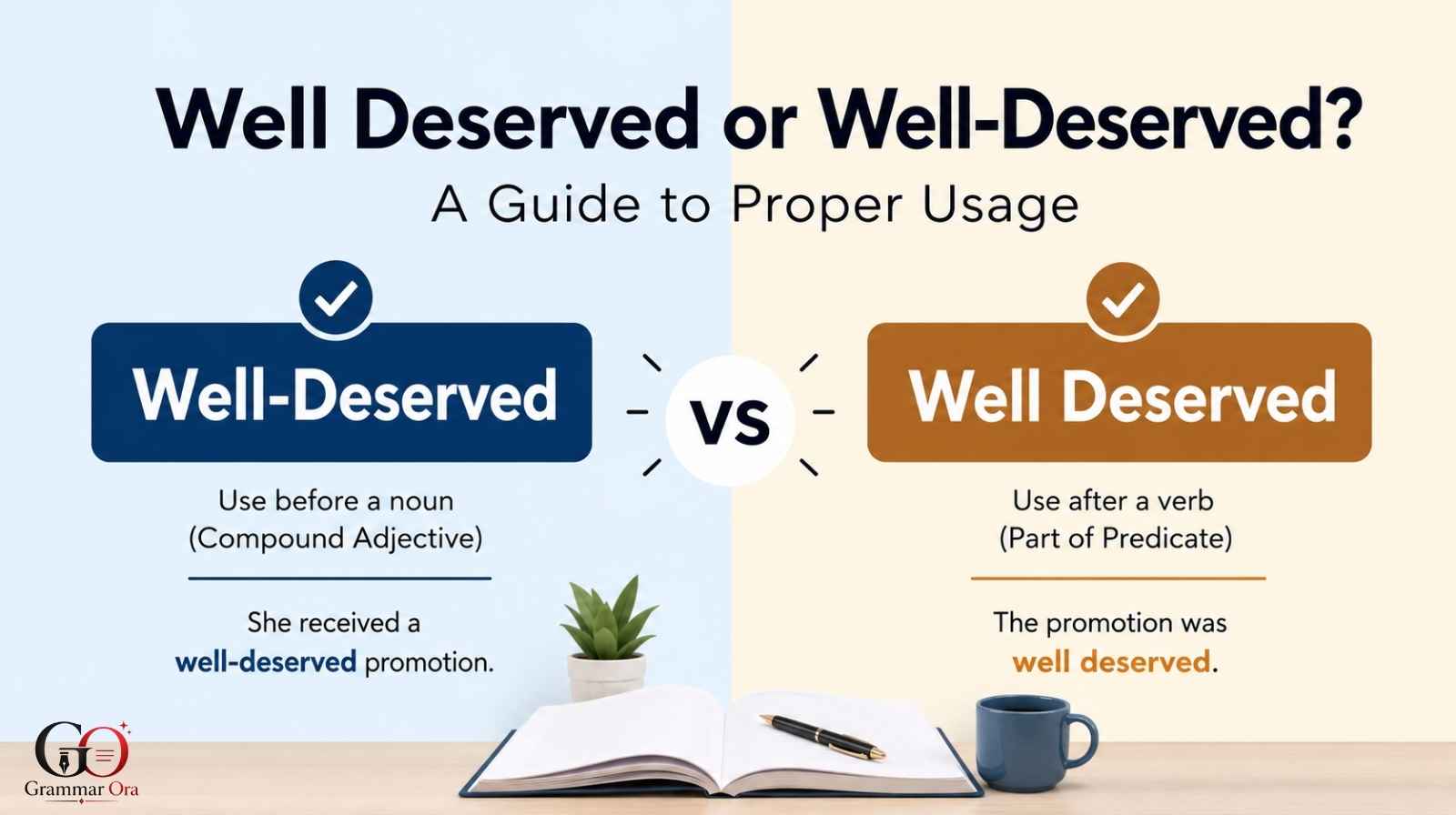
- Well-deserved (with a hyphen) is used as a compound adjective before a noun.
- Well deserved (without a hyphen) is used after the verb or when the phrase acts as a description rather than directly modifying a noun.
Although both versions have the same meaning, proper punctuation depends on sentence structure.
Quick Answer
| Form | Usage | Example |
|---|---|---|
| Well-deserved | Before a noun (compound adjective) | She received a well-deserved promotion. |
| Well deserved | After a verb | The promotion was well deserved. |
This simple rule works in almost every situation.
Is “Well-Deserved” the Correct Hyphenated Form?
Yes.
Use well-deserved whenever it appears before a noun because the two words work together as one adjective.
Examples
- They enjoyed a well-deserved vacation.
- He earned a well-deserved award.
- Everyone gave her a well-deserved standing ovation.
- The team celebrated a well-deserved victory.
- She finally got a well-deserved break.
Why the Hyphen Matters
Without the hyphen, readers may briefly interpret “well” and “deserved” separately. The hyphen signals that both words combine to describe the noun as a single idea.
When Should You Use “Well Deserved” Without a Hyphen?
When the phrase appears after the noun or after a linking verb, the hyphen is generally unnecessary.
Examples
- His promotion was well deserved.
- The praise was well deserved.
- Their success is well deserved.
- The recognition was truly well deserved.
- Every compliment she received was well deserved.
H3: Remember This Easy Rule
If you can place the phrase before a noun, use the hyphen.
If it comes after the verb, don’t use one.
Grammar Rule for Well Deserved vs. Well-Deserved
English grammar follows a common rule for compound modifiers.
Two or more words working together before a noun are often hyphenated to improve clarity.
Examples include:
- long-term project
- full-time job
- high-quality product
- well-known author
- well-deserved reward
However, when these expressions appear after the noun, many of them lose the hyphen.
Compare:
- A well-known actor
- The actor is well known
- A well-deserved honor
- The honor is well deserved
This pattern appears throughout English writing and helps maintain consistency.
Common Examples in Everyday English
You’ll frequently see these expressions in emails, news articles, workplaces, schools, and everyday conversations.
Correct Examples
- Congratulations on your well-deserved success.
- She received a well-deserved promotion.
- The applause was well deserved.
- Their championship win was well deserved.
- Enjoy your well-deserved rest.
- The award was certainly well deserved.
- He earned a well-deserved reputation.
- Everyone agreed the recognition was well deserved.
Common Incorrect Examples
❌ She received a well deserved promotion.
✅ She received a well-deserved promotion.
❌ He earned a well deserved award.
✅ He earned a well-deserved award.
Real-Life Example: How This Grammar Rule Improves Professional Writing
Imagine Sarah, a marketing manager, is preparing an email announcing that one of her colleagues has been promoted after leading several successful projects. She writes:
Congratulations to David on his well deserved promotion.
The message is warm and positive, but the missing hyphen makes the phrase slightly less polished. Since well deserved appears directly before the noun promotion, standard English style recommends writing well-deserved promotion.
After proofreading, Sarah updates the sentence:
Congratulations to David on his well-deserved promotion.
The revised version immediately looks more professional and aligns with the conventions followed by major newspapers, publishers, and business organizations. Small punctuation choices like this may seem insignificant, but they help create clear, credible writing. Whether you’re drafting workplace emails, academic papers, LinkedIn posts, or blog articles, using the correct form shows attention to detail and strengthens your communication. It’s one of those grammar rules that readers may not consciously notice when it’s correct but they often notice when it’s not.
Common Mistakes to Avoid
Many writers make the same errors repeatedly.
Forgetting the Hyphen Before a Noun
Incorrect:
- She earned a well deserved award.
Correct:
- She earned a well-deserved award.
Adding a Hyphen After the Verb
Incorrect:
- The award was well-deserved.
Preferred:
- The award was well deserved.
Being Inconsistent
Choose the correct form based on sentence structure instead of using one version everywhere.
Consistency improves readability and professionalism.
Usage Checklist
Before publishing your writing, ask yourself:
- Is the phrase before a noun? → Use well-deserved.
- Is it after a verb? → Use well deserved.
- Does the sentence sound natural when read aloud?
- Have you been consistent throughout your document?
- Did you proofread for other compound adjectives?
Following this checklist helps eliminate one of the most common punctuation mistakes in English.
What Style Guides Recommend
Major English style guides generally recommend hyphenating compound modifiers before nouns while avoiding unnecessary hyphens after linking verbs.
This approach is widely followed in professional publishing, journalism, education, and business writing. Whether you’re writing for school, work, or online content, following this convention makes your writing clearer and easier to read.
Why Correct Hyphenation Matters in Modern Writing (2025–2026)
Clear grammar plays a growing role in digital communication. Businesses, educators, and publishers increasingly rely on readability standards to produce content that is easy for both readers and search engines to understand.
According to Google’s Search Quality guidance, content should prioritize clarity, accuracy, and helpfulness. Likewise, readability experts continue to emphasize that correct punctuation improves comprehension and reduces ambiguity, especially in professional and educational writing. Properly using forms like well-deserved contributes to polished, trustworthy content that aligns with modern writing standards.
Sources:
- Google Search Central – Helpful Content Guidelines
- Merriam-Webster Dictionary
- The Chicago Manual of Style
FAQs
Q1: Is well deserved one word?
A: No. It is never written as one word. The correct forms are well deserved and well-deserved, depending on sentence structure.
Q2: Is well-deserved grammatically correct?
A: Yes. Use well-deserved when it appears before a noun.
Q3: Why is there a hyphen in well-deserved?
A: The hyphen joins two words into a compound adjective that modifies a noun.
Q4: Can I write “the award was well-deserved”?
A: Many readers will understand it, but most style guides prefer the award was well deserved without the hyphen after the verb.
Q5: Is well deserved formal English?
A: Yes. Both forms are standard English when used correctly.
Q6: Does American and British English use the same rule?
A: Yes. Both varieties generally follow the same hyphenation rule for compound adjectives.
Conclusion
Knowing when to write well deserved or well-deserved is easier than it first appears. The rule is simple: use well-deserved before a noun and well deserved after a verb. Following this grammar pattern makes your writing clearer, more professional, and consistent with modern English style guides.
Whether you’re writing emails, articles, resumes, academic papers, or social media posts, applying this small punctuation rule will help your writing look polished and credible. The next time you congratulate someone on a well-deserved achievement or say their success was well deserved, you’ll know you’ve chosen the correct form with confidence.
👉 Discover more simple and practical grammar guides on Grammar Ora

Muhammad Bilal is an expert blogger in Grammar Guide, dedicated to simplifying English grammar and helping learners write and speak with clarity, confidence, and accuracy.