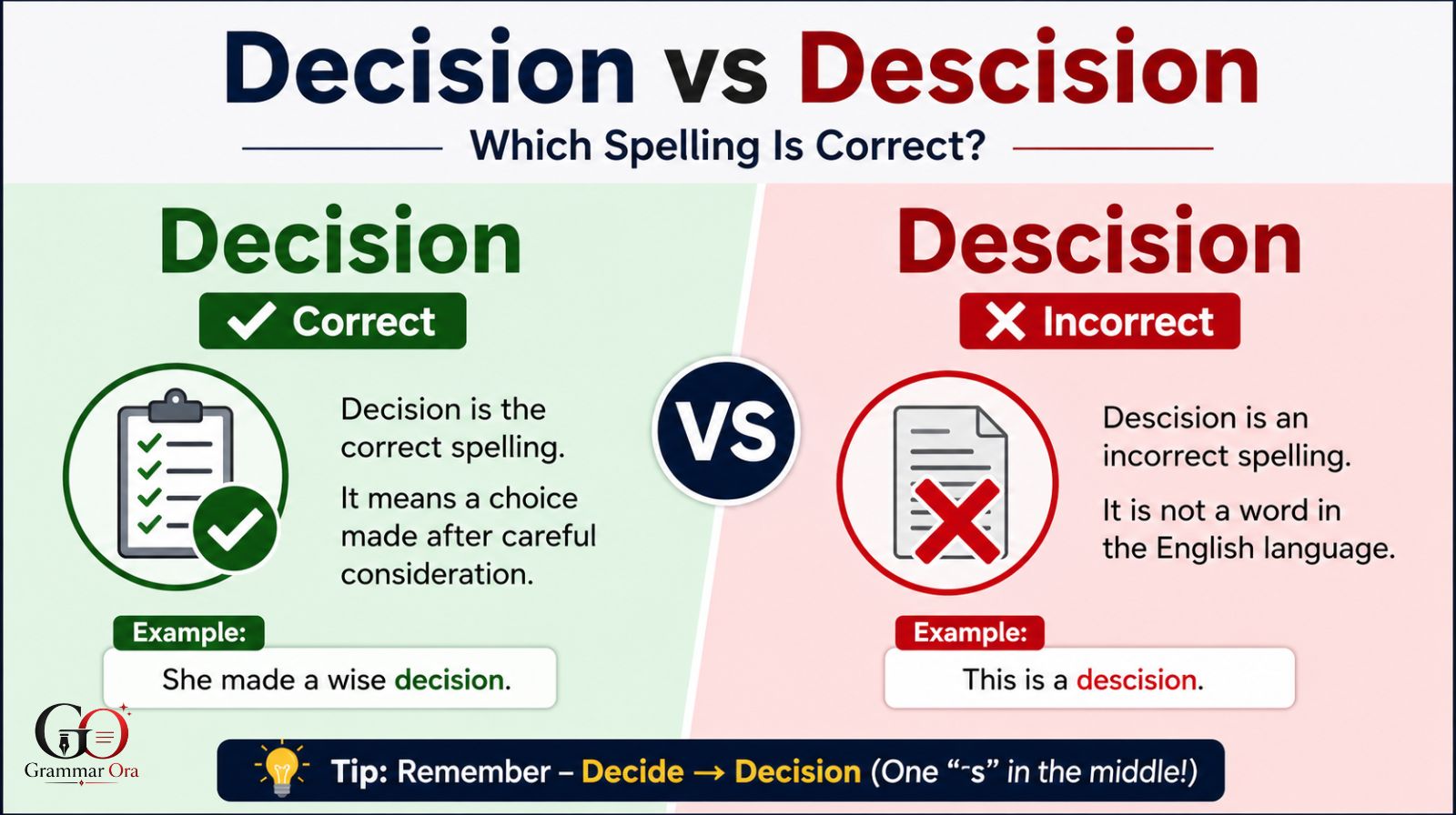
Have you ever paused while writing because you weren’t sure whether to use decision vs descision? You’re not alone. This is one of the most common English spelling mistakes because the word’s pronunciation can make it seem like there’s an extra “s” in the middle.
The good news is that the answer is simple: decision is the correct spelling, while descision is always a misspelling. In this guide, you’ll learn why people make this mistake, how to remember the correct spelling, and how to use decision confidently in everyday writing.
Decision or Descision: Which Is Correct?
The Correct Spelling Is Decision
The only correct English spelling is decision.
Definition: A decision is a choice or conclusion reached after thinking about different options.
Examples:
- Making the right decision takes time.
- Her decision changed the company’s future.
- I respect your decision to study abroad.
Is Descision a Word?
No.
Descision is not an English word. It is simply a spelling mistake that appears because many people hear an extra “s” sound when the word is spoken.
Correct: Decision ✅
Incorrect: Descision ❌
Why Do People Misspell “Decision”?
English spelling doesn’t always match pronunciation.
The word decision is pronounced something like:
/dɪˈsɪʒən/
Because speakers hear the “si” sound clearly, many accidentally insert another s, creating descision.
Other reasons include:
Fast Typing
People often type quickly and don’t notice the extra letter.
Pronunciation Confusion
The spoken sound can make the spelling seem different from the written form.
Lack of Familiarity
Learners who don’t frequently write formal English may rely on pronunciation instead of memorized spelling.
Decision Meaning Explained
A decision is the final choice someone makes after considering different possibilities.
It can refer to:
- Personal choices
- Business decisions
- Legal rulings
- Government policies
- Medical recommendations
- Academic choices
Everyday Examples
- She made a difficult decision about her career.
- The judge announced the final decision.
- Our team’s decision improved the project.
Decision vs Descision Comparison
| Feature | Decision | Descision |
|---|---|---|
| Correct English word | ✅ Yes | ❌ No |
| Found in dictionaries | ✅ Yes | ❌ No |
| Accepted in academic writing | ✅ Yes | ❌ Never |
| Used in professional documents | ✅ Yes | ❌ No |
| Recommended spelling | ✅ Always | ❌ Never |
Real-Life Example: How One Spelling Mistake Changed a First Impression
Sarah was applying for a marketing position at a multinational company. She carefully prepared her resume and wrote a professional cover letter highlighting her skills. In one sentence, she wrote, “I am confident in my descision to pursue digital marketing.”
Although the rest of her application was strong, the hiring manager noticed the spelling mistake immediately. Since communication skills were important for the role, the typo created an impression that Sarah hadn’t proofread her work carefully.
Before submitting applications again, Sarah started using spell-check tools and reviewed commonly confused words like decision, necessary, and separate. She corrected the spelling and resubmitted future applications with greater confidence.
The experience taught her that even a single spelling error can influence how others perceive professionalism. While one typo may not always determine an outcome, consistently using correct spelling builds trust and credibility in academic, business, and personal writing.
2025–2026 Data: Why Correct Spelling Still Matters
Accurate spelling remains important despite advances in AI-powered writing assistants.
Recent language and workplace research highlights that:
- Most employers continue to view spelling accuracy as a sign of professionalism.
- Search engines reward high-quality, error-free content because it improves user experience.
- Students who regularly proofread assignments generally receive fewer language-related deductions.
- Digital writing tools have reduced spelling mistakes, but human proofreading remains essential for catching context-specific errors.
These findings reinforce a simple rule: learning the correct spelling of common words like decision improves clarity, credibility, and confidence in every type of writing.
How to Remember the Correct Spelling
Think of the Root Word
Decision comes from the verb decide.
Decide → Decision
Since decide contains only one s, decision does too.
Remember This Phrase
Decide first, then make a decision.
Both words share the same spelling pattern.
Practice in Sentences
Writing the word several times helps build long-term memory.
Common Mistakes to Avoid
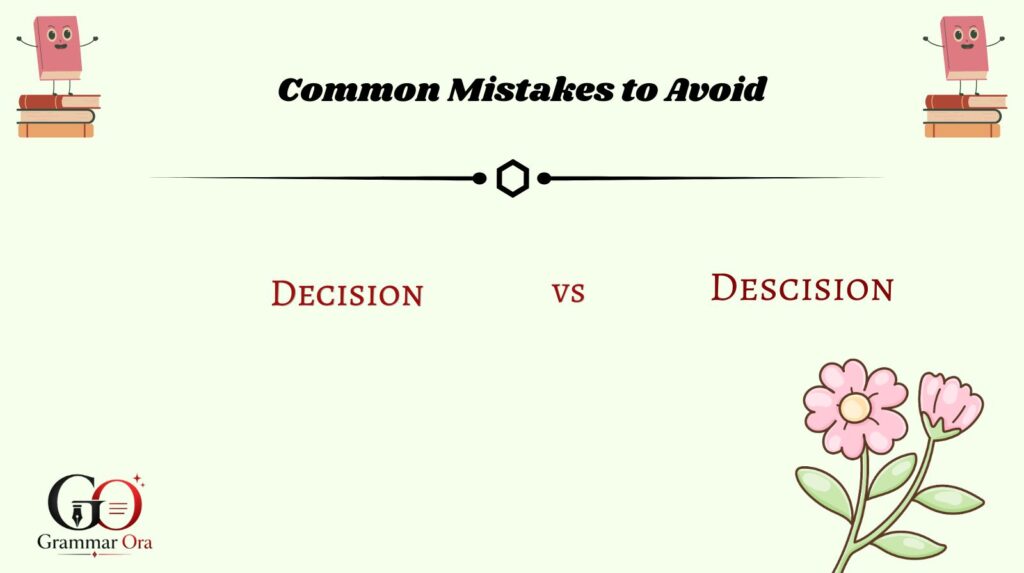
Adding an Extra “S”
❌ Descision
✅ Decision
Mixing It With Similar Words
People also confuse:
- Separate vs Seperate
- Receive vs Recieve
- Occasion vs Ocassion
- Successful vs Succesful
Learning these commonly misspelled words together improves overall writing accuracy.
FAQs
Q1: Is descision a real English word?
A: No. It is simply a misspelling of decision.
Q2: Which spelling should I use?
A: Always use decision.
Q3: Why do people write descision?
A: Because pronunciation makes it sound like there’s an extra “s.“
Q4: Is decision used in British and American English?
A: Yes. Both varieties spell it exactly the same way.
Q5: What part of speech is decision?
A: It is a noun.
Q6: What is the verb form of decision?
A: The verb is decide.
Q7: Can spell check detect descision?
A: Most modern spell checkers automatically identify descision as incorrect and suggest decision.
Conclusion
When comparing decision vs descision, there’s only one correct answer: decision is the proper English spelling, while descision is always incorrect. Remember that decision comes from the verb decide, making it easier to remember the correct spelling.
Whether you’re writing an email, an essay, or a professional report, using the correct word helps you communicate clearly and confidently.
For better writing, make proofreading a habit and double-check commonly confused words before publishing or submitting your work.
👉 Discover more simple and practical grammar guides on Grammar Ora

Muhammad Bilal is an expert blogger in Grammar Guide, dedicated to simplifying English grammar and helping learners write and speak with clarity, confidence, and accuracy.


