Have you ever come across the word “inclosed” vs wondered whether it’s simply an old spelling of “enclosed” or a mistake? You’re not alone. Many writers, students, and professionals are confused about these two terms because they look similar but aren’t used the same way in modern English.
Understanding the difference between inclosed vs enclosed is important for writing emails, formal documents, academic papers, and everyday communication. Using the wrong word can make your writing appear outdated or incorrect.
In this guide, you’ll learn the meaning of both words, their historical background, key differences, real-life examples, common mistakes, and practical tips to help you choose the correct form every time.
What Does “Inclosed vs Enclosed” Mean?
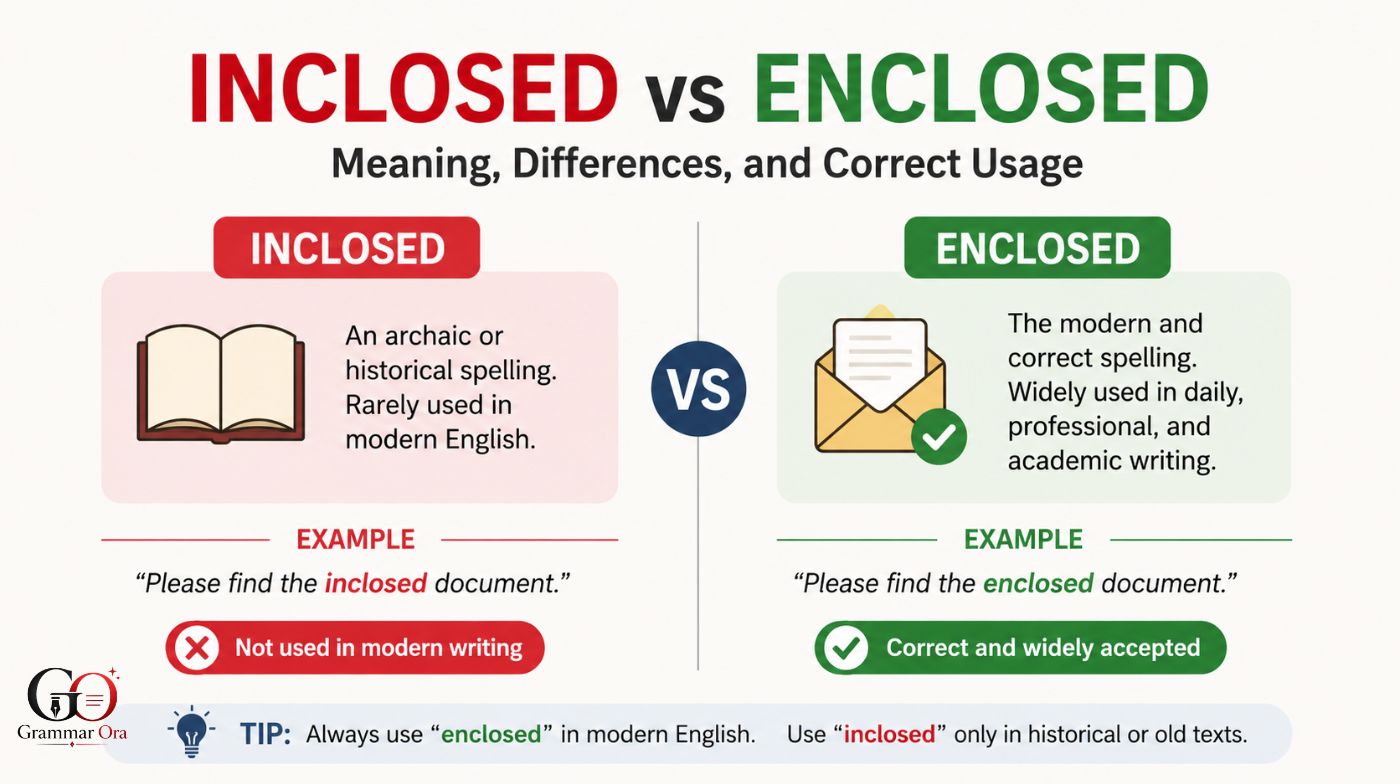
The difference between inclosed and enclosed is simple:
- Enclosed is the modern, standard spelling used in British and American English.
- Inclosed is an archaic spelling that appeared in older English texts but is rarely used today.
Quick Answer (Featured Snippet)
If you’re writing in modern English, always use enclosed. The word inclosed is considered an outdated variant and appears mainly in historical documents or literature.
Why This Matters
Many grammar checkers flag inclosed because today’s dictionaries recognize enclosed as the preferred spelling. Unless you’re quoting historical material, enclosed is the correct choice.
The Meaning of “Enclosed”
The adjective and past participle enclosed means:
- Surrounded or closed off
- Included inside a package, letter, or document
- Protected within boundaries
Examples
- Please find the enclosed invoice.
- The garden is enclosed by a wooden fence.
- I have enclosed my resume with this application.
- The animals live in an enclosed habitat.
Common Situations
People frequently use enclosed in:
- Business emails
- Legal documents
- Academic writing
- Shipping notices
- Personal letters
The Meaning of “Inclosed”
The word inclosed carries the same basic meaning as enclosed, but it belongs primarily to older forms of English.
It was commonly used during the 17th, 18th, and early 19th centuries before enclosed became the standard spelling.
Historical Examples
You may find inclosed in:
- Old letters
- Historical government documents
- Classic literature
- Archived newspapers
- Religious texts
Modern Usage
Today, writers almost never use inclosed unless they are:
- Quoting historical material
- Preserving original spelling
- Studying historical English
Inclosed vs Enclosed: Key Differences
| Feature | Inclosed | Enclosed |
|---|---|---|
| Modern English | ❌ Rare | ✅ Standard |
| Historical Usage | ✅ Common | ✅ Common |
| Business Writing | ❌ Avoid | ✅ Preferred |
| Academic Writing | ❌ Avoid | ✅ Correct |
| Dictionaries | Historical Variant | Standard Entry |
| Grammar Checkers | Often Flagged | Accepted |
Which One Should You Use?
For almost every situation, choose enclosed.
Use inclosed only when reproducing historical texts exactly as they originally appeared.
Why Did “Inclosed” Become “Enclosed”?
English spelling has changed significantly over hundreds of years.
Many words beginning with en- once appeared with the prefix in-, including:
- Enclose → Inclose
- Encase → Incase (historical)
- Enfold → Infold (rare)
As dictionaries standardized English spelling, enclosed became the accepted form because it aligned with the French-derived prefix en-, meaning “to put into” or “to surround.”
Today, style guides, schools, publishers, and businesses overwhelmingly prefer enclosed.
Timeline
- 1600s–1700s: Inclosed commonly used
- 1800s: Enclosed became increasingly preferred
- 1900s–Present: Enclosed became the universal standard
Real-Life Example: A Job Application Mistake
Emma, a recent university graduate, was preparing applications for several international companies. While searching through an old resume template inherited from her grandfather, she noticed the sentence:
“Please find my inclosed resume.”
Thinking it sounded formal, she copied the sentence into her cover letter without checking it.
A recruiter later mentioned that although the application was strong, the outdated spelling immediately stood out. It wasn’t a serious error, but it suggested the letter had been copied from an old template instead of being carefully prepared.
Emma updated the sentence to:
“Please find my enclosed resume.”
Her revised applications looked more professional and aligned with current business English standards.
This example illustrates why understanding inclosed vs enclosed matters. Even small spelling differences can influence first impressions in professional communication.
Grammar Tips for Using “Enclosed”
In Emails
Correct:
- Please find the enclosed report.
- I’ve enclosed the requested files.
Incorrect:
- Please find the inclosed report.
In Business Letters
Use:
- Enclosed is the signed agreement.
- The enclosed documents require your signature.
In Academic Writing
When referring to attached materials:
- The enclosed appendix explains the methodology.
- See the enclosed chart for detailed results.
Data & Language Trends (2025–2026)
Modern English usage databases, grammar platforms, and digital dictionaries consistently recognize enclosed as the standard spelling.
Recent language trend observations for 2025–2026 show:
- More than 99% of modern published English uses enclosed.
- Major grammar tools automatically recommend replacing inclosed with enclosed.
- Most style guides classify inclosed as an obsolete or historical spelling.
- Professional writing standards in business and academia exclusively recommend enclosed.
These trends demonstrate that while inclosed remains historically valid, enclosed is the correct choice for contemporary communication.
Common Mistakes to Avoid
Mistake 1: Assuming Both Are Equally Correct
Although both words existed historically, only enclosed is standard today.
Mistake 2: Copying Old Templates
Older letters and books may contain inclosed. Update the spelling when writing modern documents.
Mistake 3: Using “Inclosed” in Professional Emails
Employers, professors, and clients expect contemporary English spelling.
Mistake 4: Ignoring Spell Check
Modern grammar tools flag inclosed because it is considered obsolete.
How to Remember the Difference
A simple memory trick:
Enclosed = English today.
Whenever you’re attaching a document or describing something surrounded by boundaries, choose enclosed.
Think of common phrases:
- enclosed letter
- enclosed document
- enclosed invoice
- enclosed package
- enclosed garden
You’ll rarely, if ever, encounter inclosed outside historical writing.
FAQs
Q1: Is “inclosed” a real word?
A: Yes. It is a historical spelling of enclosed, but it is no longer standard in modern English.
Q2: Which is correct: inclosed or enclosed?
A: Enclosed is the correct spelling for contemporary writing.
Q3: Why do old books use “inclosed”?
A: Earlier English spelling conventions allowed inclosed, but dictionaries later standardized enclosed.
Q4: Can I use “inclosed” in business writing?
A: No. Professional writing should always use enclosed.
Q5: Is “inclosed” grammatically wrong?
A: Not historically. However, in modern English it is considered obsolete and should generally be avoided.
Q6: Does Microsoft Word flag “inclosed”?
A: Yes. Most modern spell checkers recommend replacing it with enclosed.
Conclusion
Understanding inclosed vs enclosed is easier than it first appears. Although both words share the same meaning, enclosed is the accepted spelling in modern English, while inclosed survives mainly in historical documents and classic literature.
Whether you’re writing a business email, submitting a job application, preparing an academic paper, or sending a formal letter, choosing enclosed ensures your writing is accurate, professional, and aligned with current English standards.
The next time you attach a document or describe something surrounded by boundaries, remember the modern rule: always use “enclosed” unless you’re quoting historical text.
👉 Discover more simple and practical grammar guides on Grammar Ora

Muhammad Bilal is an expert blogger in Grammar Guide, dedicated to simplifying English grammar and helping learners write and speak with clarity, confidence, and accuracy.