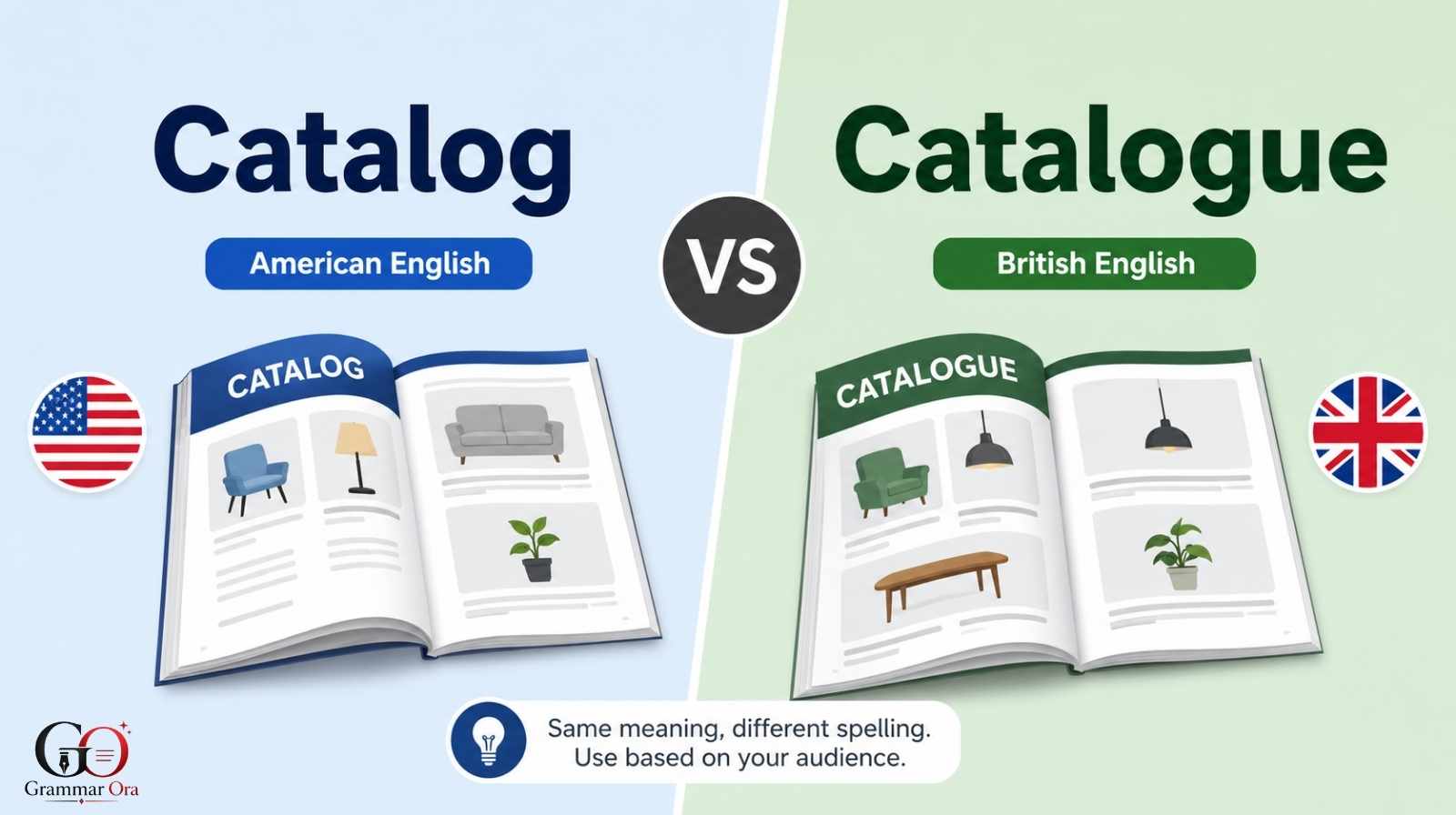
Have you ever wondered whether you should write catalog vs catalogue? If you’ve seen both spellings online, in books, or on shopping websites, you’re definitely not alone. Many English learners, writers, and even native speakers get confused because both words appear to be correct.
The good news is that both “catalog” vs “catalogue” are correct spellings. The difference isn’t about meaning it’s mainly about regional English usage. American English usually prefers catalog, while British English commonly uses catalogue.
In this guide, you’ll learn the difference between catalog vs catalogue, discover when to use each spelling, see real-world examples, avoid common mistakes, and choose the correct version confidently.
What Is the Difference Between Catalog and Catalogue?
The simplest answer is this:
| Catalog | Catalogue |
|---|---|
| Preferred in American English | Preferred in British English |
| Common in the US and Canada | Common in the UK, Australia, and many Commonwealth countries |
| Meaning is identical | Meaning is identical |
Both words refer to:
- A list of products
- A collection of books or records
- A directory of information
- An organized inventory
The Meaning Is Exactly the Same
Whether you write catalog or catalogue, you’re referring to an organized list of items, products, services, books, or information.
For example:
- The company released its new catalog.
- The company released its new catalogue.
Both sentences are completely correct.
Catalog vs Catalogue in American and British English
Regional spelling differences explain why both versions exist.
American English
American English simplified many spellings over time.
Examples include:
- Color
- Favor
- Honor
- Catalog
Most American publishers, businesses, universities, and online stores use catalog.
Example:
You can browse our online catalog before placing an order.
British English
British English has traditionally retained French-influenced spellings.
Examples include:
- Colour
- Favour
- Honour
- Catalogue
Example:
The museum published a detailed exhibition catalogue.
Which One Does Google Prefer?
Google doesn’t prefer one spelling over the other.
Instead, Google matches content with the audience’s location and search behavior.
For example:
- US users usually search catalog
- UK users often search catalogue
If your audience is international, either spelling is acceptable as long as you’re consistent throughout your article.
What Does Catalog or Catalogue Mean?
A catalog is an organized list containing information about products, services, books, artworks, courses, or other items.
It may appear in printed or digital form.
Common Types of Catalogs
- Product catalogs
- Online shopping catalogs
- Library catalogs
- Course catalogs
- Museum catalogs
- Parts catalogs
- Fashion catalogs
Example Sentences
Correct examples:
- I downloaded the latest furniture catalog.
- The university course catalog explains every program.
- The bookstore released its holiday catalogue.
- The museum catalogue contains over 500 artworks.
- Customers can browse our digital catalog online.
Catalog or Catalogue: Which Should You Use?
The best spelling depends on your audience.
Use Catalog If:
- You’re writing for American readers.
- Your website targets the United States.
- Your business follows US English.
- Your style guide uses American spelling.
Example:
“Our spring product catalog is now available.”
Use Catalogue If:
- Your audience is British.
- You’re writing for the UK or Australia.
- Your organization follows British English.
- Your publication uses UK spelling.
Example:
“Our autumn product catalogue is now available.”
The Most Important Rule
Choose one spelling and use it consistently throughout your writing.
Mixing both versions in one article looks unprofessional and may confuse readers.
Common Mistakes to Avoid
Many learners accidentally create incorrect variations.
Avoid these:
❌ Catalouge
❌ Catelog
❌ Catelogue
❌ Cattalog
❌ Cataloge
Correct spellings:
✅ Catalog
✅ Catalogue
Real-Life Example: Why Consistency Matters
A growing eCommerce business based in Canada expanded its online store to customers in both the United States and the United Kingdom. Initially, the company’s website used the word catalog on some pages and catalogue on others because different writers followed different spelling preferences.
As the website grew, customers noticed the inconsistency. While the spelling differences didn’t affect the products themselves, they made the site appear less polished. The marketing team also found that search engine optimization became harder because similar pages targeted different keyword spellings without a clear strategy.
To solve the problem, the company reviewed its audience data. Since nearly 70% of its traffic came from the United States, it standardized every page using catalog. At the same time, it created localized landing pages for UK visitors using catalogue where appropriate. This approach improved consistency, strengthened branding, and made keyword targeting more focused. The lesson was simple: both spellings are correct, but using the version that matches your audience creates a better user experience and a more professional website.
Catalog vs Catalogue Comparison Table
| Feature | Catalog | Catalogue |
|---|---|---|
| Meaning | Organized list | Organized list |
| Correct? | ✅ Yes | ✅ Yes |
| American English | ✅ Standard | Less common |
| British English | Less common | ✅ Standard |
| SEO Usage | US audiences | UK audiences |
| Pronunciation | Same | Same |
Usage Statistics (2025–2026)
Language trends in 2025–2026 continue to show a clear regional preference:
- Catalog remains the dominant spelling in American English, especially on eCommerce platforms, universities, and business websites.
- Catalogue continues to be widely used in the United Kingdom, Australia, and other Commonwealth countries.
- Major online retailers targeting US customers typically use catalog, while UK-based retailers often prefer catalogue.
- Search behavior reflects the same pattern, with users generally searching for the spelling common in their region.
For website owners and content creators, matching your audience’s regional spelling can improve readability, user trust, and keyword relevance.
FAQs
Q1: Is catalog correct?
A: Yes. Catalog is the standard American English spelling.
Q2: Is catalogue wrong?
A: No. Catalogue is the standard British English spelling.
Q3: Do they have different meanings?
A: No. Both words mean exactly the same thing.
Q4: Which spelling should I use for SEO?
A: Use the spelling your target audience searches for. If your readers are mainly in the United States, use catalog. If they are primarily in the United Kingdom or other regions that follow British English, use catalogue.
Q5: Can I use both spellings in one article?
A: It’s better not to. Choose one spelling and remain consistent throughout your content.
Q6: Is catalog used in business writing?
A: Yes. Most American businesses, online stores, and software companies use catalog in their documentation and marketing materials.
Conclusion
Understanding catalog vs catalogue is actually quite simple. Both spellings are correct, both have the same meaning, and neither is more accurate than the other. The only real difference is regional preference catalog is the standard choice in American English, while catalogue is preferred in British English.
When writing, think about your audience first. Use the spelling that matches their expectations, stay consistent throughout your content, and you’ll communicate clearly and professionally. Whether you’re creating a product catalog, organizing a library catalogue, or optimizing content for search engines, choosing the right regional spelling helps build trust with your readers.
👉 Discover more simple and practical grammar guides on Grammar Ora

Muhammad Bilal is an expert blogger in Grammar Guide, dedicated to simplifying English grammar and helping learners write and speak with clarity, confidence, and accuracy.