Have you ever come across the word hisself and wondered whether it is actually correct English? You’re not alone. Many writers, students, and English learners encounter this word in books, conversations, or online discussions and become unsure about its proper usage.
The confusion between hisself vs himself exists because both words seem to serve the same purpose. However, only one is considered standard in modern English grammar.
In this guide, you’ll learn the real difference between hisself vs himself, when each term is used, why the confusion persists, and how to avoid common grammar mistakes. By the end, you’ll know exactly which word belongs in professional, academic, and everyday writing.
What Is the Difference Between Hisself and Himself?
The simplest answer is:
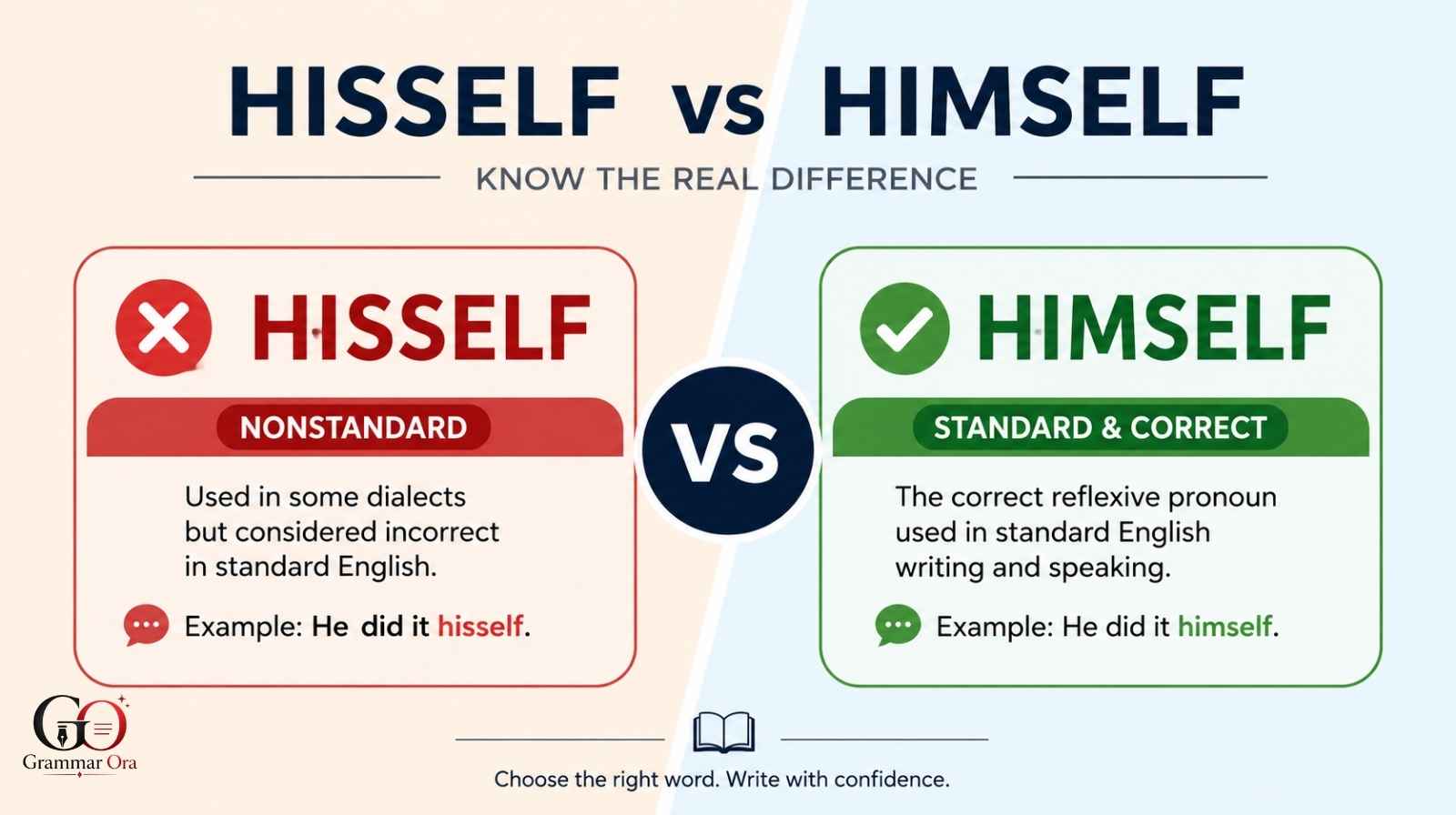
“Himself” is the standard and grammatically correct reflexive pronoun, while “hisself” is considered a nonstandard or dialectal form.
Understanding “Himself”
Himself is the accepted reflexive pronoun used when a male subject performs an action on himself.
Examples of Himself
- He taught himself how to code.
- John blamed himself for the mistake.
- He prepared the presentation himself.
In all these examples, himself follows standard English grammar rules.
Understanding “Hisself”
Hisself developed historically in some regional dialects and varieties of English. While it may appear in spoken language, literature, or dialogue, it is generally considered incorrect in formal writing.
Examples of Hisself
- He fixed it hisself. (Dialectal)
- He told hisself everything would be okay. (Nonstandard)
These examples may reflect regional speech patterns rather than standard grammar.
Why Is “Hisself” Considered Incorrect?
Many people assume that because words like myself, yourself, and herself exist, hisself should also be correct. However, English evolved differently.
Historical Development of Reflexive Pronouns
English reflexive pronouns developed over centuries. The standard forms became:
| Subject Pronoun | Reflexive Pronoun |
|---|---|
| I | myself |
| You | yourself |
| He | himself |
| She | herself |
| We | ourselves |
| They | themselves |
Notice that he → himself does not follow the exact pattern of she → herself.
Language Standardization
As English grammar became standardized through dictionaries, schools, and publishing, himself became the accepted form while hisself remained limited to certain dialects.
Modern Grammar Rules
Today, major style guides and dictionaries classify hisself as:
- Nonstandard English
- Dialectal English
- Informal speech
- Literary dialogue usage
For professional writing, himself should always be used.
Hisself vs Himself: Grammar Rules Every Writer Should Know
Rule #1: Use “Himself” in Standard English
Whenever you’re writing essays, articles, emails, reports, or professional documents, use himself.
Correct Examples
- Michael completed the project by himself.
- He introduced himself to the audience.
- The CEO explained the strategy himself.
Rule #2: Avoid “Hisself” in Formal Writing
Using hisself in academic or business communication may be viewed as a grammatical error.
Incorrect Example
- He completed the project by hisself.
Correct Version
- He completed the project by himself.
Rule #3: “Hisself” May Appear in Dialogue
Writers sometimes intentionally use hisself to reflect regional speech or character identity.
Example
“He’ll do it hisself,” said the old farmer.
In fiction, this can help create authentic dialogue.
Why the Hisself vs Himself Confusion Still Exists
Regional Dialects
Certain English-speaking communities have used hisself for generations. Children exposed to these speech patterns may naturally assume it is correct.
Influence of Similar Pronouns
Words like:
- myself
- yourself
- herself
can make hisself sound logical, even though standard grammar uses himself.
Online Communication
Social media, text messaging, and informal online discussions often prioritize speed over grammar accuracy. As a result, nonstandard forms can spread more easily.
Real-Life Example: How a Small Grammar Mistake Changed a Professional Impression
A marketing assistant applying for a content writing position submitted a portfolio that included the sentence:
“The manager completed the entire campaign hisself.”
Although the candidate had strong writing skills, the hiring manager immediately noticed the grammatical error. During feedback, the employer explained that professional content requires strict adherence to standard English conventions.
The candidate later revised the portfolio and replaced hisself with himself. After correcting several similar mistakes, the portfolio appeared more polished and professional.
This example highlights an important lesson. Grammar mistakes do not always change the meaning of a sentence, but they can affect credibility. Readers often associate correct grammar with expertise and attention to detail. In competitive environments such as education, publishing, and business communication, even a small error can influence how your work is perceived.
Understanding the distinction between hisself vs himself helps writers communicate more clearly and maintain professional standards.
Hisself vs Himself Comparison Table
| Feature | Himself | Hisself |
|---|---|---|
| Grammatically Correct | Yes | No (Standard English) |
| Accepted in Academic Writing | Yes | No |
| Accepted in Professional Writing | Yes | No |
| Common in Dialects | Rarely | Yes |
| Found in Fictional Dialogue | Sometimes | Often |
| Recommended for Modern Writing | Yes | No |
Usage Trends and Language Data (2025–2026)
Language databases and modern style guides continue to recognize himself as the standard reflexive pronoun in English.
According to grammar authorities and major dictionaries:
- Himself appears millions of times in published English content annually.
- Hisself is primarily categorized as dialectal or nonstandard.
- Educational institutions continue teaching himself as the correct form.
- Professional editors consistently replace hisself with himself unless preserving dialect in quoted speech.
These trends show that himself remains the preferred and accepted form in modern English during 2025 and 2026.
How to Remember the Correct Form
Quick Memory Trick
Think of this phrase:
He + himself = correct English
Whenever you’re unsure, remember that standard English uses himself, not hisself.
Easy Practice Method
Replace the sentence with another reflexive pronoun.
Example
- She taught herself.
- He taught himself.
The pattern helps reinforce the correct form.
Proofreading Tip
Before publishing or submitting any document:
- Search for “hisself.”
- Replace it with “himself.”
- Verify whether dialect is intentionally required.
This simple check can eliminate a common grammar error.
FAQs
Q1: Is hisself a real word?
A: Yes. Hisself exists as a dialectal and nonstandard word in some varieties of English, but it is not accepted in standard formal writing.
Q2: Which is correct: hisself or himself?
A: Himself is the grammatically correct form in standard English.
Q3: Can I use hisself in creative writing?
A: Yes. Writers sometimes use hisself in dialogue to represent regional speech or characterize a speaker.
Q4: Why do some people say hisself?
A: It developed in certain dialects and speech communities over time and continues to be used informally in some regions.
Q5: Is hisself considered bad grammar?
A: In formal English, yes. Most teachers, editors, and style guides treat it as a grammatical error.
Q6: Does hisself appear in dictionaries?
A: Many dictionaries include hisself, but they usually label it as nonstandard, dialectal, or informal.
Q7: Should students use hisself in school assignments?
A: No. Students should use himself in academic and professional writing.
Conclusion
Understanding the difference between hisself vs himself is essential for clear and professional communication. While hisself exists as a dialectal form found in some regional speech patterns, himself is the only standard and grammatically correct choice for formal English.
When writing essays, business documents, blog posts, or professional emails, always choose himself. Doing so improves clarity, strengthens credibility, and ensures your writing follows accepted grammar standards.
The next time you encounter hisself vs himself, you’ll know exactly which word belongs in polished English writing and why.
Want to improve your grammar even further? Bookmark this guide and share it with anyone who still gets confused by reflexive pronouns.
👉 Discover more simple and practical grammar guides on Grammar Ora

Muhammad Bilal is an expert blogger in Grammar Guide, dedicated to simplifying English grammar and helping learners write and speak with clarity, confidence, and accuracy.