Have you ever paused while writing and wondered whether you should use allude vs elude? You’re not alone. These two words look and sound somewhat similar, which makes them easy to confuse.
Understanding the difference between Allude vs Elude is important for clear communication, professional writing, and academic success. Although they share a similar pronunciation pattern, their meanings are completely different.
In this guide, you’ll learn what each word means, how to use them correctly, common mistakes to avoid, and simple memory tricks that will help you remember the difference forever.
What Is the Difference Between Allude and Elude?
The simplest way to understand Allude vs Elude is this:
| Word | Meaning | Part of Speech |
|---|---|---|
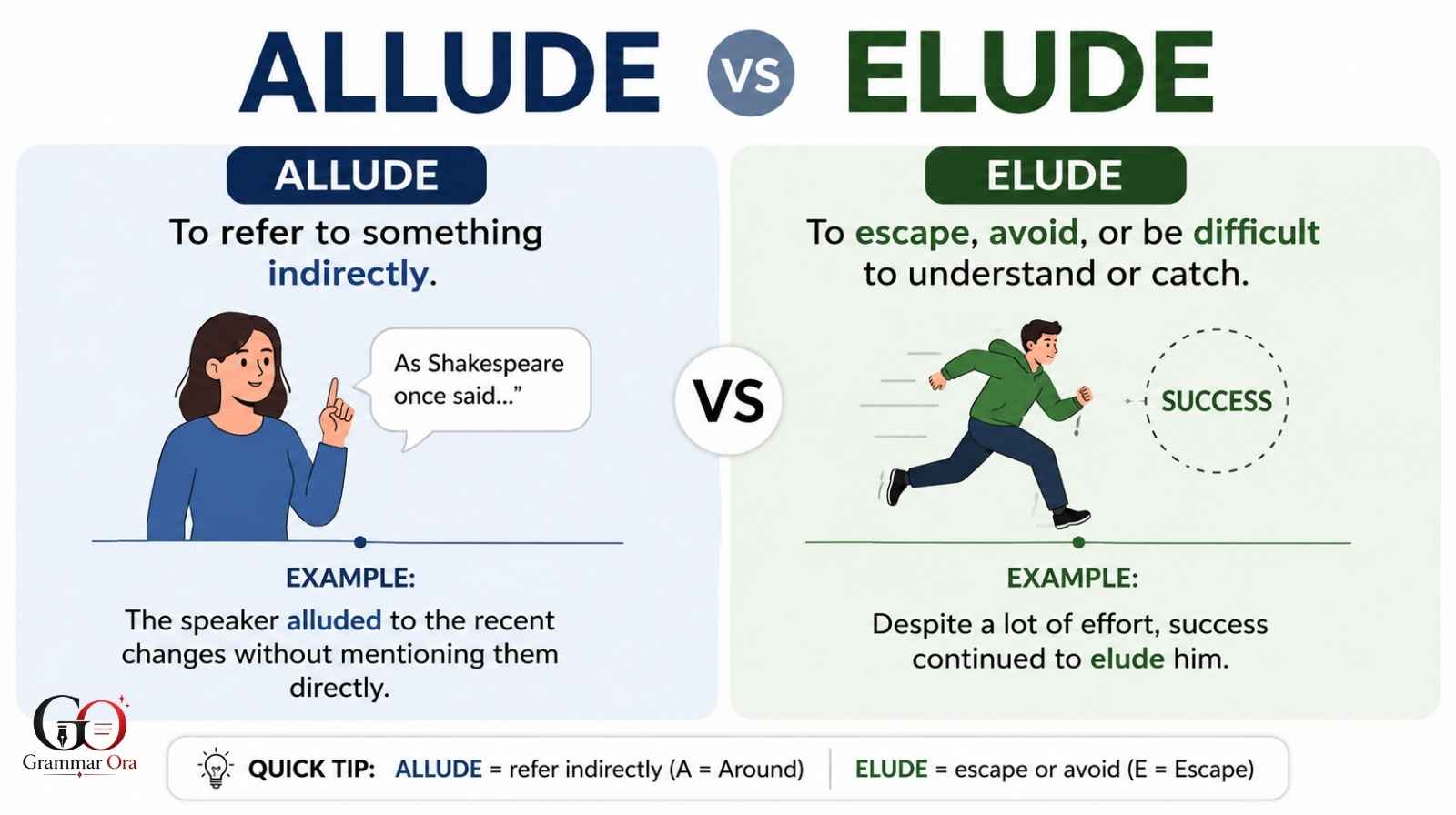
| Allude | To refer to something indirectly | Verb |
| Elude | To escape, avoid, or evade something | Verb |
Example of Allude
When you allude to something, you mention it indirectly without stating it outright.
Example:
“The speaker alluded to recent company changes without mentioning them directly.”
Example of Elude
When something eludes you, it escapes your understanding, capture, or reach.
Example:
“The solution to the puzzle continued to elude me.”
Quick Featured Snippet Answer
Allude means to refer indirectly to something, while elude means to escape, evade, or avoid being understood, found, or captured.
Understanding the Meaning of Allude
The verb allude comes from the Latin word alludere, meaning “to refer to indirectly.”
Writers, speakers, and storytellers frequently use allusions to hint at ideas without explicitly stating them.
Why People Use Allude
Indirect references can:
- Add depth to writing
- Create curiosity
- Connect ideas efficiently
- Reference cultural or historical events
Examples of Allude in Sentences
- She alluded to a previous disagreement during the meeting.
- The article alludes to a famous historical event.
- The teacher alluded to the exam questions without revealing them.
Common Situations Where You Might Allude
Literature
Authors often allude to myths, religious stories, or famous books.
Public Speaking
Speakers may allude to sensitive topics without discussing them directly.
Business Communication
Managers sometimes allude to future plans before making official announcements.
Understanding the Meaning of Elude
Unlike allude, elude focuses on avoidance or escape.
If something eludes you, it remains out of reach physically or mentally.
Common Uses of Elude
People use elude when talking about:
- Escaping capture
- Avoiding detection
- Missing understanding
- Remaining difficult to achieve
Examples of Elude in Sentences
- The suspect managed to elude police for several days.
- Sleep continued to elude her during the stressful week.
- Success may elude those who give up too quickly.
Physical vs Abstract Elusion
Physical Escape
“The fox eluded the hunters.”
Mental Escape
“The meaning of the poem eluded the students.”
Achievement Escape
“Financial freedom continued to elude him.”
Allude vs Elude: Side-by-Side Comparison
Understanding the distinction becomes easier when the words are compared directly.
| Feature | Allude | Elude |
|---|---|---|
| Meaning | Refer indirectly | Escape or avoid |
| Usage | Communication | Avoidance |
| Context | Speaking and writing | Pursuit, understanding, achievement |
| Example | She alluded to the issue. | The answer eluded me. |
| Memory Hint | A = Mention Around | E = Escape |
How to Remember the Difference
A simple memory trick:
Allude = A = Around
You talk around a topic without directly mentioning it.
Elude = E = Escape
Something escapes you or avoids capture.
This quick association helps many writers remember the correct word instantly.
Common Mistakes People Make
Many English learners and even native speakers mix up these words because they sound similar.
Incorrect Usage
❌ “He alluded the police for weeks.”
Correct Usage
✅ “He eluded the police for weeks.”
Incorrect Usage
❌ “The author eluded to Shakespeare.”
Correct Usage
✅ “The author alluded to Shakespeare.”
Why the Confusion Happens
The confusion typically occurs because:
- Both words end with “-lude”
- Both are verbs
- Their pronunciation patterns are similar
- They’re not used in everyday conversation as often as other verbs
Real-Life Writing Example: How a Small Word Choice Changes Meaning
A content editor at a marketing agency once reviewed a client article discussing a product launch. The writer intended to say that company executives indirectly referenced future features during an interview.
The original sentence read:
“The CEO eluded to several upcoming improvements.”
Although the sentence looked acceptable at first glance, the meaning was incorrect. Readers familiar with the language immediately noticed the mistake because elude means “escape” or “avoid.”
The corrected sentence became:
“The CEO alluded to several upcoming improvements.”
This small correction dramatically improved clarity and professionalism.
The editor later explained that grammar-related word confusion remains one of the most common issues found in business content. Even experienced writers occasionally confuse similar-sounding words. However, using the correct word helps establish credibility and improves reader trust.
This example demonstrates why mastering Allude vs Elude is more than a grammar exercise it directly impacts communication effectiveness.
Why Word Choice Matters More Than Ever in 2025–2026
Accurate language has become increasingly important as businesses, educators, and professionals rely heavily on digital communication.
According to research published by the National Association of Colleges and Employers (NACE), written communication remains one of the most valued skills among employers in recent workforce surveys.
Additionally, content marketing studies from HubSpot continue to show that clear and understandable writing improves reader engagement and trust.
As AI-assisted tools and digital publishing expand in 2025–2026, strong grammar and precise word selection help content stand out from poorly edited material.
What This Means for Writers
- Small word errors can reduce credibility.
- Clear language improves readability.
- Correct grammar supports professional communication.
- Precision helps readers understand your message faster.
How to Use Allude and Elude Correctly Every Time
Follow this simple checklist:
Use “Allude” When:
✔ Referring indirectly to something
✔ Hinting at a topic
✔ Mentioning something without explicitly stating it
✔ Discussing references in writing or speech
Use “Elude” When:
✔ Something escapes capture
✔ Understanding is difficult
✔ A goal remains out of reach
✔ Someone avoids detection
One-Sentence Test
Ask yourself:
Am I referring to something indirectly?
→ Use Allude
Am I talking about escape or avoidance?
→ Use Elude
FAQs
Q1: Is allude the same as imply?
A: Not exactly. When you allude, you indirectly refer to something. When you imply, you suggest something without directly stating it. The concepts are related but not identical.
Q2: What does elude mean in simple terms?
A: Elude means to escape, evade, avoid capture, or remain difficult to understand.
Q3: Can allude and elude be used interchangeably?
A: No. Their meanings are completely different and should never be used interchangeably.
Q4: How do I remember allude vs elude?
A: Remember:
- Allude = Around a topic
- Elude = Escape
Q5: Is “allude to” always followed by “to”?
A: In most cases, yes. Writers commonly say “allude to something.”
Q6: Can an idea elude someone?
A: Yes. Ideas, solutions, meanings, and answers can all elude a person when they are difficult to understand or discover.
Conclusion
Understanding Allude vs Elude becomes simple once you focus on their core meanings. Allude means to refer indirectly to something, while elude means to escape, avoid, or remain beyond reach.
Whenever you’re unsure, remember the quick rule:
- Allude = Around a topic
- Elude = Escape from reach
Mastering this distinction will improve your writing, strengthen your communication skills, and help you avoid one of English’s most common word-choice mistakes. Start practicing these words in your daily writing, and you’ll use them confidently every time.
👉 Discover more simple and practical grammar guides on Grammar Ora

Muhammad Bilal is an expert blogger in Grammar Guide, dedicated to simplifying English grammar and helping learners write and speak with clarity, confidence, and accuracy.