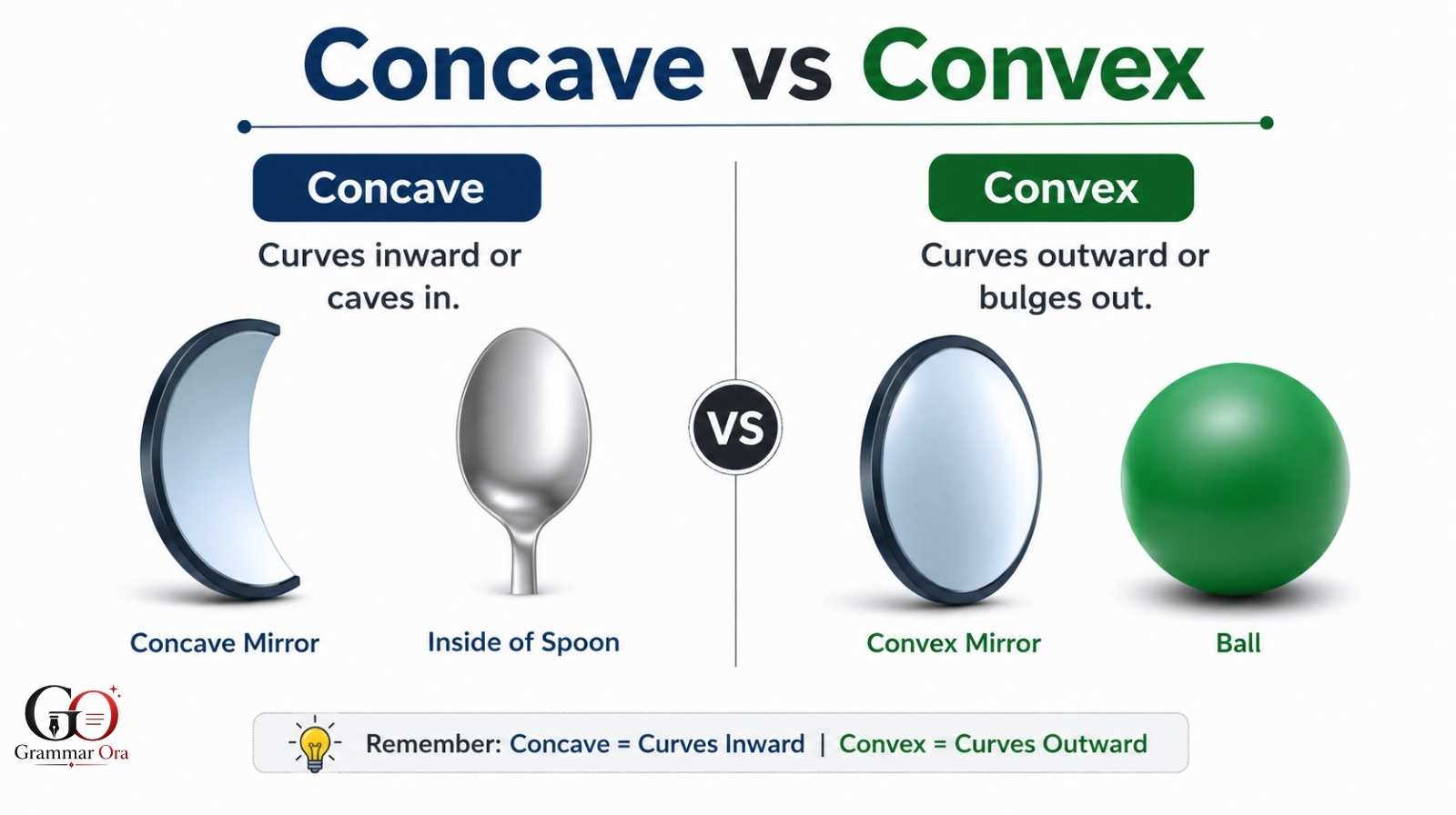
Have you ever looked at a spoon and noticed that one side curves inward while the other curves outward? If so, you’ve already encountered the difference between concave vs convex.
Many students, professionals, and everyday learners struggle to remember which shape curves inward and which curves outward. This confusion becomes even more common when discussing lenses, mirrors, geometry, or real-world applications.
In this guide, you’ll learn exactly what concave vs convex mean, how they differ, where they’re used, and practical tricks to remember them forever. By the end, you’ll be able to identify concave and convex objects confidently in both academic and real-life situations.
What Is the Difference Between Concave and Convex?
The primary difference between concave vs convex is the direction of the curve.
- Concave curves inward like the inside of a bowl.
- Convex curves outward like the outside of a ball.
Concave Definition
A concave shape has a surface that bends inward toward its center.
Examples include:
- Inside of a spoon
- Cave entrance
- Satellite dishes
- Certain mirrors
Convex Definition
A convex shape bulges outward from its center.
Examples include:
- Basketball
- Globe
- Outside of a spoon
- Magnifying glass lens
Quick Memory Trick
Think of:
- Concave = Cave = Curves In
- Convex = Volcano = Bulges Out
This simple association helps many learners remember the difference instantly.
Concave vs Convex Comparison Table
The following table provides a quick overview.
| Feature | Concave | Convex |
|---|---|---|
| Curve Direction | Inward | Outward |
| Shape Appearance | Hollow | Bulging |
| Light Behavior (Lens) | Diverges light | Converges light |
| Mirror Effect | Can magnify nearby objects | Produces smaller images |
| Common Examples | Spoon interior, cave | Ball, globe, spoon exterior |
| Geometry | Has inward indentation | No inward indentation |
At a Glance
If a shape appears “caved in,” it is likely concave. If it appears swollen outward, it is likely convex.
Understanding Concave and Convex Shapes in Geometry
Geometry uses these terms extensively to classify polygons and curves.
What Is a Concave Polygon?
A polygon is concave when at least one interior angle exceeds 180°.
Examples include:
- Arrow-shaped figures
- Star-like polygons
- Irregular geometric shapes
What Is a Convex Polygon?
A convex polygon has all interior angles less than 180°.
Examples include:
- Squares
- Rectangles
- Pentagons
- Hexagons
How to Identify Them
A simple test is to draw a line between any two points inside the shape.
- If the line always stays inside, the shape is convex.
- If the line leaves the shape at any point, the shape is concave.
Concave vs Convex Lenses
One of the most common uses of these concepts appears in optics.
Concave Lens
A concave lens is thinner at the center and thicker at the edges.
Characteristics:
- Spreads light rays apart
- Produces smaller virtual images
- Used to correct nearsightedness (myopia)
Convex Lens
A convex lens is thicker at the center and thinner at the edges.
Characteristics:
- Focuses light rays together
- Produces magnified images
- Used in cameras, microscopes, and magnifying glasses
Real-World Applications
Common devices using convex lenses include:
- Cameras
- Binoculars
- Projectors
- Telescopes
Common uses of concave lenses include:
- Eyeglasses for myopia
- Laser systems
- Optical instruments
Concave vs Convex Mirrors
Mirrors provide another practical example of the difference.
Concave Mirror
A concave mirror reflects light inward toward a focal point.
Uses include:
- Makeup mirrors
- Dental mirrors
- Telescope reflectors
- Vehicle headlights
Convex Mirror
A convex mirror spreads reflected light outward.
Uses include:
- Security mirrors
- Road intersections
- Vehicle side mirrors
- Parking garages
Why Convex Mirrors Improve Safety
Because convex mirrors provide a wider field of view, they help drivers and security personnel see larger areas at once.
Real-Life Case Study: How Convex Mirrors Improve Road Safety
A transportation department in a busy urban area identified several accident-prone intersections where drivers struggled with limited visibility around corners.
To solve the problem, engineers installed convex traffic mirrors at strategic locations. Unlike flat mirrors, convex mirrors provide a much wider viewing angle. Drivers approaching the intersections could now see vehicles, cyclists, and pedestrians that were previously hidden from view.
Within the following months, traffic reports showed a noticeable reduction in near-miss incidents and visibility-related collisions. Drivers reported feeling more confident when entering intersections because they could better assess surrounding traffic conditions.
This real-world example demonstrates why understanding concave vs convex isn’t just an academic exercise. The choice between these shapes directly impacts safety, efficiency, and user experience. Convex surfaces help maximize visibility, while concave surfaces are often used when focusing light or creating magnification is necessary.
As a result, engineers, architects, and product designers regularly consider concave and convex properties when developing solutions for everyday challenges.
Concave vs Convex in Science and Engineering

Beyond geometry and optics, these shapes play important roles in modern industries.
Architecture
Architects use convex and concave designs to:
- Improve aesthetics
- Manage acoustics
- Enhance structural strength
Medical Equipment
Many medical instruments use specialized lenses and mirrors.
Examples include:
- Endoscopes
- Surgical imaging devices
- Diagnostic microscopes
Aerospace Engineering
Aircraft and spacecraft components often incorporate curved surfaces to optimize:
- Aerodynamics
- Structural integrity
- Performance
Statistics and Industry Trends (2025–2026)
Recent developments in optics and imaging technology continue to increase demand for advanced lens systems.
According to industry reports from organizations such as the Optica Society and the International Data Corporation (IDC), the global optics and photonics sector is projected to continue expanding through 2026 due to growth in:
- Medical imaging technologies
- Autonomous vehicles
- Smartphone camera systems
- Industrial automation
- Augmented reality devices
Modern smartphones now commonly contain multiple convex lens elements working together to improve image quality, autofocus performance, and low-light photography.
These advancements highlight how fundamental concepts like concave and convex shapes remain essential to cutting-edge technology.
How to Remember Concave vs Convex Easily

Method 1: The Cave Trick
- Concave → Cave → Curves inward
Method 2: Spoon Test
Look at a spoon:
- Inside = Concave
- Outside = Convex
Method 3: Hand Gesture
Cup your hand:
- Palm side resembles concave
- Back side resembles convex
These visual cues make the distinction much easier to remember.
FAQs
Q1: Is a bowl concave or convex?
A: The inside surface of a bowl is concave because it curves inward.
Q2: Is a football convex?
A: Yes. A football generally has a convex outer surface because it bulges outward.
Q3: Which lens is used in a magnifying glass?
A: A convex lens is used because it converges light and magnifies objects.
Q4: Why are security mirrors convex?
A: Convex mirrors provide a wider field of view, allowing users to see more area at once.
Q5: Can a shape be both concave and convex?
A: Different parts of a complex object may contain both concave and convex surfaces, but a specific geometric shape is generally classified as one or the other.
Q6: Which mirror is used by dentists?
A: Dentists commonly use concave mirrors because they can magnify nearby objects.
Conclusion
Understanding concave vs convex becomes simple once you remember the direction of the curve. Concave surfaces curve inward, while convex surfaces bulge outward. These concepts appear everywhere from geometry and optics to road safety, architecture, medicine, and advanced technology.
Whether you’re studying for an exam, choosing the right optical device, or simply trying to understand the world around you, knowing the difference between concave and convex provides a valuable foundation. Use the comparison table and memory tricks in this guide, and you’ll never confuse the two again.
If you found this guide helpful, explore more geometry and optics concepts to strengthen your understanding of how shapes influence the world around us.
👉 Discover more simple and practical grammar guides on Grammar Ora

Muhammad Bilal is an expert blogger in Grammar Guide, dedicated to simplifying English grammar and helping learners write and speak with clarity, confidence, and accuracy.