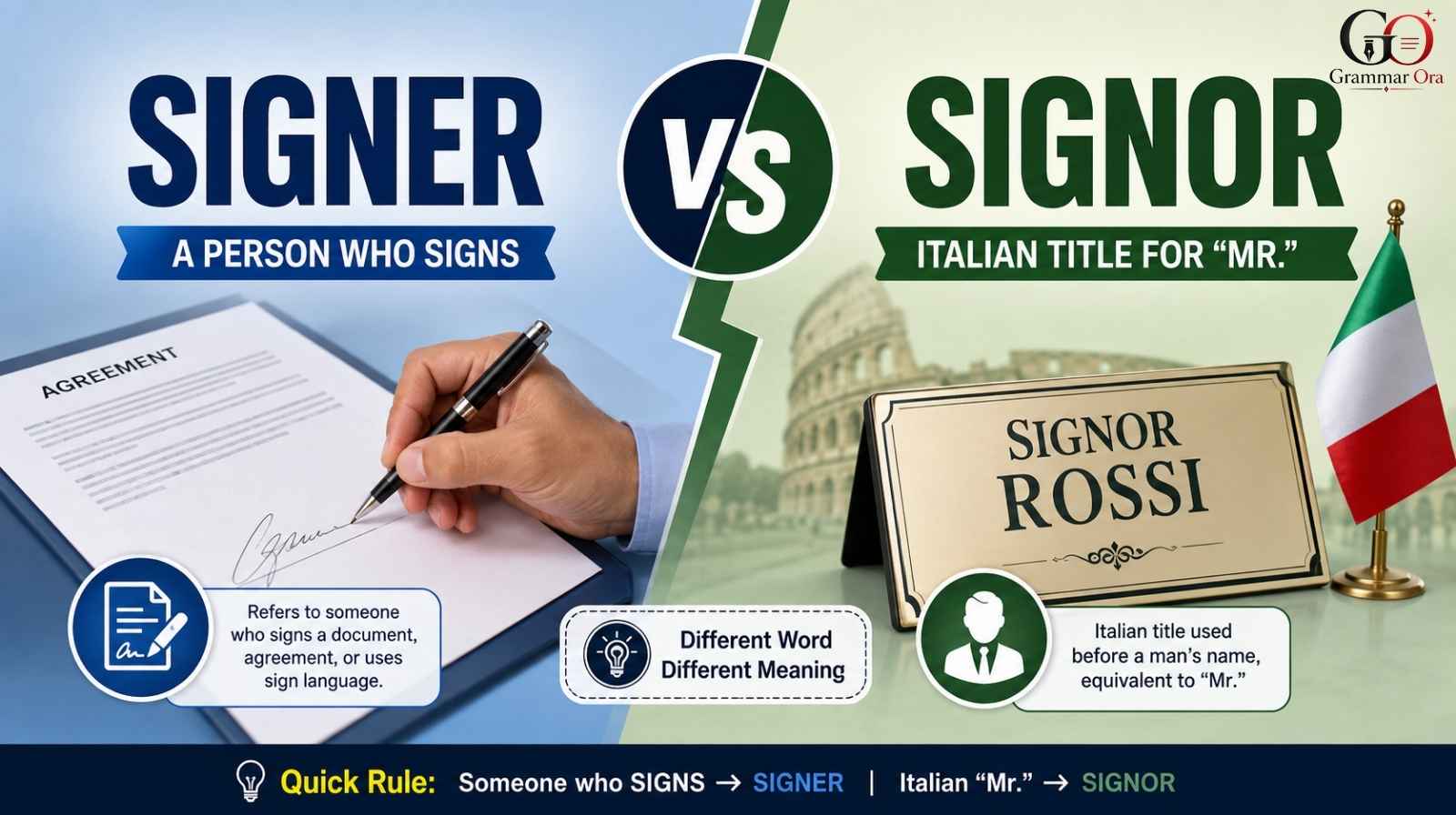
If you’ve ever seen signer vs signor and wondered whether these words are interchangeable, you’re not alone. They look similar, but they have completely different meanings and uses. Signer is an English word connected with signing or sign language, while signor is a title used for a man, especially in Italian contexts.
In this guide, you’ll learn the difference between signer vs signor, when to use each word, how they’re pronounced, and how to avoid confusing them.
Signer vs Signor: What’s the Difference?

The simplest distinction is this:
- Signer = a person who signs a document, agreement, petition, or other official text; it can also mean a person who uses sign language.
- Signor = an Italian title equivalent to Mr. or Mister, normally used before a man’s name.
Cambridge Dictionary defines signer as someone who has signed an official document and also uses the word for someone who uses sign language.
Signor, on the other hand, is associated with the Italian form of address signore, corresponding to “Mr.” when used before a man’s name.
Signer Meaning
Signer is a noun derived from the verb sign.
Examples:
- Maria was the final signer of the agreement.
- Every signer must provide a valid identification document.
- The petition had hundreds of signers.
- He is a skilled signer who communicates through sign language.
So, if you’re talking about someone who signs something, “signer” is usually the correct word.
Signor Meaning
Signor is a title used in Italian and in English writing when referring to an Italian man or using an Italian-style form of address.
Examples:
- Signor Rossi will attend the meeting.
- I spoke with Signor Bianchi yesterday.
- The letter was addressed to Signor Marco Conti.
It doesn’t mean “a person who signs.”
Quick Comparison
| Word | Meaning | Typical Use | Example |
|---|---|---|---|
| Signer | Person who signs something | Documents, agreements, petitions, sign language | The signer approved the contract. |
| Signor | Italian title equivalent to Mr. | Names and forms of address | Signor Rossi arrived early. |
Easy rule: If you mean someone who signs, use signer. If you mean Mr. in an Italian context, use signor.
When Should You Use Signer?
The word signer is useful in several everyday and professional situations. It usually describes a person who puts their signature on something or, in another context, someone who communicates using sign language.
Signer in Legal and Official Documents
Legal and administrative writing frequently needs a word for someone who signs an agreement.
For example:
The signer must read the terms before signing the contract.
Other examples include:
- Each signer must initial every page.
- The agreement requires two signers.
- The authorized signer approved the transaction.
- The document was returned to the signer for correction.
In formal contexts, signatory can also be appropriate. Cambridge defines signatory as a person, organization, or country that has signed an agreement.
Signer in Sign Language
Signer also has another established meaning: a person who uses sign language.
For example:
- The conference provided interpreters for Deaf signers.
- She is an experienced American Sign Language signer.
- The study included both hearing participants and Deaf signers.
Therefore, don’t assume that “signer” always means someone who signs a written document. Context determines the meaning.
Signer in Everyday English
You may encounter signer in situations involving:
- Contracts
- Petitions
- Forms
- Agreements
- Legal documents
- Authorization forms
- Sign language
For example:
Incorrect meaning:
Signor John signed the contract.
If you mean that John was the person who signed it, the relevant noun is signer:
John was the signer of the contract.
When Should You Use Signor?
Signor has a very different role. It is a title rather than a noun describing someone who signs a document.
Signor as an Italian Title
Signor is used before a man’s name in Italian contexts, much like Mr. in English.
Examples:
- Signor Romano is waiting outside.
- I spoke to Signor Ferraro after the meeting.
- Signor Bianchi owns the restaurant.
- The invitation was sent to Signor Giuseppe Rossi.
Cambridge’s English–Italian dictionary gives signor as the Italian equivalent of “Mr.”
Signor vs Mr.
These words serve similar grammatical purposes, but they belong to different linguistic contexts.
- Mr. Smith → English
- Signor Smith → Italian-style title
- Signor Rossi → natural Italian usage
If you’re writing ordinary English, Mr. is normally the natural choice unless the Italian title is intentional.
Signor and Signore
The longer Italian word signore means a man or gentleman and can function as a polite form of address. Signor is commonly used before a proper name, as in signor Bianchi. Cambridge’s Italian-English dictionary translates signore in contexts including “man,” “Mr.,” and “gentleman.”
Signer vs Signor: Common Mistakes to Avoid
Because the two words look almost identical, spelling and meaning can easily become mixed up.
Mistake 1: Using Signor for Someone Who Signs
❌ Signor of the contract
✅ Signer of the contract
“Signer” describes the person who signs.
Mistake 2: Using Signer as a Title
❌ Signer Rossi will attend the meeting.
✅ Signor Rossi will attend the meeting.
If you’re addressing an Italian man by a traditional title, signor is the appropriate word.
Mistake 3: Confusing Signor With Signature
The words signor, signer, and signature look related, but they don’t perform the same grammatical job.
- Sign = the action
- Signer = the person who signs
- Signature = the name or mark placed on a document
- Signor = an Italian title meaning approximately “Mr.”
Cambridge defines signature as a person’s name written in a particular way, commonly to show that they wrote or agreed to something.
A Simple Memory Trick
Think:
Signer → signs
Signor → Mr.
The ending can help you remember the difference:
SIGNER = person who SIGNS
SIGNOR = Italian MR.
Signer vs Signor: Real-Life Example

Imagine an international business meeting involving an Italian company and an English-speaking legal team.
A contract is prepared for a new partnership. Signor Matteo Rossi, the company’s representative, reads the agreement. After reviewing the terms, he signs the final page.
At this point, two different words can correctly describe him but they describe different things about him.
He may be addressed as Signor Rossi because signor is an Italian title used before a man’s name. Once he signs the contract, he can also be called a signer because he is one of the people who signed the document.
For example:
Signor Rossi attended the meeting and became a signer of the partnership agreement.
This distinction is important because the two words aren’t interchangeable. Signor identifies his form of address, while signer describes his role in signing the document.
The same principle works outside business. Suppose a petition has 500 people who put their names on it. Those people are signers or petition signers. You wouldn’t call them signors simply because they signed.
Likewise, if you’re introducing an Italian gentleman named Rossi, you might write Signor Rossi, but that doesn’t tell the reader whether he signed anything.
The key is to focus on what you’re trying to communicate: a person’s title or a person’s action. If it’s the title, use signor. If it’s the person who signed, use signer.
Signer vs Signor: 2025–2026 Usage and Search Data
There isn’t a reliable public dictionary statistic showing exactly how many times signer or signor was used in English during 2025–2026. It would be misleading to invent a percentage or monthly search volume for these two niche terms.
However, Google Trends provides a useful way to investigate search interest. Google explains that Trends uses aggregated and anonymized search data and normalizes results on a 0–100 scale, meaning the numbers represent relative search interest rather than absolute search volume.
Google also notes that very low-interest queries can produce statistical noise, so isolated spikes shouldn’t automatically be interpreted as meaningful popularity.
What This Means for Signer and Signor
For a niche comparison such as signer vs signor, the most useful data points are:
- Search interest over the selected period.
- Geographic differences.
- Related searches.
- Whether enough search activity exists to generate a reliable Trends graph.
Google Trends allows users to compare search terms and examine interest by region.
So, for SEO research in 2025–2026, it’s better to treat search-volume estimates as directional rather than presenting unsupported exact figures.
SEO takeaway: Because signer and signor have different meanings, content that clearly answers the distinction can satisfy a highly specific informational search intent.
Signer vs Signor: Quick Decision Guide

Use this checklist when you’re unsure which word belongs in your sentence.
Choose Signer If…
- Someone signed a contract.
- Someone signed a petition.
- Someone signed an official document.
- You’re talking about an authorized person who signs paperwork.
- You’re referring to someone who uses sign language.
Example:
The signer agreed to all the terms.
Choose Signor If…
- You’re using an Italian title.
- You’re addressing or referring to an Italian man.
- The word appears before a man’s name.
- You want the Italian equivalent of “Mr.”
Example:
Signor Romano will join us for dinner.
One-Line Test
Ask yourself:
Am I talking about someone who signs, or an Italian title?
Someone who signs → signer
Italian title → signor
FAQs
Q1: Is signer the same as signor?
A: No. Signer means a person who signs something or, in another context, a person who uses sign language. Signor is an Italian title equivalent to “Mr.”
Q2: What does signer mean?
A: A signer is a person who signs an official document, agreement, petition, or similar item. The word can also refer to someone who uses sign language.
Q3: What does signor mean?
A: Signor is an Italian title used before a man’s name and is approximately equivalent to Mr. in English.
Q4: Is Signor a person’s name?
A: Usually, no. Signor is a title, much like Mr. It is generally placed before a man’s name, such as Signor Rossi.
Q5: Is signer a correct English word?
A: Yes. Signer is a standard English noun. It can describe someone who has signed a document or someone who uses sign language.
Q6: Can one person be both a signer and a signor?
A: Yes. A person can be both depending on context. For example, Signor Rossi may be the signer of a contract. The two words describe different things about the same person.
Q7: What is the difference between signer and signatory?
A: Both can refer to someone who has signed an agreement, but signatory is especially common in formal or legal contexts. Cambridge lists signatory as a person, organization, or country that has signed an agreement.
Q8: Is signor the Italian word for Mr.?
A: Yes. Signor is used as the Italian equivalent of Mr. before a man’s name. For example, Signor Rossi corresponds to Mr. Rossi.
Conclusion:
The difference between signer vs signor becomes easy once you focus on meaning.
Signer refers to someone who signs something, such as a contract, petition, or official document. It can also describe a person who uses sign language.
Signor is an Italian title equivalent to Mr., generally used before a man’s name.
Remember the simplest rule:
Signer = someone who signs
Signor = Italian Mr.
Choosing the right word makes your writing more precise and prevents a small spelling similarity from creating a completely different meaning.
For more useful spelling, grammar, and word-choice guides, keep exploring our Grammar Guide and learn the differences that can make your English clearer and more professional.
👉 Discover more simple and practical grammar guides on Grammar Ora

Muhammad Bilal is an expert blogger in Grammar Guide, dedicated to simplifying English grammar and helping learners write and speak with clarity, confidence, and accuracy.