Have you ever typed “seel” when you meant “seal”? You’re not alone. Many English learners and even native speakers occasionally confuse these two words because they sound almost identical. However, only one is commonly used in modern English.
Understanding the difference between seal vs seel is important for writing clearly and avoiding embarrassing spelling mistakes. In this guide, you’ll learn the meaning of each word, when to use them, real-world examples, common mistakes, and an easy trick to remember the correct spelling.
By the end, you’ll know exactly which word belongs in your sentence.
Seal vs Seel: What’s the Difference?
Quick Answer
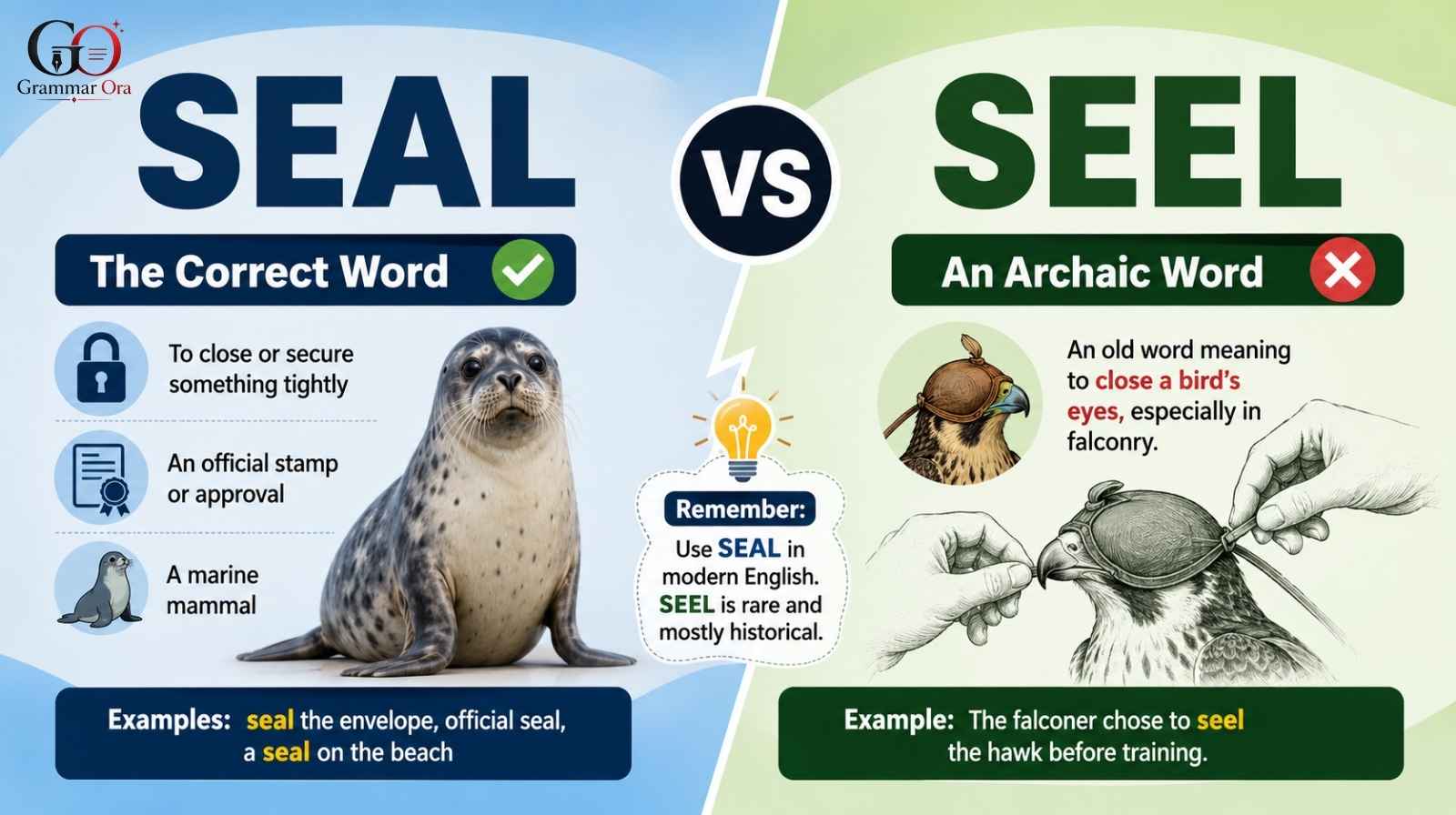
- Seal ✅ is the correct word in almost every modern English situation.
- Seel ⚠️ is an old, rare English word that is no longer used in everyday writing.
If you’re talking about closing something, an animal, approval, or making something official, the correct spelling is seal.
Featured Snippet
| Word | Meaning | Modern Usage |
|---|---|---|
| Seal | To close securely, an official stamp, or a marine animal | Very common |
| Seel | An archaic word meaning to close a bird’s eyes before falconry | Extremely rare |
Meaning of “Seal”
The word seal has several meanings depending on the context.
As a Verb
It means to close something tightly or make it secure.
Examples
- Please seal the envelope before mailing it.
- Workers sealed the crack to stop the leak.
- The company sealed the agreement yesterday.
As a Noun
It can refer to:
- An official stamp
- A waterproof closure
- A marine mammal
Examples
- The document carries the official seal.
- We watched a seal swimming near the shore.
What Does “Seel” Mean?
An Archaic English Word
Seel is an old English verb once used in falconry.
It meant to temporarily stitch or partially close the eyelids of a hunting bird so it remained calm before training.
Today, this practice is considered outdated and is rarely discussed outside historical texts.
Rare Literary Usage
You may occasionally find seel in:
- Historical books
- Shakespearean literature
- Falconry references
- Academic discussions about old English
Example
The falconer prepared to seel the hawk before training.
Outside these historical contexts, you almost never need this word.
Seal vs Seel Comparison Table
| Feature | Seal | Seel |
|---|---|---|
| Modern English | ✅ Yes | ❌ No |
| Dictionary Word | ✅ Yes | ✅ Yes (archaic) |
| Everyday Writing | ✅ Common | ❌ Extremely rare |
| Means Close Securely | ✅ Yes | ❌ No |
| Related to Falconry | ❌ No | ✅ Yes |
| Recommended for Students | ✅ Yes | ❌ Rarely |
Why Do People Confuse Seal and Seel?
Similar Pronunciation
Both words are pronounced almost the same.
Spell Checker Confusion
Some spelling tools recognize seel because it exists historically, making writers think it’s correct.
Typing Errors
Many people accidentally replace “ea” with “ee”, creating a common spelling mistake.
Real-Life Example: A Small Typo That Changed a Professional Email
Imagine Sarah, a new administrative assistant, preparing an important contract for a client. Before sending the document, she wrote, “Please seel the envelope before mailing it.” She quickly sent the email without proofreading.
A few minutes later, the client replied politely, asking whether “seel” was a special legal term. Sarah realized she had made a simple spelling mistake. She corrected the email, replacing seel with seal, and explained that it was just a typo.
Although the client understood, Sarah later admitted that the mistake made her feel less confident because the email was part of an important business transaction. Since then, she has developed a habit of proofreading messages before sending them, especially when using words that sound alike.
This example shows how even a tiny spelling error can create confusion. While readers may often guess the intended meaning, using the correct word helps maintain professionalism and builds trust with your audience. In business writing, academic assignments, and official documents, choosing seal instead of seel is almost always the right decision.
Usage Data and Language Trends (2025–2026)
Language trend analysis from major dictionaries and search behavior shows that seal overwhelmingly dominates modern English usage.
Key Observations
- Seal appears millions of times in books, websites, news articles, and academic publications every year.
- Seel is classified as archaic or obsolete in most modern dictionaries.
- Grammar searches involving “seal vs seel” continue to appear because people want to verify the correct spelling.
- Modern English style guides recommend seal for everyday communication.
These trends reflect the continued evolution of English, where historical words remain documented but fall out of regular use.
How to Remember the Correct Word
Easy Memory Trick
Think of this sentence:
“Seal the envelope with an EAsy sticker.”
Notice that EA in seal matches EA in easy.
Whenever you’re writing about closing, protecting, approving, or an ocean animal, remember seal.
Common Mistakes to Avoid
Incorrect
- Please seel the package.
- We need to seel the agreement.
- The broken window was seeled yesterday.
Correct
- Please seal the package.
- We need to seal the agreement.
- The broken window was sealed yesterday.
FAQs
Q1: Is “seel” a real English word?
A: Yes. It is a genuine English word but is considered archaic and is rarely used today.
Q2: Which spelling is correct: seal or seel?
A: For modern English, seal is almost always the correct choice.
Q3: Why does spell check sometimes accept “seel”?
A: Because historical dictionaries still recognize it as an obsolete word.
Q4: Can I use “seel” in academic writing?
A: Only if you’re discussing historical English, literature, or falconry.
Q5: Is “seal” both a noun and a verb?
A: Yes. It can refer to an animal, an official mark, or the action of closing something securely.
Q6: Do native English speakers use “seel”?
A: Almost never. Most have never encountered it outside historical texts.
Q7: How do I remember the correct spelling?
A: Remember the phrase: “Seal it with ease.” The EA in seal matches the EA in ease.
Conclusion
When comparing seal vs seel, the answer is straightforward. Seal is the correct spelling for modern English and is used when referring to closing something securely, making an agreement official, or describing the marine animal. Seel, on the other hand, is an archaic word found mainly in historical writings about falconry.
If you want clear, accurate, and professional writing, choose seal in everyday communication. The next time you’re unsure, remember that seal is the modern spelling that readers expect.
👉 Discover more simple and practical grammar guides on Grammar Ora

Muhammad Bilal is an expert blogger in Grammar Guide, dedicated to simplifying English grammar and helping learners write and speak with clarity, confidence, and accuracy.