
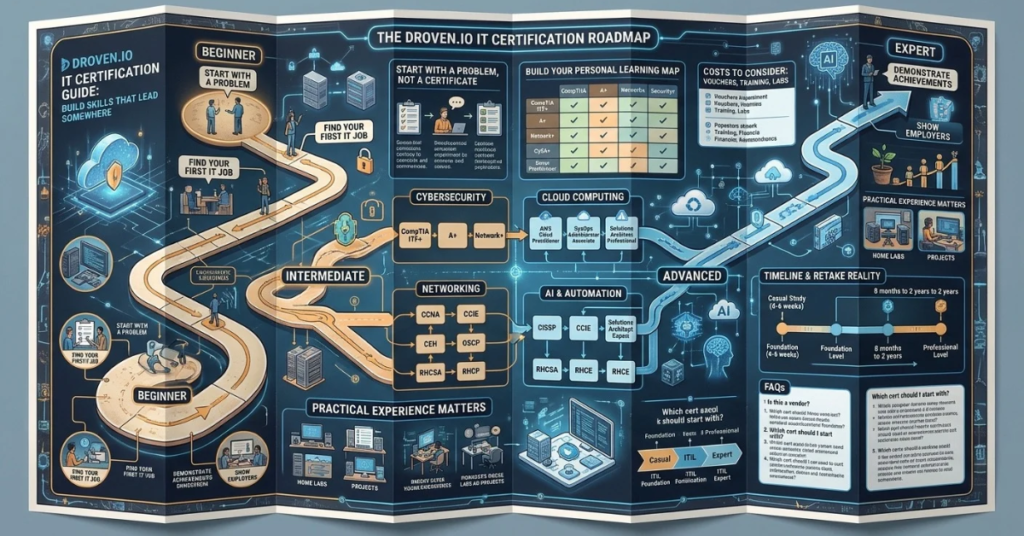

The technology industry is constantly changing, and having the right technical skills can make a significant difference when pursuing a career in IT. From cloud computing and cybersecurity to artificial intelligence and software development, employers increasingly value professionals who can demonstrate their knowledge and practical abilities. This is where the droven. io it certification guide becomes an interesting topic for students, beginners, and experienced technology professionals.
IT certifications can help learners develop specialized knowledge, strengthen their resumes, and demonstrate their understanding of particular technologies. However, choosing the right certification is not always straightforward. There are different providers, examination requirements, learning resources, and career paths to consider.
In this guide, we will explore what Droven.io is, how it relates to IT certification preparation, which professional certifications are worth considering, and how to build a practical learning strategy that supports long-term career development.
What Is Droven.io?
Droven.io is associated with technology-related educational content and discussions about modern IT developments. Its subject areas are described in third-party coverage as including artificial intelligence, cloud computing, cybersecurity, automation, software development, and emerging technologies.
For someone exploring the technology industry, this type of content can provide a starting point for understanding unfamiliar concepts and identifying areas worth studying further.
However, it is important to understand the difference between a technology information website and an official certification provider.
An educational website may publish:
-
Technology explainers and introductory guides.
-
Information about professional IT certifications.
-
Discussions about emerging technologies.
-
Career advice and technical learning recommendations.
-
Comparisons of different IT skills and career paths.
These resources can support independent learning, but they do not automatically provide an accredited qualification.
Important: Available public information does not establish Droven.io as an official IT certification issuer. Before paying for a course or examination advertised under its name, verify the provider, accreditation, examination arrangements, and certificate recognition.
Does Droven.io Offer Official IT Certifications?
This is probably the most important question for anyone researching the platform.
There is a difference between learning about an IT certification and actually earning one. A website can explain examination topics, recommend study materials, and introduce different technical career paths without having the authority to issue professional credentials.
Recognized certification organizations include:
-
CompTIA
-
Amazon Web Services (AWS)
-
Microsoft
-
Cisco
-
Google Cloud
-
ISACA
-
EC-Council
These organizations maintain their own certification requirements, examination processes, and credential verification systems.
If your goal is to earn a qualification that employers can recognize, use the relevant certification organization’s official website to confirm the latest requirements.
Droven-related educational content can be treated as supplementary reading rather than proof of professional certification.
Popular IT Certifications Worth Considering
Choosing a certification should depend on your interests, existing knowledge, and the type of job you want to pursue. The following options are worth exploring if you are building a career in information technology.
1. CompTIA A+ – IT Support and Technical Fundamentals
It covers essential concepts such as:
-
Computer hardware and troubleshooting.
-
Operating systems and software installation.
-
Networking fundamentals.
-
Mobile devices and endpoint management.
-
Basic security and operational procedures.
Suitable career paths:
-
IT Support Specialist
-
Help Desk Technician
-
Desktop Support Technician
-
Technical Support Engineer
It is a reasonable starting point if you have limited professional IT experience and want to understand how computer systems work.
2. AWS Certified Cloud Practitioner – Cloud Computing
It introduces learners to:
-
Cloud computing concepts.
-
AWS infrastructure and core services.
-
Security and compliance.
-
Cloud pricing and billing.
-
Basic cloud architecture concepts.
The current CLF-C02 examination is 90 minutes long, contains 65 questions, and costs $100 USD according to AWS’s published exam information.
Amazon Web Services, Inc.+1
Suitable career paths:
-
Junior Cloud Support Associate
-
Cloud Operations Associate
-
IT Administrator
-
Cloud-focused Business Analyst
3. Microsoft Azure Fundamentals (AZ-900)
It is particularly useful for individuals interested in enterprise IT environments where Microsoft technologies are widely used.
Key learning areas include:
-
Cloud computing principles.
-
Azure services and architecture.
-
Virtual machines and storage.
-
Networking fundamentals.
-
Security, governance, and management.
The certification is designed to demonstrate foundational knowledge rather than advanced cloud engineering skills.
Microsoft Learn+1
Suitable career paths:
-
Junior Cloud Administrator
-
IT Support Specialist
-
Cloud Operations Associate
-
Junior Systems Administrator
4. Cisco CCNA – Networking and Infrastructure
Unlike introductory technology courses, CCNA requires a stronger understanding of how networks operate and how to configure and troubleshoot networking equipment.
Its examination covers:
-
Network fundamentals.
-
Network access.
-
IP connectivity.
-
IP services.
-
Security fundamentals.
-
Automation and programmability.
Cisco’s current 200-301 examination is 120 minutes long, with a published price of $300 USD.
Cisco+1
Suitable career paths:
-
Network Engineer
-
Network Administrator
-
Network Support Engineer
-
Infrastructure Technician
5. CompTIA Security+ – Cybersecurity
CompTIA Security+ is designed to validate foundational security knowledge and practical security skills.
Its subject areas include:
-
Threats, vulnerabilities, and attacks.
-
Network security.
-
Identity and access management.
-
Security architecture.
-
Risk management.
-
Incident response.
Suitable career paths:
-
Junior Security Analyst
-
Security Operations Center (SOC) Analyst
-
Cybersecurity Support Specialist
-
Information Security Technician
Check the official CompTIA website for the latest examination version and eligibility recommendations before registering.
6. Google Cloud Certifications – Cloud Infrastructure
Depending on your experience, you can explore foundational, associate, and professional-level credentials.
Potential learning areas include:
-
Cloud infrastructure.
-
Data storage and databases.
-
Application deployment.
-
Cloud security.
-
Machine learning services.
-
Infrastructure management.
Suitable career paths:
-
Cloud Engineer
-
Cloud Administrator
-
Data Engineer
-
Cloud Solutions Architect
Comparison of Popular IT Certifications
| Certification | Main specialization | Recommended level |
|---|---|---|
| CompTIA A+ | IT support | Beginner |
| AWS Cloud Practitioner | Cloud computing | Beginner |
| Azure Fundamentals | Microsoft cloud | Beginner |
| Cisco CCNA | Networking | Foundational to intermediate |
| CompTIA Security+ | Cybersecurity | Foundational to intermediate |
| Google Cloud | Cloud infrastructure | Varies by credential |
The best option depends on your intended career direction. A beginner interested in technical support may benefit from CompTIA A+, while someone interested in cloud infrastructure could start with AWS or Azure fundamentals.
How to Choose the Right IT Certification
With so many available qualifications, it is easy to spend money on a certification that does not match your professional goals.
Instead of following trends, consider these factors before selecting a program.
1. Identify Your Career Goals
Start by deciding which area of technology interests you most.
For example:
-
Interested in computer troubleshooting? Explore IT support.
-
Enjoy solving network problems? Consider networking.
-
Interested in protecting systems? Explore cybersecurity.
-
Want to work with cloud infrastructure? Consider AWS or Azure.
-
Interested in application development? Focus on programming and software engineering.
Having a clear direction makes it easier to select relevant study materials.
2. Check the Certification Requirements
Not every certification is designed for complete beginners.
Some examinations expect candidates to have previous technical experience, while others focus on foundational knowledge.
Before registering, review:
-
Required experience, if any.
-
Official examination objectives.
-
Recommended training.
-
Examination format.
-
Certification validity and renewal requirements.
3. Consider Your Budget
Certification expenses can include more than the examination fee.
Your overall budget may need to cover:
-
Online training courses.
-
Practice examinations.
-
Technical books.
-
Cloud laboratory access.
-
Examination registration.
-
Retake fees, if necessary.
Use free official learning resources wherever possible before purchasing additional study materials.
4. Research Employer Requirements
Look at job advertisements for positions you eventually want to apply for.
Identify the certifications, tools, and technical skills employers repeatedly mention. This gives you a more realistic picture of which qualifications may be valuable in your target job market.
A certification should support your career plan rather than become a qualification you collect without a clear purpose.
How to Prepare for an IT Certification Examination
Passing a professional certification examination requires more than memorizing definitions. You need to understand technical concepts and know how they apply in practical situations.
Here is a straightforward preparation strategy.
Step 1: Download the Official Exam Objectives
Start with the examination guide published by the certification organization.
It outlines the topics covered in the examination and helps you understand what you are expected to know.
Avoid relying entirely on unofficial summaries because examination requirements can change.
Step 2: Create a Realistic Study Schedule
Set aside consistent study time instead of trying to learn everything immediately before the examination.
A simple weekly routine could look like this:
| Day | Study activity |
|---|---|
| Monday | Learn new technical concepts |
| Tuesday | Read documentation and examples |
| Wednesday | Complete practical exercises |
| Thursday | Review difficult topics |
| Friday | Attempt practice questions |
| Saturday | Work on a small technical project |
| Sunday | Revise and assess progress |
You can adjust this schedule according to your existing knowledge and available time.
Step 3: Use Hands-On Learning Resources
Practical experience helps turn theoretical knowledge into useful technical skills.
Depending on your chosen specialization, you can practice using:
-
Virtual machines for operating systems.
-
Cisco Packet Tracer for networking.
-
AWS Free Tier resources, where eligible, for cloud experimentation.
-
Linux environments for command-line practice.
-
Virtual labs for cybersecurity exercises.
-
GitHub for software development projects.
Always review usage limits and potential charges before launching cloud resources.
Step 4: Take Practice Examinations
Practice tests help identify weak areas before the actual examination.
Rather than memorizing answers, focus on understanding why an answer is correct and why the other options are incorrect.
Keep a record of your mistakes and revisit those subjects during revision.
Step 5: Register Through the Official Provider
Once you feel prepared, visit the certification organization’s official website and follow its examination registration process.
Check the examination fee, available testing locations, online proctoring requirements, identification rules, and cancellation policies.
Avoid unofficial websites claiming to sell guaranteed certificates or examination passes.
Can IT Certifications Help You Get a Job?
Yes, professional IT certifications can improve your employment prospects, but they do not guarantee a job.
Employers often use certifications as one way to evaluate whether applicants understand specific technologies. They can be particularly useful for candidates who are transitioning into IT or trying to demonstrate knowledge in a new specialization.
However, employers also consider other factors, including:
Practical experience: Being able to troubleshoot a computer, configure a network, or deploy a cloud application demonstrates skills beyond theoretical knowledge.
Technical projects: Personal projects, GitHub repositories, laboratory exercises, and documented implementations can help demonstrate your abilities.
Problem-solving: IT professionals regularly deal with unexpected technical issues. Employers value people who can investigate problems and develop effective solutions.
Communication: Explaining technical issues clearly is important when working with customers, colleagues, and management teams.
For the strongest professional profile, combine recognized certifications with practical projects and relevant experience.
Free Resources for IT Certification Preparation
You do not necessarily need to spend hundreds of dollars to begin learning information technology. Several organizations provide free educational resources that can help you develop foundational knowledge.
Here are some useful options:
| Platform | Learning opportunities |
|---|---|
| Microsoft Learn | Azure, security, AI, and Microsoft technologies |
| AWS Skill Builder | Cloud computing and AWS services |
| Cisco Networking Academy | Networking, cybersecurity, and programming |
| freeCodeCamp | Programming, web development, and technical skills |
| Google Cloud Skills Boost | Google Cloud training and practical labs |
Official learning resources:
These platforms are useful for building knowledge, although free learning content and official certification examinations are not necessarily the same thing.
Common Mistakes to Avoid When Pursuing IT Certifications
Many learners invest considerable time in certification preparation but overlook important aspects of professional development.
Avoid these common mistakes:
-
Choosing certifications without a career plan: Select qualifications that match the type of IT position you want.
-
Ignoring practical experience: Reading study materials alone will not develop your troubleshooting and implementation abilities.
-
Memorizing practice questions: Understand the concepts instead of relying on repeated examination answers.
-
Using outdated materials: Always check whether your study resources match the current examination objectives.
-
Collecting too many certificates: A few relevant qualifications combined with practical experience are generally more useful than numerous unrelated certificates.
-
Ignoring examination policies: Register through authorized channels and understand the testing requirements.
The key is to approach certification as part of a broader professional learning journey.
Frequently Asked Questions (FAQs)
1. What is the Droven.io IT certification guide?
It is a search topic associated with technology learning and IT certification guidance. It helps readers explore technical subjects and understand different certification options. However, Droven.io should not be confused with an officially recognized certification issuer.
2. Is Droven.io an official IT certification provider?
Available public information does not establish Droven.io as an official certification authority. Recognized organizations such as CompTIA, Cisco, Microsoft, and AWS issue their own professional credentials.
3. Can beginners use Droven.io to learn about IT?
Yes, technology-related educational articles can help beginners understand technical concepts, explore different specializations, and identify relevant learning opportunities. Beginners should supplement general reading with structured courses and practical exercises.
4. Which IT certification is best for beginners?
CompTIA A+, AWS Certified Cloud Practitioner, and Microsoft Azure Fundamentals are worth considering. The right choice depends on whether you are interested in technical support, cloud computing, or Microsoft technologies.
5. Are IT certifications worth the investment?
They can be valuable because they demonstrate knowledge and provide structured learning goals. However, their value depends on industry recognition, employer requirements, practical experience, and how closely the qualification matches your career objectives.
6. Can I get an IT job without a certification?
Yes. Many IT positions do not require a formal certification. Employers may consider practical experience, technical projects, education, and demonstrated problem-solving abilities. However, certain specialized positions may prefer or require specific credentials.
7. How long does it take to prepare for an IT certification?
Preparation time varies depending on the examination and your existing knowledge. An introductory certification may require several weeks of consistent study, while more advanced qualifications can take several months or longer.
8. Do IT certifications expire?
Some certifications have renewal requirements, while others have different validity arrangements. For example, Cisco lists CCNA as valid for three years. Always check the individual certification’s renewal policy before registering.
Cisco
9. Which IT certification is best for cybersecurity?
CompTIA Security+ is a popular option for developing foundational cybersecurity knowledge. More advanced career paths may involve specialized credentials in security operations, penetration testing, cloud security, and information security management.
10. Are free IT certification courses available?
Yes. Microsoft Learn, AWS Skill Builder, Cisco Networking Academy, and other educational platforms offer free learning opportunities. However, completing a free course does not necessarily mean you have earned the corresponding professional certification.
Conclusion
Building a successful career in technology requires continuous learning, practical experience, and a clear understanding of industry requirements. The droven. io it certification guide is a useful topic to explore when researching technology education and professional certification pathways, but it is important to distinguish informational resources from organizations that actually issue recognized credentials.
If you are starting your IT journey, begin by identifying your preferred specialization. Explore networking, cloud computing, cybersecurity, software development, or technical support, and select a certification that supports your career objectives.
Most importantly, do not rely on certificates alone. Combine structured learning with hands-on projects, technical practice, and continuous skill development. This balanced approach will help you build a stronger professional profile and prepare for the changing demands of the technology industry.