Have you ever searched for kinesthesiology only to see nearly every university, textbook, and research paper use kinesiology instead? You’re not alone. This spelling confusion appears thousands of times online because both words look believable and relate to movement.
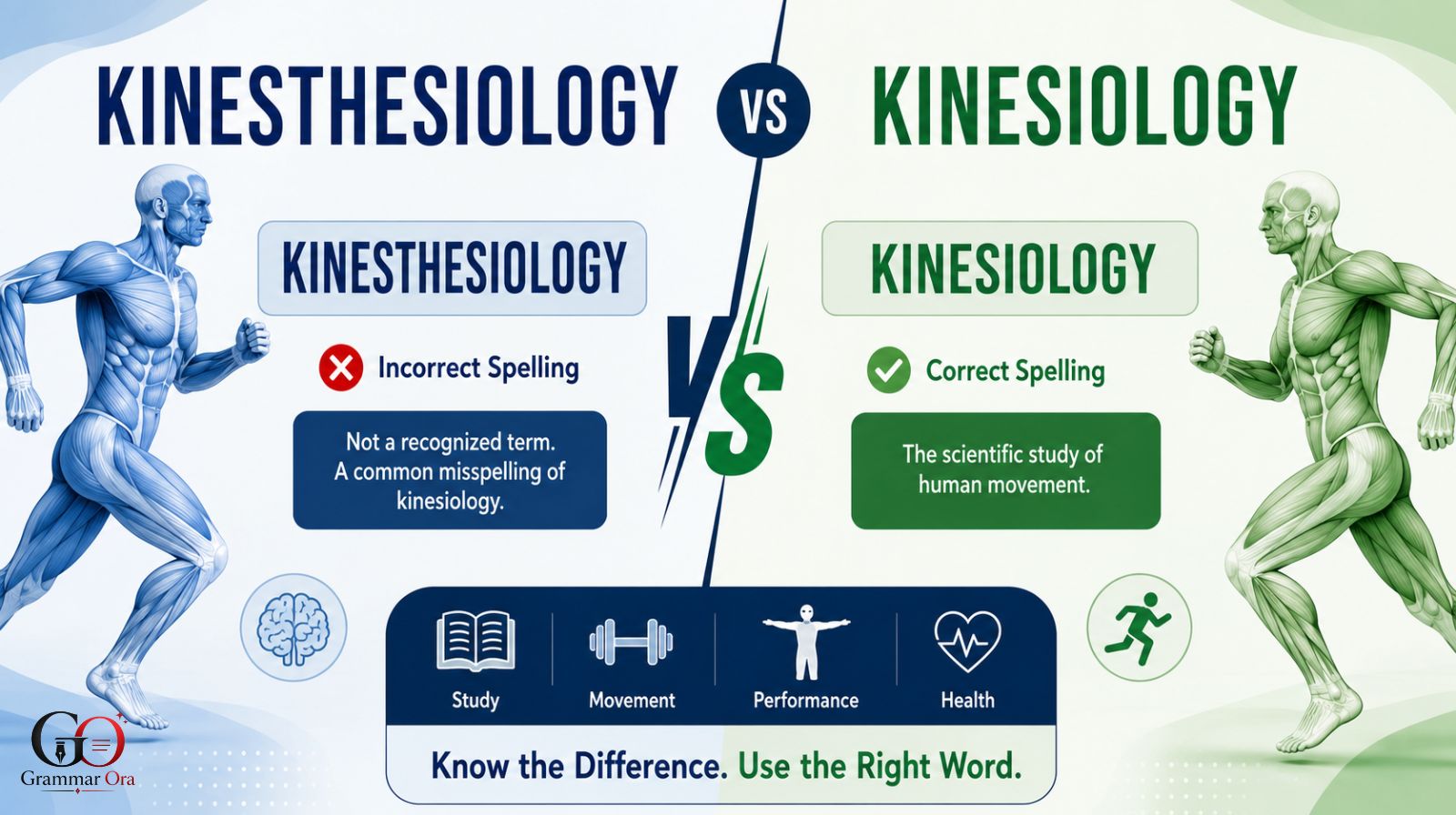
The truth is simple: kinesiology is the accepted academic and scientific term, while kinesthesiology is generally considered a misspelling or a blend of two different concepts.
In this guide, you’ll discover the difference between kinesthesiology vs kinesiology, learn where the confusion comes from, see real examples, and know exactly which word you should use in professional and academic writing.
What Is the Difference Between Kinesthesiology and Kinesiology?

The biggest difference is recognition and correctness.
| Term | Meaning | Correct? |
|---|---|---|
| Kinesiology | The scientific study of human movement. | ✅ Yes |
| Kinesthesiology | A nonstandard or mistaken variation of kinesiology. | ❌ No |
Today, universities, medical organizations, and scientific journals overwhelmingly use kinesiology.
Why “Kinesiology” Is Correct
The word comes from the Greek word kinesis, meaning movement, combined with -logy, meaning the study of.
Examples:
- She earned a degree in kinesiology.
- The university offers a Bachelor of Science in Kinesiology.
- Researchers published a new study on kinesiology.
Why People Write “Kinesthesiology”
Many people accidentally combine:
- Kinesthetic (related to body movement or physical sensation)
- Kinesiology (the study of movement)
This creates the hybrid word kinesthesiology, which sounds logical but is not recognized as the standard academic spelling.
Understanding Kinesiology
Kinesiology studies how the body moves.
It combines knowledge from:
- Anatomy
- Physiology
- Biomechanics
- Exercise Science
- Psychology
- Motor Learning
Professionals in kinesiology work in areas such as:
- Physical therapy
- Athletic training
- Sports medicine
- Rehabilitation
- Personal training
- Ergonomics
- Research
Example
A physical therapist may use principles of kinesiology to help a patient recover after knee surgery.
Why the Confusion Happens

Several factors contribute to the confusion.
The Influence of “Kinesthetic”
Many people are already familiar with words like:
- Kinesthetic learner
- Kinesthetic memory
- Kinesthetic awareness
Since these words begin with kinesth-, it’s easy to assume the science of movement should also begin the same way.
Similar Pronunciation
When spoken quickly,
- kinesiology
- kinesthesiology
sound remarkably similar.
As a result, people often spell the word based on pronunciation rather than its actual origin.
Internet Autocorrections
Search engines often recognize kinesthesiology as an intended search for kinesiology, making users think both spellings are acceptable.
Real-Life Example: A Student’s Assignment Mistake
Emily, a first-year university student, wanted to apply for a degree in human movement science. While researching programs online, she repeatedly searched for “Kinesthesiology Degree.” She found very few official university pages using that spelling, but thousands of search results automatically redirected her to kinesiology programs.
Initially, she assumed universities simply preferred a different spelling. After asking one of her professors, she learned that kinesiology is the internationally recognized academic discipline, while kinesthesiology is generally viewed as a spelling error created by blending kinesthetic and kinesiology.
Emily corrected her assignment before submitting it. Her professor later explained that using accurate terminology is important because academic databases, scientific journals, and university departments consistently use standardized vocabulary. By changing just one word, Emily made her research appear more professional and aligned with accepted scientific language. This small correction also improved the quality of her references since she was now finding authoritative sources instead of unrelated search results.
Kinesiology in Universities and Research (2025–2026)
As of 2025–2026, kinesiology remains the globally accepted term across higher education and scientific research.
Current Trends
- Thousands of universities worldwide offer Kinesiology degree programs.
- Research databases such as Google Scholar overwhelmingly index studies under kinesiology rather than kinesthesiology.
- Professional organizations and journals consistently use the standard spelling in publications related to exercise science, biomechanics, rehabilitation, and human performance.
This widespread adoption reinforces that kinesiology is the correct and authoritative term for the study of human movement.

How to Remember the Correct Spelling
Easy Memory Trick
Think of this formula:
Kinesis (movement) + Logy (study) = Kinesiology
Do not insert “thes” into the middle of the word.
Whenever you’re referring to the scientific study of movement, choose kinesiology.
Common Examples
Correct:
- She studied kinesiology at university.
- He teaches kinesiology courses.
- The department focuses on kinesiology research.
- Kinesiology helps improve athletic performance.
Incorrect:
- She has a degree in kinesthesiology.
- Our university offers Kinesthesiology.
- He researches kinesthesiology.
FAQs
Q1: Is kinesthesiology a real word?
A: It occasionally appears online, but it is not the accepted academic or scientific term.
Q2: Which spelling is correct?
A: Kinesiology is the correct spelling.
Q3: Why do people write kinesthesiology?
A: Because they mix kinesthetic with kinesiology.
Q4: Do universities teach kinesthesiology?
A: No. Universities almost always use kinesiology for departments and degree programs.
Q5: Is kinesthetic related to kinesiology?
A: Yes. Both involve movement, but they describe different concepts.
Q6: Does using the wrong spelling matter?
A: Yes. Using kinesiology improves clarity, professionalism, and search accuracy.
Q7: Can I use kinesthesiology in academic writing?
A: No. Academic papers should use kinesiology unless quoting a source that contains the nonstandard spelling.
Conclusion
When comparing kinesthesiology vs kinesiology, the answer is straightforward. Kinesiology is the correct, internationally recognized term for the scientific study of human movement. Kinesthesiology is generally a nonstandard spelling that results from confusion with the word kinesthetic.
Whether you’re writing an essay, applying to a university, or publishing professional content, always choose kinesiology. Using the correct terminology strengthens your credibility, improves search accuracy, and ensures your writing aligns with accepted academic standards.
If you found this guide helpful, explore more grammar and word-difference articles to avoid common language mistakes and write with confidence.
👉 Discover more simple and practical grammar guides on Grammar Ora

Muhammad Bilal is an expert blogger in Grammar Guide, dedicated to simplifying English grammar and helping learners write and speak with clarity, confidence, and accuracy.