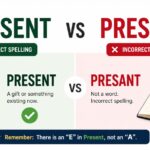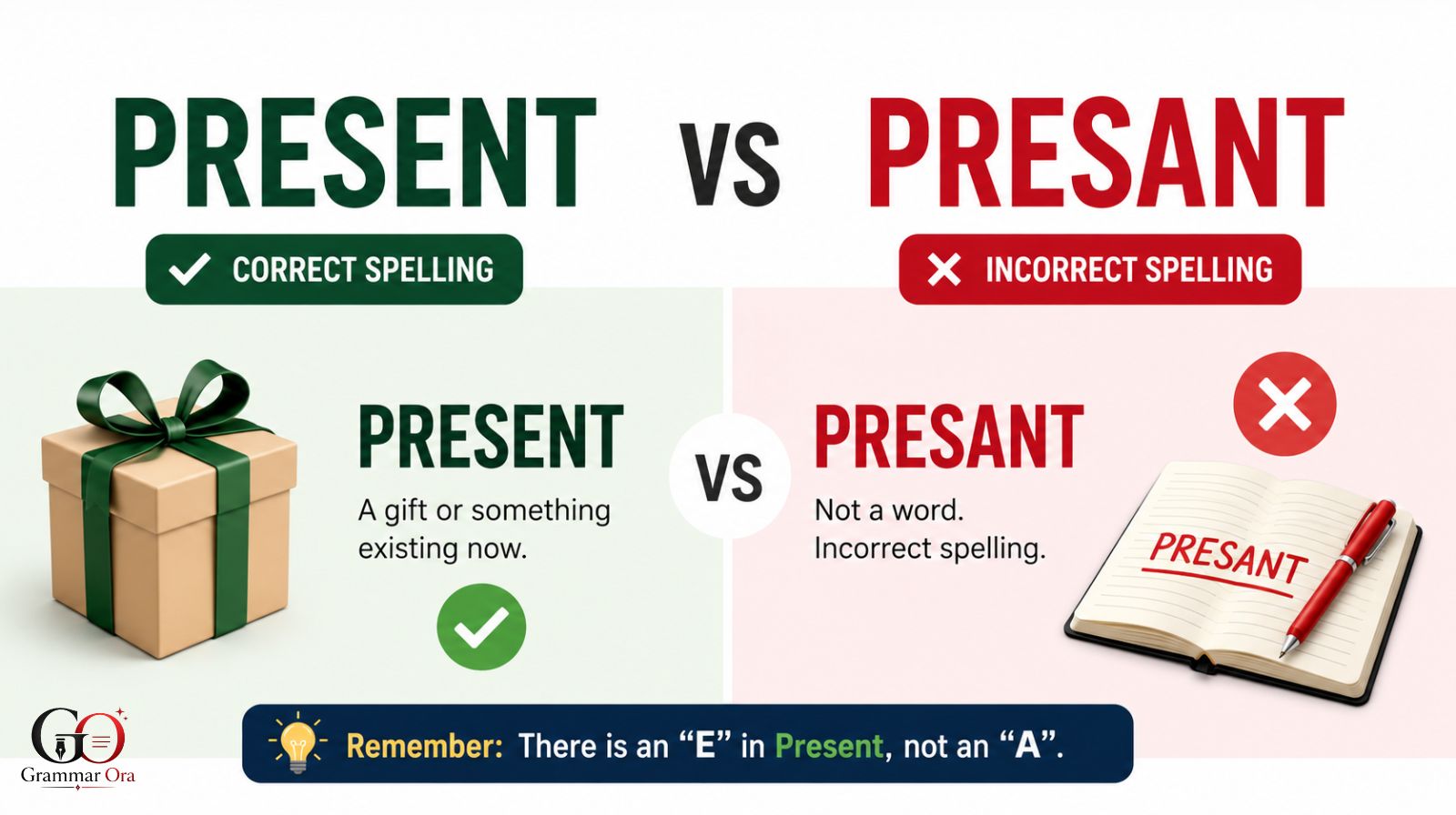
If you’ve ever wondered whether present vs presant is the correct spelling, you’re not alone. Many English learners and even native speakers accidentally write presant, especially when typing quickly. The good news is that the answer is simple: present is the correct English word, while presant is a misspelling.
In this guide, you’ll learn the difference between present vs presant, when to use present, why people make this spelling mistake, and how to remember the correct form every time.
Is It Present or Presant?
The correct spelling is present.
Presant is not recognized as a standard English word and does not appear in major dictionaries.
Quick Answer
| Word | Correct? | Meaning |
|---|---|---|
| Present | ✅ Yes | Existing now, a gift, or to introduce/show something |
| Presant | ❌ No | Incorrect spelling of “present” |
Whenever you mean the noun, adjective, or verb, always write present.
Examples
✅ I received a birthday present.
✅ She is present in class today.
✅ Please present your passport.
❌ I received a birthday presant.
❌ She is presant today.
Why Do People Write “Presant”?
The mistake usually happens because English pronunciation can be misleading.
The Unstressed Vowel
When speaking quickly, the second syllable sounds like “priz-uhnt.” Because of this, some people incorrectly spell it with a instead of e.
Fast Typing
Typing quickly without proofreading can easily produce presant.
Phonetic Guessing
Many learners spell words exactly as they hear them rather than following standard spelling rules.
Meaning of Present
The word present has several meanings depending on how it’s used.
Present as a Noun
A present is a gift.
Examples
- She bought me a wonderful present.
- Thank you for the birthday present.
- Every child opened a present.
Present as an Adjective
It means existing now or being in attendance.
Examples
- All students were present.
- We live in the present moment.
- The present situation is improving.
Present as a Verb
It means to give, introduce, or show something.
Examples
- The manager will present the report.
- Please present your identification.
- They presented the award to the winner.
Present vs Presant: Side-by-Side Comparison
| Feature | Present | Presant |
|---|---|---|
| Correct spelling | ✅ Yes | ❌ No |
| Dictionary word | ✅ Yes | ❌ No |
| Used in writing | Frequently | Never (except as an error) |
| Appears in exams | Yes | No |
| Accepted in formal English | Yes | No |
Real-Life Example: How One Spelling Error Changed a Professional Email
Imagine you’re applying for a new job and writing:
“Please accept this presant as my portfolio.”
Although the employer will likely understand what you mean, the misspelling creates a poor first impression. Recruiters often review dozens or even hundreds of applications, and small spelling mistakes can make a candidate appear less detail-oriented.
Now compare it with:
“Please accept this present as my portfolio.”
The sentence looks polished, professional, and grammatically correct. This example shows why proofreading matters. Whether you’re writing emails, school assignments, resumes, or business documents, using the correct spelling helps build credibility and confidence. Even a single letter can influence how your writing is perceived.
Usage Statistics (2025–2026)
Recent language trends continue to show that present overwhelmingly dominates English usage, while presant appears almost exclusively as a spelling mistake.
According to writing tools and dictionary databases in 2025–2026:
- Present appears millions of times in books, websites, and academic writing.
- Presant is flagged as a spelling error by grammar and spell-checking software.
- English dictionaries do not recognize presant as a valid word.
- Search engines commonly suggest “Did you mean: present?” when users search for presant.
These trends reinforce that present is the only correct spelling in modern English.
Tips to Remember the Correct Spelling
Remember the “E”
The word contains “sent.”
Think:
pre + sent = present
Since sent is a real English word, it’s easier to remember the correct spelling.
Read More
Regular reading helps your brain recognize correct spellings naturally.
Use Spell Check
Modern writing tools quickly identify presant and suggest present.
Practice Writing
Writing the correct spelling several times helps build long-term memory.
Common Mistakes to Avoid
Avoid these incorrect forms:
❌ Presant
❌ Presentt
❌ Presint
❌ Presinnt
Always use:
✅ Present
FAQs
Q1: Is presant a real English word?
A: No. Presant is a misspelling of present.
Q2: Which spelling is correct: present or presant?
A: Present is the only correct spelling.
Q3: Why do people spell present as presant?
A: Because the pronunciation can make the middle vowel sound like “a,” leading to phonetic spelling mistakes.
Q4: Can I use presant in formal writing?
A: No. It should never be used in academic, professional, or business writing.
Q5: Does Grammarly detect presant?
A: Yes. Most grammar and spell-check tools identify presant as a spelling error and recommend present.
Q6: Is present used as a noun and a verb?
A: Yes. It can be a noun (gift), an adjective (existing now), or a verb (to introduce or show).
Q7: Is present commonly used in English?
A: Yes. It is one of the most frequently used English words in everyday conversation and writing.
Conclusion
When comparing present vs presant, the answer is straightforward. Present is the correct spelling and is accepted in all forms of English writing, while presant is simply a spelling mistake. Whether you’re referring to a gift, the current time, or introducing something, always choose present.
Remember this simple rule: If you’re unsure, think of the word “sent” inside “present.” That quick memory trick can help you avoid this common error and write with confidence.
👉 Discover more simple and practical grammar guides on Grammar Ora

Muhammad Bilal is an expert blogger in Grammar Guide, dedicated to simplifying English grammar and helping learners write and speak with clarity, confidence, and accuracy.