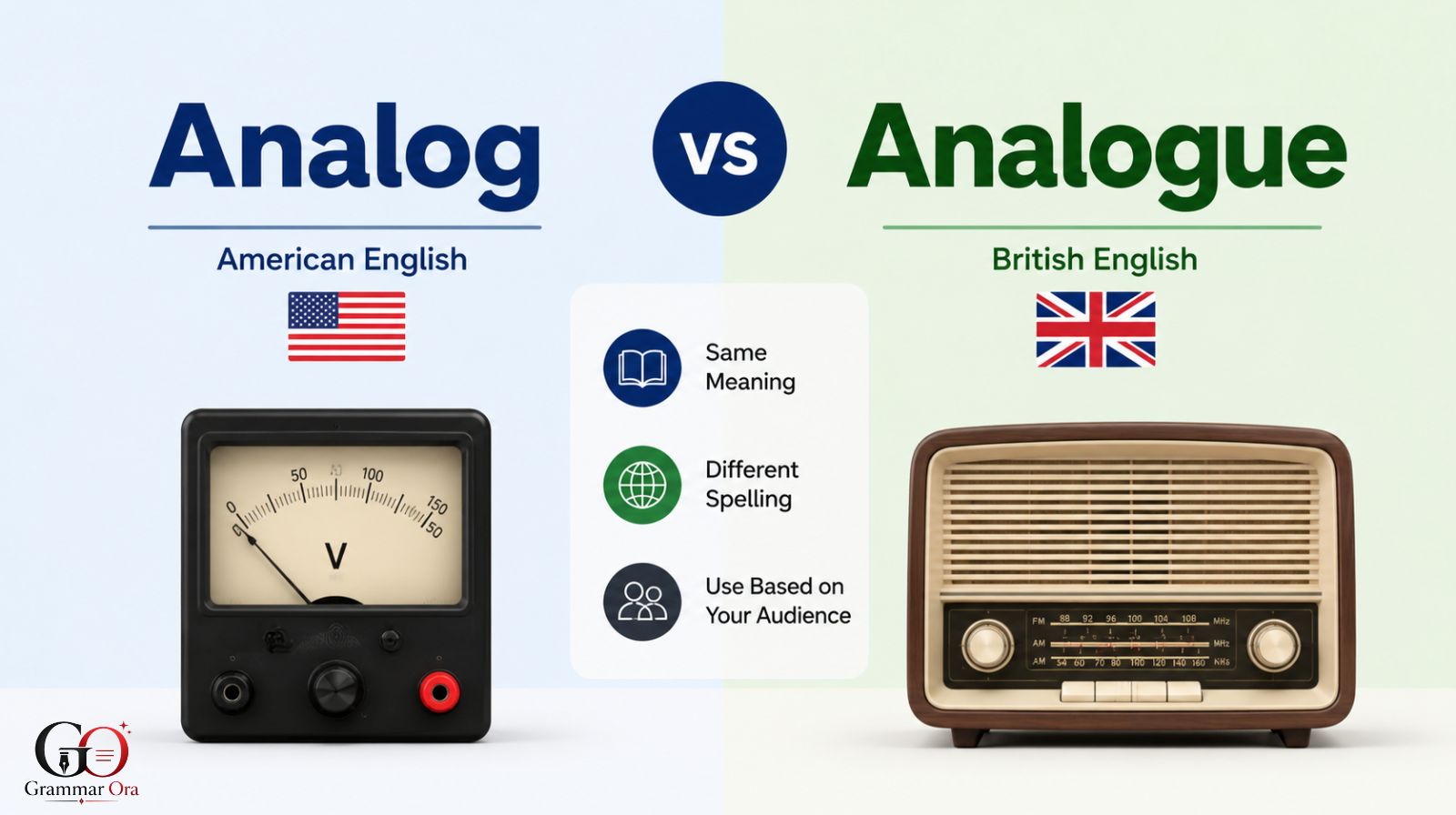
If you’ve seen both analog vs analogue, you might wonder whether one is incorrect or if they mean different things. The good news is that both spellings are correct. The difference comes down to regional English, not meaning.
In this guide, you’ll learn what analog vs analogue means, when to use each spelling, how they’re used in technology and everyday writing, and which version is best for your audience. By the end, you’ll know exactly which spelling fits your situation.
What Is the Difference Between Analog and Analogue?
The difference between analog and analogue is purely one of spelling.
- Analog is the preferred spelling in American English.
- Analogue is the preferred spelling in British English, as well as in many countries that follow British spelling conventions, including Canada (in some contexts), Australia, and New Zealand.
Both words describe something that represents information through continuous physical values rather than digital signals.
Analog vs Analogue at a Glance
| Feature | Analog | Analogue |
|---|---|---|
| Preferred in | United States | United Kingdom |
| Meaning | Continuous signal or comparable thing | Same meaning |
| Correct? | ✅ Yes | ✅ Yes |
| Common in Technology | Yes | Yes |
| Pronunciation | Same | Same |
Quick Example
American English:
I still enjoy listening to analog records.
British English:
The museum displays several analogue radios.
Both sentences are completely correct.
Analog vs Analogue in Technology
Technology is where these words appear most often.
What Is Analog Technology?
Analog technology stores or transmits information using continuous signals.
Examples include:
- Vinyl records
- Cassette tapes
- Film cameras
- Traditional thermometers
- Analog clocks
What Is Digital Technology?
Digital technology uses binary numbers (0s and 1s) instead of continuous signals.
Examples include:
- Smartphones
- MP3 files
- Digital cameras
- Smartwatches
- Streaming services
Example Sentences
- Many musicians still prefer analog recording equipment.
- The engineer repaired an old analogue amplifier.
- Analog photography has become popular among hobbyists.
- Analogue watches remain a classic fashion choice.
Analog vs Analogue in Everyday English
The words aren’t limited to electronics.
They can also describe something similar or comparable.
Examples
- The new system is an analog of the original design.
- This species is the closest analogue found in Europe.
- Scientists often use analog models to explain complex ideas.
- Historians look for historical analogues when comparing events.
In this meaning, both spellings remain interchangeable depending on regional English.
Analog or Analogue: Which Should You Use?
The best spelling depends on your audience.
Use Analog If You Are Writing For
- American readers
- US businesses
- American schools
- US-based websites
- American SEO audiences
Use Analogue If You Are Writing For
- UK readers
- British publications
- Australia
- New Zealand
- International organizations following British English
SEO Tip
If your website primarily targets US traffic, use analog consistently.
If your audience is mostly from the UK, analogue is the better choice.
Avoid mixing both spellings in the same article unless you’re specifically comparing them.
Real-Life Example: Why Consistency Matters
Imagine two technology blogs reviewing the exact same vintage audio equipment. One blog is based in New York and consistently uses the spelling analog, while the other is published in London and uses analogue throughout its content.
Both articles explain the same concepts, discuss identical products, and even recommend the same equipment. However, each article is tailored to its audience’s language expectations. American readers naturally expect to see “analog audio,” “analog recording,” and “analog signal.” British readers, on the other hand, are more familiar with “analogue audio” and “analogue recording.”
Search engines also recognize regional spelling preferences. When users search for “analog camera,” Google often favors pages optimized for American English. Similarly, searches for “analogue camera” may return more UK-focused results.
The lesson is simple: choose one spelling based on your target audience and use it consistently across your website. This improves readability, builds trust with readers, and supports stronger SEO performance without changing the actual meaning of your content.
2025–2026 Data: Why Analog Is Still Relevant
Despite rapid advances in digital technology, analog devices continue to thrive in several industries.
Recent market reports from 2025 indicate:
- Vinyl record sales have continued growing for several consecutive years, reflecting renewed interest in analog audio.
- Professional music studios still use analog equipment for its distinctive sound quality.
- Film photography has experienced a resurgence among artists and hobbyists.
- Luxury watch brands continue producing premium analog watches despite the popularity of smartwatches.
- Many educational institutions still teach analog electronics as a foundation for understanding modern digital systems.
These trends show that analog technology remains valuable, even in an increasingly digital world.
Analog vs Analogue Comparison Checklist
| Question | Choose Analog | Choose Analogue |
|---|---|---|
| Writing for US readers? | ✅ | |
| Writing for UK readers? | ✅ | |
| Same meaning? | ✅ | ✅ |
| Same pronunciation? | ✅ | ✅ |
| Correct spelling? | ✅ | ✅ |
| Different definitions? | ❌ | ❌ |
Common Mistakes to Avoid
Mixing Both Spellings
Choose one spelling and remain consistent throughout your article.
Assuming One Is Wrong
Neither spelling is incorrect.
Ignoring Your Audience
Regional spelling preferences improve readability and user experience.
FAQs
Q1: Is analog or analogue correct?
A: Both are correct. Analog is American English, while analogue is British English.
Q2: Is there any difference in meaning?
A: No. They have exactly the same meaning.
Q3: Why do Americans use analog?
A: American English commonly drops the -ue ending from certain words, resulting in analog.
Q4: Which spelling should I use for SEO?
A: Use the version your audience searches for most. US websites generally perform better with analog, while UK websites should use analogue.
Q5: Is analog still used today?
A: Yes. Analog technology remains popular in music production, photography, broadcasting, engineering, and luxury watches.
Q6: Can I use both spellings in one article?
A: Only if you’re specifically comparing them. Otherwise, stick with one spelling for consistency.
Conclusion
The debate over analog vs analogue isn’t about right or wrong it’s about regional spelling. Analog is the standard choice in American English, while analogue is preferred in British English and many Commonwealth countries. Since both words carry the same meaning, your decision should depend on your target audience.
Whether you’re writing about vintage audio, photography, electronics, or everyday comparisons, using the appropriate spelling consistently will make your content more professional, easier to read, and better optimized for search engines.
For the best SEO results, choose the spelling that matches your readers and use it naturally throughout your content.
👉 Discover more simple and practical grammar guides on Grammar Ora

Muhammad Bilal is an expert blogger in Grammar Guide, dedicated to simplifying English grammar and helping learners write and speak with clarity, confidence, and accuracy.