Have you ever paused while writing an email or company document because you weren’t sure whether to write company-wide or companywide?
You’re not alone. Small punctuation choices like hyphens often create confusion, especially in professional writing where accuracy matters. While both forms appear online, style guides and dictionaries don’t always agree, making the decision even more challenging.
The good news is that the rule is simpler than it seems. In this guide, you’ll learn the difference between company-wide and companywide, discover which spelling is more widely accepted, see real-world examples, and understand when each version is appropriate.
By the end, you’ll know exactly which form to use in emails, reports, websites, HR policies, and business communications.
Is It Company-Wide or Companywide?
The short answer is:
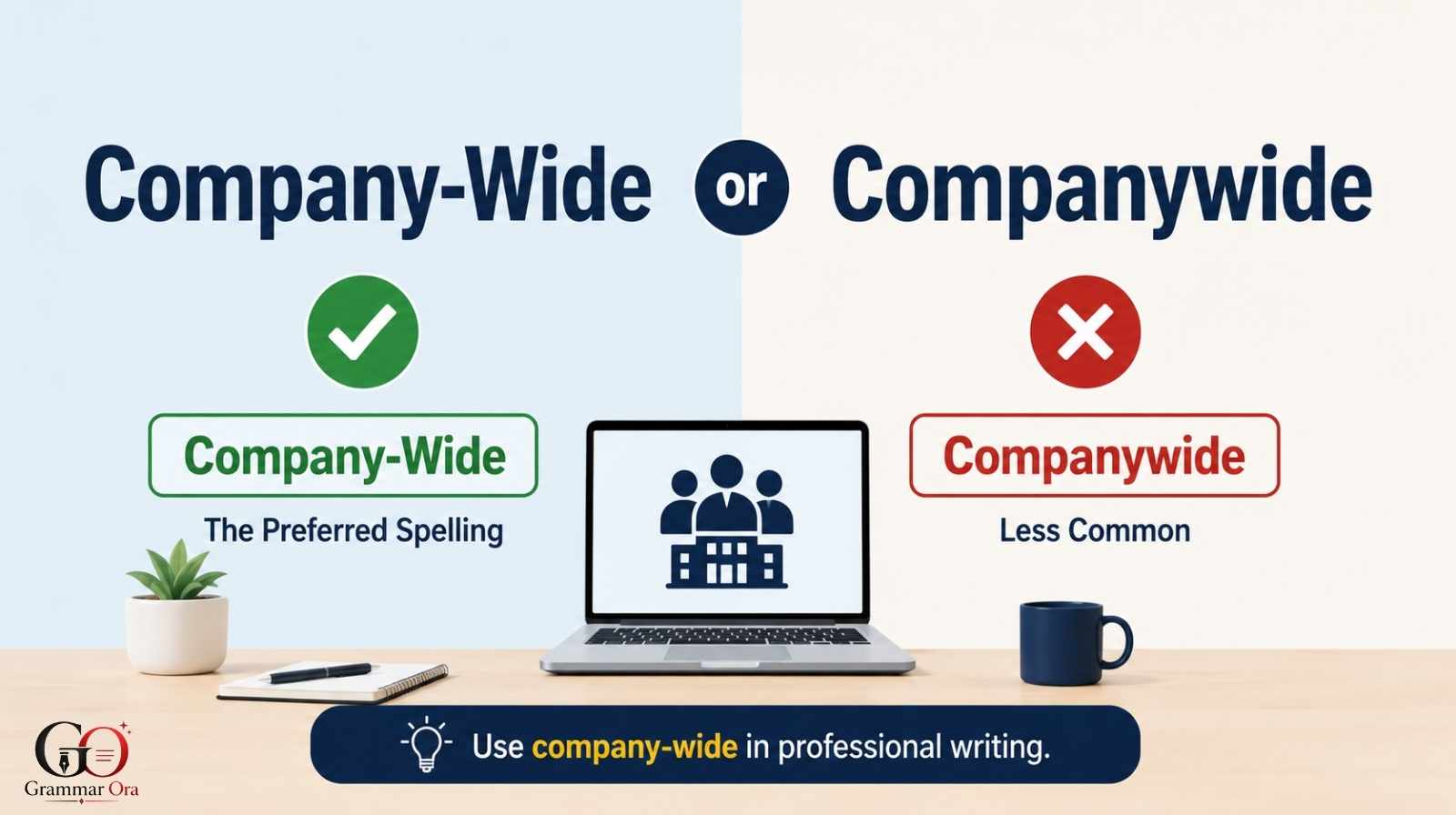
“Company-wide” is the standard and most widely accepted spelling.
The hyphen connects company and wide to show that the action, policy, or event applies to the entire company.
Correct
- Company-wide meeting
- Company-wide announcement
- Company-wide policy
- Company-wide training
- Company-wide initiative
Less Common
- Companywide meeting
- Companywide policy
Although companywide appears in some modern publications and corporate writing, it is still less common than the hyphenated version and isn’t preferred by many major style guides.
Why Does the Hyphen Matter?
Hyphens improve readability by showing that two words work together as a single modifier.
Compare these examples:
Without the Hyphen
“We announced a company wide policy.”
Readers may briefly interpret company and wide as separate words.
With the Hyphen
“We announced a company-wide policy.”
The meaning becomes immediately clear the policy affects the entire company.
This is why editors often recommend keeping the hyphen.
What Do Major Dictionaries Say?
Several respected dictionaries recognize company-wide as the preferred spelling.
Merriam-Webster
Uses company-wide with a hyphen.
Cambridge Dictionary
Generally prefers the hyphenated construction for compound adjectives ending in -wide.
Collins Dictionary
Also recognizes company-wide.
Some modern publications occasionally remove the hyphen, especially in headlines or branding, but traditional grammar still favors the hyphenated version.
Company-Wide as a Compound Adjective
When company-wide comes before a noun, it functions as a compound adjective.
Examples
- A company-wide survey
- A company-wide email
- A company-wide event
- A company-wide update
- A company-wide initiative
Here, the hyphen helps combine the words into one descriptive unit.
Examples in Business Writing
Business communication frequently includes phrases like:
- Company-wide restructuring
- Company-wide compliance training
- Company-wide software update
- Company-wide performance review
- Company-wide security policy
These examples sound professional and follow standard English conventions.
Can You Ever Write “Companywide”?
Yes but with caution.
Some organizations intentionally use companywide because:
- Their internal style guide removes many hyphens.
- They prefer simplified branding.
- Their content management system standardizes compound words.
For example, a software company may consistently write:
“Our companywide initiative improves employee collaboration.”
While this isn’t technically wrong, it is less common and may appear inconsistent if the rest of the document follows traditional grammar rules.
For most writers, company-wide remains the safer and more universally accepted choice.
Company-Wide vs Companywide Comparison
| Feature | Company-Wide | Companywide |
|---|---|---|
| Most common spelling | ✅ Yes | ❌ Less common |
| Preferred in professional writing | ✅ Yes | Sometimes |
| Used by major dictionaries | ✅ Yes | Limited |
| Easier to read | ✅ Yes | Slightly less |
| Best for academic writing | ✅ Yes | Usually not |
Real-Life Example: How One HR Team Improved Communication
A mid-sized technology company with more than 800 employees noticed inconsistent wording across its internal communications. Some HR documents referred to company-wide training, while others used companywide training. Marketing materials mixed both spellings, and even executive emails alternated between the two.
At first, this seemed like a minor issue. However, employees began questioning which version was correct when creating presentations, onboarding guides, and policy documents. The inconsistency also made the company’s knowledge base appear less polished.
The communications team decided to review recommendations from leading dictionaries and editorial style guides. After comparing sources, they adopted company-wide as the official spelling for all internal and external content. They updated their writing guidelines, added examples to their editorial handbook, and trained employees during a documentation workshop.
Within a few months, document consistency improved noticeably. New employees found it easier to follow the company’s writing standards, and editors spent less time correcting repetitive formatting issues. Although changing a single hyphen may seem insignificant, establishing one clear standard helped strengthen the company’s professional image and reduced confusion across departments.
The lesson is simple: consistency matters. Whether you’re writing emails, reports, or website content, choosing one accepted style and using it consistently creates clearer communication.
2025–2026 Language Trends and Writing Statistics
Recent language and workplace trends show that clear, consistent writing continues to play an important role in professional communication.
- More organizations are investing in editorial style guides to improve consistency across digital content.
- Business communication experts continue recommending compound adjectives with hyphens when they improve readability.
- Digital publishing teams increasingly rely on consistent grammar to improve user trust and search visibility.
- Many corporate content teams still follow established references such as AP Style, Chicago Manual of Style, Merriam-Webster, and major dictionaries when deciding whether to hyphenate compound modifiers.
Although language naturally evolves, company-wide remains the dominant form in professional and edited English.
Best Practices for Using Company-Wide Correctly
Follow these simple guidelines:
✅ Use company-wide in business documents.
✅ Keep the hyphen before nouns.
✅ Stay consistent throughout your document.
✅ Follow your organization’s style guide if one exists.
✅ Choose readability over trend-based spellings.
Avoid switching between company-wide and companywide within the same article or report.
Common Mistakes
Incorrect
- Company wide meeting
- Company wide announcement
- Companywide policy (if your style guide prefers hyphens)
- Company wide update
Correct
- Company-wide meeting
- Company-wide announcement
- Company-wide policy
- Company-wide update
FAQs
Q1: Is company-wide grammatically correct?
A: Yes. Company-wide is the standard and most widely accepted spelling in professional English.
Q2: Is companywide one word?
A: It can appear as one word in some publications, but it is much less common than company-wide.
Q3: Why is there a hyphen in company-wide?
A: The hyphen joins company and wide into a compound adjective, making the meaning clearer.
Q4: Which spelling should I use in business writing?
A: Choose company-wide unless your organization’s style guide specifically prefers companywide.
Q5: Is company-wide used in American and British English?
A: Yes. The hyphenated form is commonly accepted in both American and British English.
Q6: Does Microsoft Word accept company-wide?
A: Yes. Most modern spell checkers recognize company-wide as the standard spelling.
Conclusion
When deciding between Company-Wide or Companywide, the safest and most widely accepted choice is company-wide. The hyphen improves readability, follows traditional grammar conventions, and aligns with the recommendations of many dictionaries and editorial style guides.
While companywide is occasionally used by some organizations, it remains less common in professional writing. If you want your emails, reports, policies, and website content to look polished and consistent, company-wide is the better option.
The next time you write about an initiative, announcement, policy, or meeting that affects everyone in your organization, you’ll know exactly which spelling to choose.
👉 Discover more simple and practical grammar guides on Grammar Ora

Muhammad Bilal is an expert blogger in Grammar Guide, dedicated to simplifying English grammar and helping learners write and speak with clarity, confidence, and accuracy.