Have you ever paused while writing traveling and wondered whether it should actually be travelling? You’re not alone. It’s one of the most common spelling questions in English, especially for students, writers, bloggers, and professionals who write for international audiences.
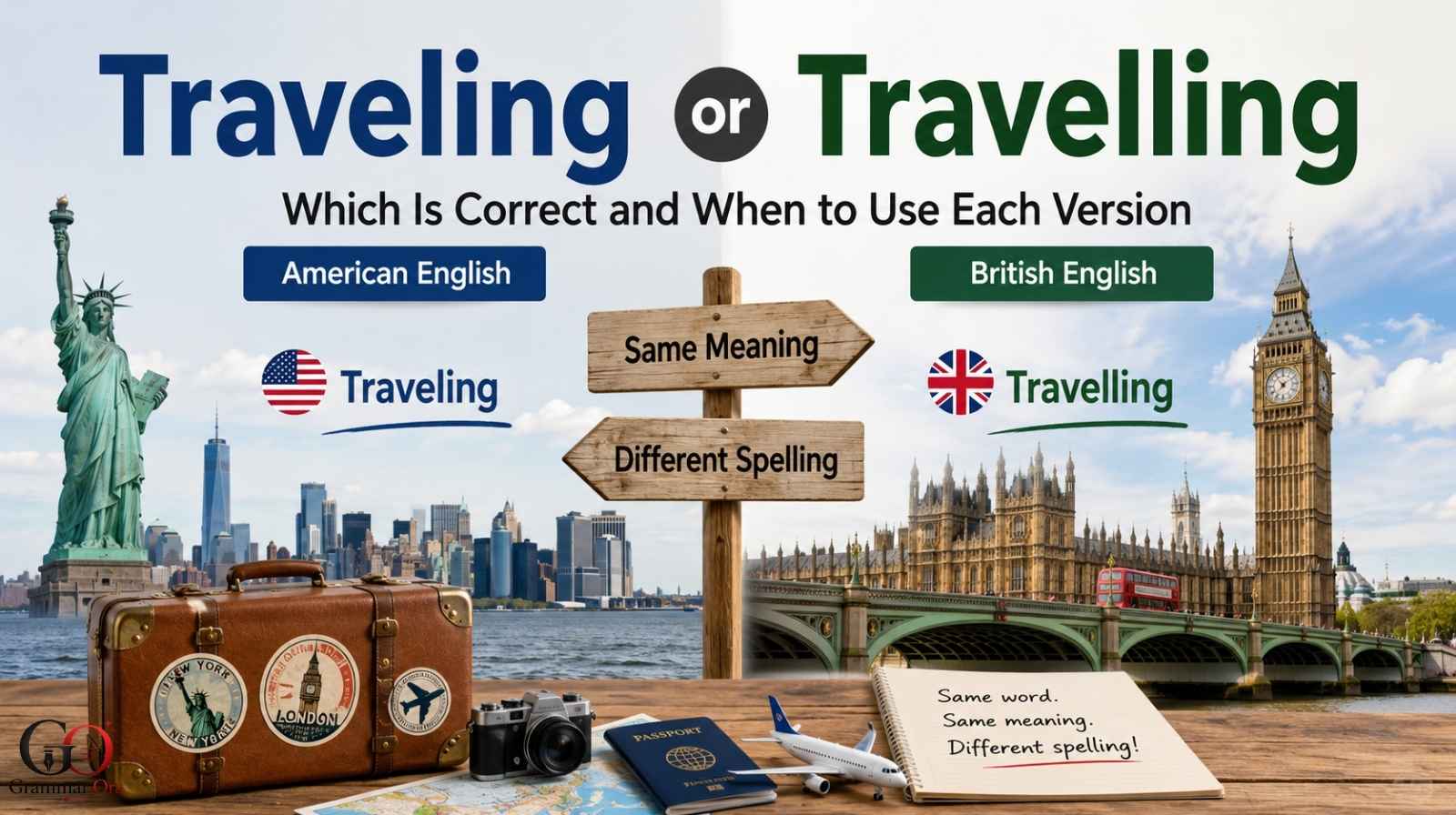
The confusing part is that both spellings are correct. The difference depends on the version of English you’re using. While American English prefers traveling, British English uses travelling.
In this guide, you’ll learn the difference between these two spellings, discover when to use each one, see real-world examples, and avoid one of the most common English spelling mistakes.
Is It Traveling or Travelling?
The short answer is simple:
- Traveling is the preferred spelling in American English.
- Travelling is the preferred spelling in British English, as well as Australian, Canadian (often), and many other Commonwealth countries.
Both words have exactly the same meaning:
Traveling/Travelling means going from one place to another, usually over a long distance.
The only real difference is the regional spelling convention.
Why Do the Spellings Differ?
The variation comes from differences between American English and British English spelling rules.
In American English, many words ending with a vowel followed by l keep only one l before adding -ing.
British English usually doubles the l before adding -ing.
This pattern appears in many other words too.
Quick Answer
| American English | British English |
|---|---|
| Traveling | Travelling |
| Traveled | Travelled |
| Traveler | Traveller |
Traveling vs Travelling: What’s the Difference?
Although the spelling changes, the meaning never does.
Traveling (American English)
If you’re writing for readers in the United States, use traveling.
Examples:
- I’m traveling to California next week.
- She loves traveling during summer vacations.
- He spends most of the year traveling for work.
This spelling follows standard American dictionaries like Merriam-Webster.
Travelling (British English)
If you’re writing for readers in the UK or many Commonwealth countries, use travelling.
Examples:
- We’re travelling across Europe this summer.
- She enjoys travelling by train.
- He’s travelling for business next month.
This version appears in dictionaries such as the Cambridge Dictionary and Oxford English Dictionary.
Why Does American English Use One “L”?
One reason comes from spelling reforms introduced by American lexicographer Noah Webster.
Webster simplified many English spellings to make them more consistent.
Examples include:
| American | British |
|---|---|
| Traveling | Travelling |
| Canceled | Cancelled |
| Labeled | Labelled |
| Modeled | Modelled |
American English generally avoids doubling the final l when the last syllable isn’t stressed.
British English usually keeps the double l, making spellings like travelling standard.
How to Choose the Correct Spelling
Choosing the correct version depends entirely on your audience.
Use Traveling If You Write For:
- American readers
- US businesses
- American schools and universities
- US-based websites
- American newspapers
Use Travelling If You Write For:
- United Kingdom
- Australia
- New Zealand
- Ireland
- Many international organizations using British English
If Your Audience Is Global
Consistency matters more than the spelling itself.
If your article starts with American English, continue using American spelling throughout.
If you choose British English, keep every spelling consistent.
Avoid mixing both versions in the same article.
Common Mistakes People Make
Many learners accidentally mix spelling styles.
Incorrect:
- I love traveling around Europe while my favourite hobby is travelling.
Correct
- I love traveling around Europe.
Correct
- I love travelling around Europe.
Another mistake is assuming one spelling is incorrect.
Remember:
✔ Traveling = Correct
✔ Travelling = Correct
The only difference is regional English.
Real-Life Example: Why One Letter Matters
Imagine Sarah, a freelance travel writer based in Canada. She wrote an article titled “10 Tips for Traveling Europe on a Budget.” When pitching it to a British travel magazine, the editor accepted the content but asked her to update the spelling to match the publication’s style guide. Every instance of traveling, traveled, and traveler was changed to travelling, travelled, and traveller.
Later, Sarah republished a similar version for an American audience. This time, she switched the spellings back to the American versions because her readers expected American English conventions.
Nothing about the advice changed only the spelling. Yet using the preferred regional spelling made the content feel more natural and professional to each audience. This is common practice among publishers, businesses, and global brands. Matching your readers’ language expectations builds trust and improves readability, even when the meaning stays exactly the same.
Spelling Differences Related to Traveling
Many English words follow the same regional pattern.
| American English | British English |
|---|---|
| Traveling | Travelling |
| Traveled | Travelled |
| Traveler | Traveller |
| Canceled | Cancelled |
| Counseling | Counselling |
| Jewelry | Jewellery |
| Program | Programme (certain contexts) |
Recognizing these patterns makes it easier to switch between American and British English without confusion.
2025–2026 Usage Trends and Data
Recent language trends show that both spellings remain widely accepted, but their popularity varies by region.
- Search engines continue to return results for both spellings because users search with their local English conventions.
- Major American publications overwhelmingly use traveling, while British newspapers and publishers consistently use travelling.
- SEO professionals recommend matching the spelling to your target audience, as it improves user experience and aligns with regional search behavior.
- According to recent language usage trends in 2025–2026, American English dominates much of the global web, but British English remains the standard across the UK, Australia, and many international organizations.
For websites targeting a specific country, using the local spelling can strengthen consistency and reader trust.
FAQs
Q1: Is traveling correct?
A: Yes. Traveling is the standard spelling in American English.
Q2: Is travelling wrong?
A: No. Travelling is the standard spelling in British English.
Q3: Which spelling should I use in school?
A: Use the spelling style required by your teacher, school, or institution. American schools typically prefer traveling, while British schools expect travelling.
Q4: Does Google recognize both spellings?
A: Yes. Google understands both spellings and usually returns results based on your location and search preferences.
Q5: Which spelling is better for SEO?
A: Neither is universally better. Choose the spelling that matches your target audience and use it consistently throughout your content.
Q6: Why does British English double the “L”?
A: British English generally doubles the final l before adding suffixes like -ing or -ed, whereas American English often keeps a single l in these cases.
Conclusion
The debate over traveling or travelling spelling isn’t about right versus wrong it’s about American English versus British English.
If you’re writing for readers in the United States, use traveling. If your audience is in the United Kingdom, Australia, or other countries that follow British English, use travelling.
The most important rule is consistency. Pick one spelling style based on your audience and stick with it throughout your writing. Doing so makes your content look polished, professional, and easier for readers to trust.
Whether you choose traveling or travelling, you’re using correct English the only difference is where your readers are from.
👉 Discover more simple and practical grammar guides on Grammar Ora

Muhammad Bilal is an expert blogger in Grammar Guide, dedicated to simplifying English grammar and helping learners write and speak with clarity, confidence, and accuracy.