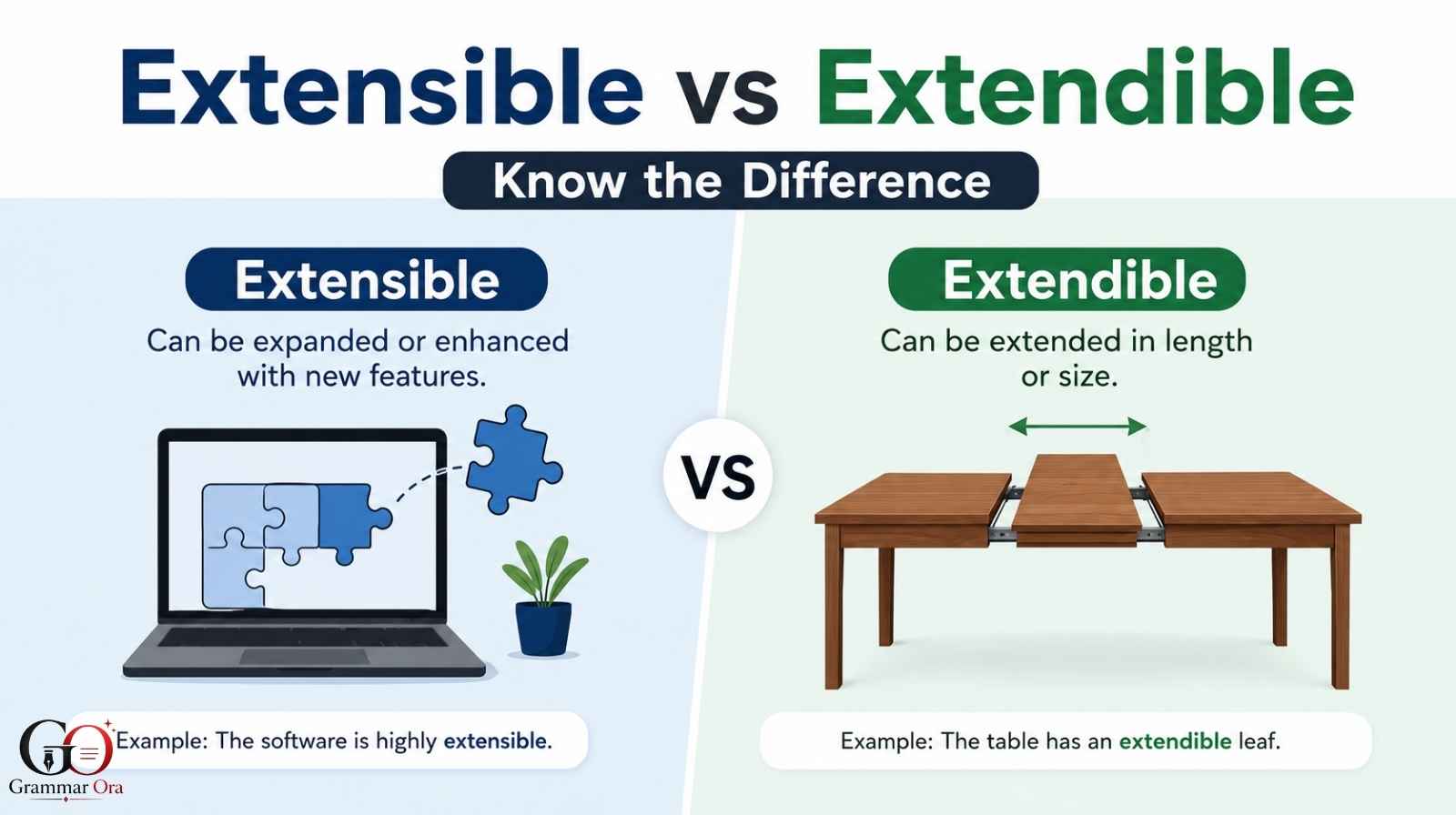
Have you ever come across the words extensible vs extendible and wondered whether they mean the same thing? You’re not alone. These two words look almost identical, and many writers, students, software developers, and English learners often confuse them.
The good news is that both words are correct English. However, they aren’t used equally, and one is much more common than the other in modern writing especially in technology, engineering, and academic contexts.
In this guide, you’ll learn the meaning of extensible vs extendible, understand their subtle differences, discover where each word is used, and see plenty of real-world examples. By the end, you’ll know exactly which word fits your sentence and why.
What Does Extensible Mean?
Extensible is an adjective that describes something that is designed to be expanded, enhanced, or modified without changing its original structure.
Today, this is the preferred word in software development, technology, engineering, and many professional industries.
Extensible Definition
An extensible system allows new features or functions to be added easily while keeping the existing framework intact.
Examples of Extensible
- The software has an extensible architecture.
- This programming language is highly extensible.
- Our platform is designed to be extensible for future updates.
- The framework supports extensible plugins.
Why Is “Extensible” So Popular?
The word emphasizes future growth through design rather than simply making something longer. That’s why it’s widely used in technical documentation and professional writing.
What Does Extendible Mean?
Extendible is also a correct adjective. It describes something that can be extended or made longer.
Unlike extensible, this word focuses more on the physical or literal act of extending something.
Extendible Definition
Something that is extendible can increase in length, size, duration, or reach.
Examples of Extendible
- The table has an extendible leaf.
- They bought an extendible ladder.
- The antenna is fully extendible.
- The dining table includes extendible sections.
Is Extendible Wrong?
No. It is grammatically correct.
However, it appears far less frequently in modern English because extensible has become the preferred choice in many industries.
Extensible vs Extendible: What’s the Difference?
Although both words originate from the verb extend, their meanings have evolved differently.
| Feature | Extensible | Extendible |
|---|---|---|
| Meaning | Can be expanded or enhanced | Can be physically extended |
| Common Usage | Software, technology, engineering | Furniture, tools, physical objects |
| Popularity | Very common | Less common |
| Focus | Adding capabilities | Increasing length or size |
| Modern Preference | Preferred | Less frequently used |
Quick Rule
Use extensible when discussing systems, software, frameworks, or anything designed for future growth.
Use extendible when referring to physical objects that become longer or larger.
Why Do People Confuse Extensible and Extendible?
The confusion happens because both words come from the same root verb: extend.
They also share similar pronunciation and spelling.
Similar Origins
Both derive from the Latin extendere, meaning “to stretch out.”
Over time, English developed two adjectives that took on different common uses.
Modern Usage Changed
Language evolves with professional fields.
As software engineering expanded, extensible became the industry standard because it better describes systems that accept new functionality.
Meanwhile, extendible remained mostly associated with physical objects.
Extensible in Technology and Software Development
One reason extensible is so common today is the rapid growth of software platforms.
Modern applications must evolve without rebuilding everything from scratch.
Extensible Architecture
Developers create extensible systems that support:
- Plugins
- Modules
- APIs
- Third-party integrations
- Custom features
Extensible Programming Languages
Many programming languages allow developers to add libraries, frameworks, or packages without modifying the core language.
Examples include:
- Python
- Java
- JavaScript
- C#
This flexibility makes software easier to maintain and upgrade.
Why Businesses Prefer Extensible Systems
Companies save time and money by choosing software that can grow with their needs instead of replacing entire systems every few years.
Real-Life Example: How an Extensible Design Saved a Growing Business
Imagine a small online clothing store that launched with only basic shopping features. Initially, the website handled product listings, payments, and customer accounts. As the business grew, customers began requesting loyalty rewards, live chat support, personalized recommendations, and multiple payment options.
Because the store was built on an extensible eCommerce platform, the owners didn’t need to rebuild the website from scratch. Instead, they added new plugins and integrations one by one. Within a few months, they introduced a rewards program, connected advanced shipping tools, and integrated marketing automation software without disrupting the existing system.
A competing retailer using a less flexible platform faced a different experience. Every major feature required custom coding, resulting in higher costs, longer development times, and frequent compatibility issues.
This example highlights why businesses increasingly choose extensible software. Planning for future expansion reduces long-term expenses, minimizes downtime, and allows organizations to adapt quickly as customer expectations change.
Data and Industry Trends (2025–2026)
Recent technology reports continue to emphasize the importance of software flexibility and modular design.
- Organizations increasingly prioritize scalable and extensible software architectures when adopting cloud-based solutions.
- API-first development continues to grow because it enables systems to expand without major redesigns.
- Businesses investing in modular software report faster deployment of new features and easier maintenance compared to rigid systems.
- Open-source platforms remain popular because their extensible ecosystems encourage community-built plugins and integrations.
These trends demonstrate why extensible has become far more common than extendible in professional and technical writing.
How to Choose the Correct Word
Use Extensible When…
- Talking about software
- Discussing applications
- Describing programming frameworks
- Referring to business systems
- Explaining technology platforms
Use Extendible When…
- Talking about ladders
- Describing tables
- Referring to poles
- Mentioning antennas
- Discussing physical equipment
Easy Memory Trick
Think of extensible as adding extra capabilities.
Think of extendible as becoming longer in size.
This simple trick helps most writers remember the difference instantly.
Common Mistakes to Avoid
Using Extendible for Software
❌ The application has an extendible architecture.
✅ The application has an extensible architecture.
Using Extensible for Physical Objects
❌ We bought an extensible dining table.
✅ We bought an extendible dining table.
Assuming One Word Is Incorrect
Many people believe only one spelling exists.
In reality, both are correct they simply fit different contexts.
FAQs
Q1: Is extensible or extendible correct?
A: Both are correct English words. Extensible is generally preferred for software, systems, and technology, while extendible usually refers to physical objects that can be made longer.
Q2: Why is extensible more common?
A: Because software development, cloud computing, and modular system design frequently use the concept of adding new functionality, extensible has become the standard term in technical writing.
Q3: Can I use the words interchangeably?
A: Not always. Although dictionaries recognize both words, choosing the one that matches the context makes your writing clearer and more professional.
Q4: Is extendible outdated?
A: No. It still appears in dictionaries and is commonly used for physical products such as ladders, tables, poles, and antennas.
Q5: Which word should I use in programming?
A: Always use extensible, as it is the accepted term in software engineering and technical documentation.
Conclusion
Understanding extensible vs extendible is easier once you know their modern usage. While both words are grammatically correct, extensible is the preferred choice when discussing software, technology, systems, and anything designed for future expansion. Extendible, on the other hand, is best reserved for physical objects that can be lengthened or enlarged.
Choosing the right word improves clarity, strengthens your writing, and helps you communicate more professionally. The next time you encounter these similar-looking terms, you’ll know exactly which one belongs in your sentence.
👉 Discover more simple and practical grammar guides on Grammar Ora

Muhammad Bilal is an expert blogger in Grammar Guide, dedicated to simplifying English grammar and helping learners write and speak with clarity, confidence, and accuracy.


