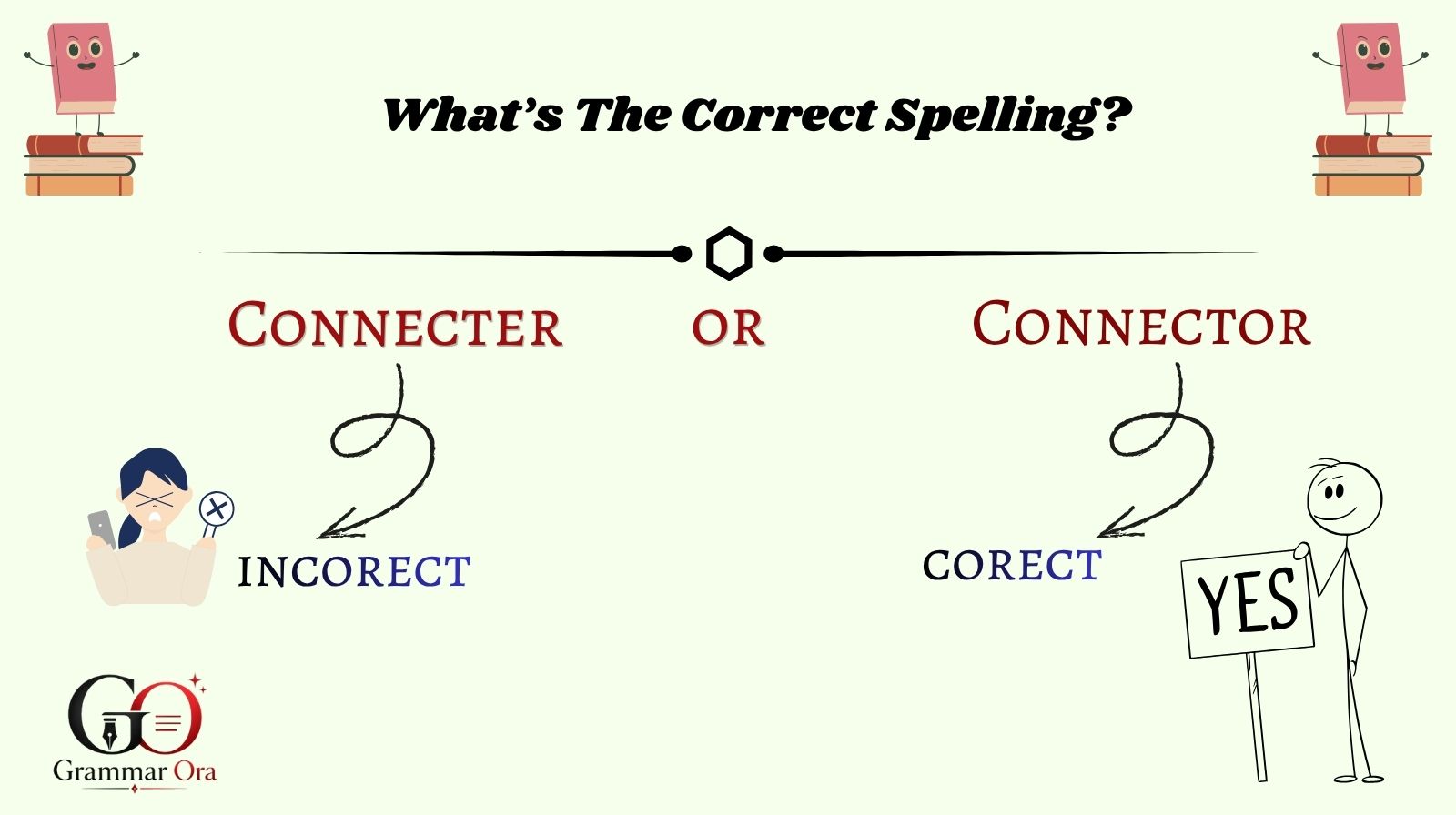
Have you ever typed “connecter” and suddenly wondered whether it should actually be “connector”? You are not alone. Many English learners, students, writers, and even professionals get confused between these two spellings because they look and sound very similar.
However, only one of them is considered correct in standard English.
In this guide, you will learn the difference between connecter or connector, which spelling is correct, why people confuse these words, and how to use the right spelling confidently in everyday writing. You will also discover real examples, grammar explanations, a simple comparison table, and practical tips to avoid this common spelling mistake in the future.
What Does “Connector” Mean?
The correct spelling is connector.
A connector is something that joins, links, or connects two things together. The word is commonly used in technology, grammar, communication, engineering, networking, and everyday English.
Examples of “Connector” in Sentences
- The USB connector stopped working.
- Transition words act as connectors between ideas.
- The electrician replaced the damaged cable connector.
- Emotional connectors help brands communicate with customers.
In all these examples, connector refers to something that creates a link or connection.
Why “Connector” Is Correct
The word comes from the verb connect plus the suffix -or, which is commonly used in English to describe a person, tool, or thing that performs an action.
Examples:
| Verb | Correct Noun |
|---|---|
| Act | Actor |
| Conduct | Conductor |
| Connect | Connector |
Therefore, connector follows the standard English word formation rule.
Is “Connecter” a Real Word?
Technically, connecter exists in very limited historical or regional usage, but it is not accepted as the standard spelling in modern English.
Today, dictionaries, grammar guides, and professional writing standards overwhelmingly prefer connector.
Why People Write “Connecter”
The confusion usually happens because:
1. Similar Pronunciation
Both words sound nearly identical in casual speech.
2. Spelling Pattern Confusion
Many English words end in -er, so writers naturally assume “connecter” should follow the same pattern.
3. Autocorrect and Typing Habits
Fast typing or weak autocorrect suggestions can sometimes produce the wrong spelling.
However, in professional, academic, and SEO writing, connector is the correct choice.
Connecter or Connector: Quick Comparison
| Feature | Connecter | Connector |
|---|---|---|
| Standard English | ❌ No | ✅ Yes |
| Accepted in dictionaries | Rarely | Yes |
| Common modern usage | Very uncommon | Extremely common |
| Used in technology | ❌ | ✅ |
| Used in grammar | ❌ | ✅ |
| Recommended for writing | ❌ | ✅ |
Quick Answer
If you are choosing between connecter or connector, always use connector in modern English writing.
Why “Connector” Is Common in Technology and Grammar
The word connector appears frequently in both technical and non-technical fields.
Connector in Technology
In technology, a connector links devices, cables, or systems together.
Examples include:
- HDMI connector
- USB connector
- Ethernet connector
- Power connector
Without connectors, electronic communication between devices would fail.
Connector in Writing and Grammar
In grammar, connectors help join sentences and ideas smoothly.
Common connectors include:
- However
- Therefore
- Although
- Meanwhile
- For example
These words improve readability and help readers follow your thoughts more naturally.
Connector in Human Communication
Marketing experts also use the term connector to describe a person who builds relationships between people or communities.
For example:
A strong social connector can help businesses grow faster through networking.
Because of its versatility, the word connector is widely recognized across industries.
Real-Life Example: How One Small Spelling Mistake Hurt a Website
A small spelling mistake may seem harmless, but it can affect professionalism, SEO rankings, and user trust.
In 2025, a freelance tech blogger published an article reviewing laptop accessories. Throughout the article, the writer repeatedly used the spelling “connecter” instead of “connector.”
At first, the mistake seemed minor. However, the article struggled to rank on Google despite having useful information. After reviewing the content, an SEO editor noticed that the primary keyword users searched for was “USB connector,” not “USB connecter.”
The writer corrected the spelling across the article, updated headings, image alt text, and metadata, and republished the content. Within several weeks, the article began receiving more impressions and better search visibility.
This happened because search engines prioritize standard spelling and commonly searched keywords. Readers also tend to trust content that follows correct grammar and spelling rules.
The example shows how using the correct spelling especially for SEO-focused content can directly impact visibility and credibility online.
Grammar Rule Behind Connector
Understanding the grammar pattern makes this easier to remember permanently.
The “-or” Suffix Rule
English often uses the suffix -or for nouns describing tools, devices, or agents performing actions.
Examples include:
| Verb | Noun |
|---|---|
| Connect | Connector |
| Translate | Translator |
| Reflect | Reflector |
| Conduct | Conductor |
Since a connector performs the action of connecting, the “-or” ending is grammatically correct.
Why “-er” Feels Natural
The suffix -er is also common in English.
Examples:
- Teacher
- Writer
- Speaker
Because of this pattern, many writers incorrectly assume “connecter” should exist as the standard noun form.
However, English does not always follow one universal rule. Some words naturally take -or instead.
Data and Usage Trends (2025–2026)
Language usage data clearly shows that connector dominates modern English.
According to writing trend analysis tools and search engine keyword databases from 2025:
- “Connector” receives significantly higher monthly search volume than “connecter.”
- Technical industries almost exclusively use “connector.”
- Grammar and education websites consistently recommend “connector.”
- “Connecter” is mostly identified as a misspelling.
Additionally, SEO keyword research platforms show that searches for phrases like:
- USB connector
- wire connector
- sentence connectors
- connector words
continue growing due to increased technology and online education usage.
This confirms that connector is the preferred and trusted spelling globally.
How to Remember the Correct Spelling
If you frequently confuse connecter or connector, these simple tricks can help.
Think About Technology
Most electronic devices use “connectors,” not “connecters.”
Imagine:
- USB connector
- charging connector
- cable connector
Seeing the word in real products helps reinforce the correct spelling.
Remember Similar Words
Think of related nouns ending in -or:
- Conductor
- Reflector
- Translator
Connector follows the same structure.
Use Spell Check Carefully
Modern grammar tools usually flag “connecter” as incorrect. However, always proofread manually because automated tools are not perfect.
Common Mistakes People Make
Many writers accidentally misuse the word in these situations.
Incorrect Examples
❌ The HDMI connecter is broken.
❌ Use transition connecters in essays.
❌ This connecter improves network speed.
Correct Examples
✅ The HDMI connector is broken.
✅ Use transition connectors in essays.
✅ This connector improves network speed.
Using the correct spelling improves clarity and professionalism instantly.
Connector Synonyms and Related Words
Depending on context, you can also use related words like:
- Link
- Adapter
- Coupler
- Bridge
- Joiner
- Interface
However, these words may have slightly different meanings depending on technical or grammatical usage.
For example:
- A USB adapter is not exactly the same as a USB connector.
- A transition word acts as a connector in writing.
Therefore, context always matters.
Best Practices for Writers and Students
If you create academic, technical, or SEO content, following proper spelling standards is essential.
Always Use Standard English
Readers trust content that looks polished and accurate.
Verify Industry Terms
Technical terminology should always match industry-standard spelling.
Optimize for Search Engines
Search engines recognize and prioritize common keyword usage. Using the wrong spelling may reduce discoverability.
Proofread Before Publishing
Even experienced writers make small spelling mistakes. Careful proofreading improves content quality significantly.
FAQs
Q1: Is connecter ever correct?
A: Connecter” exists in rare or outdated usage, but it is not considered standard modern English. “Connector” is the correct spelling for almost all situations.
Q2: Which spelling should I use in professional writing?
A: Always use connector in academic, business, technical, and SEO writing.
Q3: Why do people confuse connecter and connector?
A: The confusion happens because both words sound similar, and many English nouns end in “-er.”
Q4: Is connector used in grammar?
A: Yes. In grammar, connectors are words that link ideas, sentences, or paragraphs smoothly.
Q5: Is connector used in technology?
A: Yes. Connector is extremely common in technology, electronics, networking, and engineering.
Q6: Does Google recognize connecter?
A: Google usually treats “connecter” as a misspelling and may suggest “connector” instead.
Q7: Which spelling is better for SEO?
A: Connector” is far better for SEO because it matches standard search behavior and user intent.
External References
For further reading and language verification, you can explore:
Conclusion
If you have been confused between connecter or connector, the answer is simple: connector is the correct and standard spelling in modern English.
While “connecter” may occasionally appear in outdated or incorrect usage, it is not recommended for professional, academic, technical, or SEO writing. Connector is widely accepted in grammar, technology, networking, electronics, and communication contexts.
By understanding the grammar rule, usage patterns, and real-world examples, you can now use the correct spelling confidently in any situation.
The next time you write about cables, transition words, networking, or communication tools, remember this simple rule:
Connector connects correctly.
If you found this guide helpful, consider bookmarking it and sharing it with other writers, students, or English learners who may also confuse connecter and connector.
👉 Discover more simple and practical grammar guides on Grammar Ora

Muhammad Bilal is an expert blogger in Grammar Guide, dedicated to simplifying English grammar and helping learners write and speak with clarity, confidence, and accuracy.