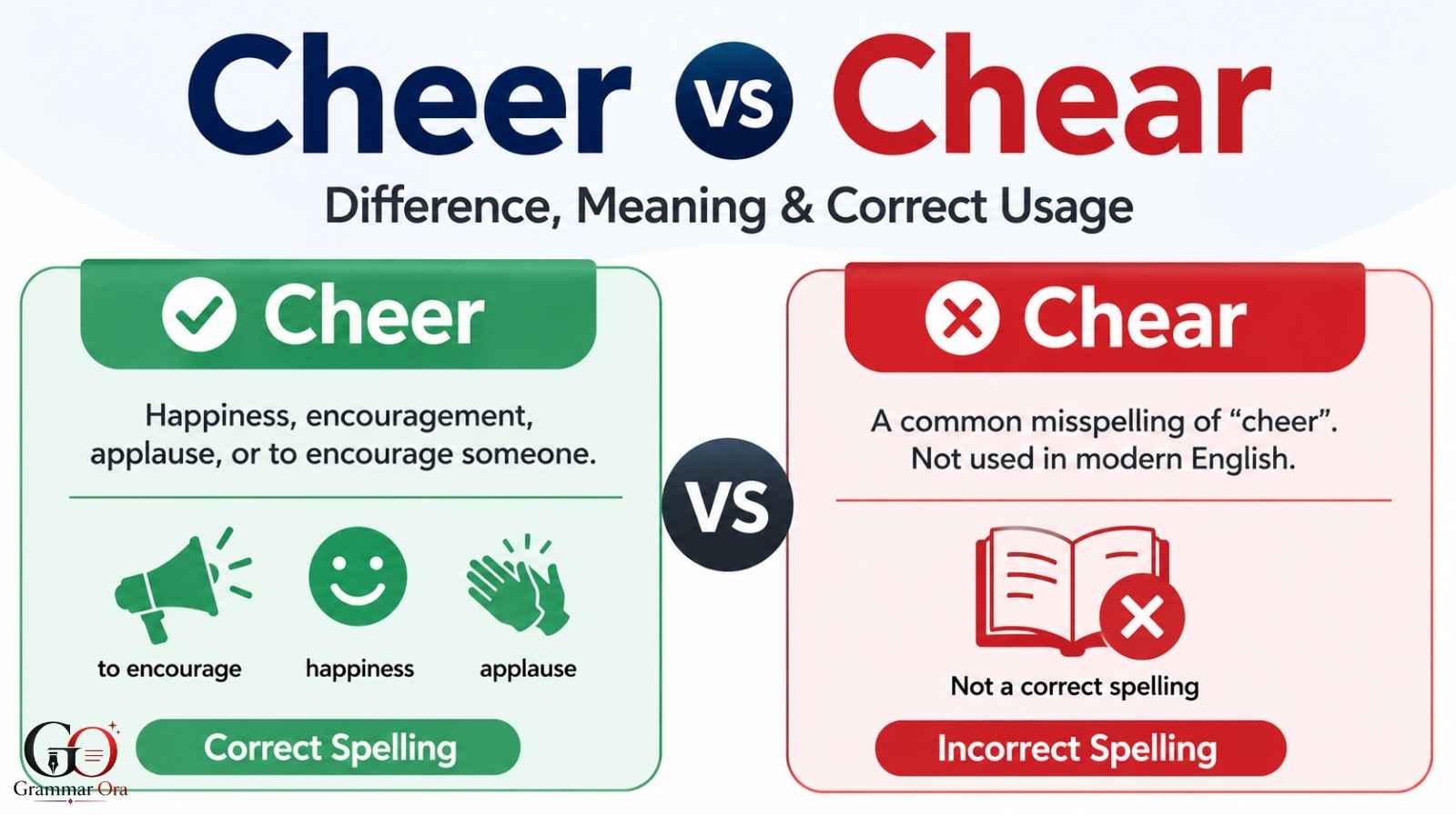
Have you ever typed “chear” vs “cheer” and wondered if both words are correct? You’re not alone. Thousands of English learners, students, and even native speakers occasionally confuse these spellings because they sound nearly identical.
The good news is that the difference is simple once you understand it. In this guide, you’ll learn the meaning of cheer, vs chear is a real English word, how to use cheer correctly in sentences, common mistakes to avoid, and easy memory tricks to remember the correct spelling.
By the end, you’ll never hesitate when choosing between cheer and chear.
What Is the Difference Between Cheer and Chear?
The quick answer is simple:
| Word | Correct? | Meaning |
|---|---|---|
| Cheer | ✅ Yes | Happiness, encouragement, applause, or to encourage someone |
| Chear | ❌ No (modern English) | A common misspelling of cheer |
In modern English, cheer is the only correct spelling.
Although you may occasionally find chear in very old historical texts or surname references, it is not accepted as the standard English spelling today.
Why People Confuse Them
Several factors contribute to this mistake:
- Both words are pronounced the same.
- English contains many words ending in -ear.
- Typing errors and autocorrect mistakes.
- Limited exposure to the correct spelling.
What Does “Cheer” Mean?
The word cheer has several meanings depending on the context.
Cheer as a Noun
It means happiness, encouragement, or applause.
Examples:
- The crowd erupted in cheer after the winning goal.
- Holiday decorations brought cheer to the neighborhood.
- Her smile filled the room with cheer.
Cheer as a Verb
It means to encourage, support, or applaud.
Examples:
- Everyone cheered for the marathon runners.
- Let’s cheer our teammates.
- The audience stood to cheer the performers.
Common Expressions with Cheer
- Cheer up
- Cheer someone on
- Good cheer
- Loud cheers
- Holiday cheer
Is “Chear” Ever Correct?
The simple answer is no for everyday English.
Modern English Usage
Major dictionaries recognize cheer as the standard spelling.
If you write:
We all gave a loud chear.
it will generally be considered a spelling mistake.
The correct sentence is:
We all gave a loud cheer.
Rare Historical Usage
You may occasionally encounter chear in:
- Historical manuscripts
- Old English literature
- Family surnames
- Archived documents
These instances do not make it correct in modern writing.
Cheer vs Chear: Side-by-Side Comparison
| Feature | Cheer | Chear |
|---|---|---|
| Correct modern spelling | ✅ | ❌ |
| Found in dictionaries | ✅ | Rare historical references only |
| Used in schools | ✅ | ❌ |
| Accepted in professional writing | ✅ | ❌ |
| Used in business emails | ✅ | ❌ |
| Common on the internet | Very common | Mostly spelling mistakes |
Quick Checklist
Before using the word, ask yourself:
- ✅ Am I writing about encouragement?
- ✅ Am I referring to applause?
- ✅ Am I describing happiness?
If yes, always choose cheer.
How to Use Cheer Correctly in Everyday English
In Conversations
- Cheer up!
- We all cheered together.
- Thanks for cheering me on.
In School Writing
- The students gave a loud cheer after the announcement.
- Her positive attitude spread cheer across the classroom.
In Business Communication
- Let’s cheer the team’s success.
- The company celebrated with holiday cheer.
In Sports
- Fans cheered throughout the match.
- The stadium was filled with cheers.
Real-Life Example: How One Small Spelling Mistake Changed the Impression
Emma, a university student, was preparing a motivational speech for a school leadership competition. She wanted to encourage her classmates during exam season and included the sentence:
“Let’s all give our friends a loud chear during difficult times.”
Although her speech was thoughtful, one of her teachers noticed the spelling mistake before the presentation. The teacher explained that “chear” is not the accepted spelling in modern English and suggested changing it to “cheer.”
Emma later admitted that she had been spelling the word incorrectly for years because she relied on pronunciation rather than checking a dictionary. After learning the correct spelling, she updated her notes, presentation slides, and future assignments.
A few weeks later, she also noticed that her social media captions and emails looked more professional because she had corrected similar spelling mistakes. This small improvement increased her confidence in academic writing and helped her avoid losing marks for avoidable errors.
The lesson is simple: even one incorrect spelling can affect the professionalism of your writing, especially in school, work, or public communication.
Usage Trends and Language Data (2025–2026)
Dictionary Recognition
Leading English dictionaries, including Merriam-Webster, Cambridge Dictionary, and Oxford Learner’s Dictionaries, recognize cheer as the correct modern spelling.
Search Behavior
Language-related search trends continue to show that many learners search questions like:
- Is chear a word?
- Cheer or chear?
- How do you spell cheer?
- What is the difference between cheer and chear?
This indicates that spelling confusion remains common among English learners in 2025–2026.
Why It Matters
Spell-check tools, grammar checkers, and search engines consistently flag chear as a spelling error in standard English, reinforcing cheer as the accepted form.
Easy Memory Trick to Remember the Correct Spelling
Remember This:
Cheer helps you hear good news.
Both cheer and hear contain “ear.”
Whenever someone cheers, you’re likely to hear applause.
This simple connection makes cheer much easier to remember.
Common Mistakes to Avoid
Incorrect
- She gave me a chear.
- Everyone began to chear.
- Holiday chear filled the city.
Correct
- She gave me a cheer.
- Everyone began to cheer.
- Holiday cheer filled the city.
FAQs
Q1: Is chear a real English word?
A: No. In modern English, chear is considered a misspelling of cheer, although it may appear in rare historical texts.
Q2: Which spelling is correct: cheer or chear?
A: Cheer is the correct spelling.
Q3: Why do people write chear?
A: Most people confuse the spelling because both words sound the same when spoken.
Q4: Can I use chear in formal writing?
A: No. Professional, academic, and business writing should always use cheer.
Q5: Does cheer have more than one meaning?
A: Yes. It can refer to happiness, encouragement, applause, or the act of encouraging someone.
Q6: Is “cheer up” correct?
A: Yes. Cheer up is a common English expression meaning to become happier or help someone feel happier.
Conclusion
Understanding the difference between cheer vs chear is easier than it first appears. Cheer is the correct spelling used in modern English for happiness, encouragement, applause, and support, while chear is simply an outdated or incorrect spelling in today’s standard language.
Whenever you’re writing an email, school assignment, article, or social media post, always choose cheer. Using the correct spelling makes your writing more professional, improves clarity, and helps you communicate with confidence.
The next time you wonder whether to write cheer or chear, remember one simple rule: cheer is always the right choice in modern English.
👉 Discover more simple and practical grammar guides on Grammar Ora

Muhammad Bilal is an expert blogger in Grammar Guide, dedicated to simplifying English grammar and helping learners write and speak with clarity, confidence, and accuracy.