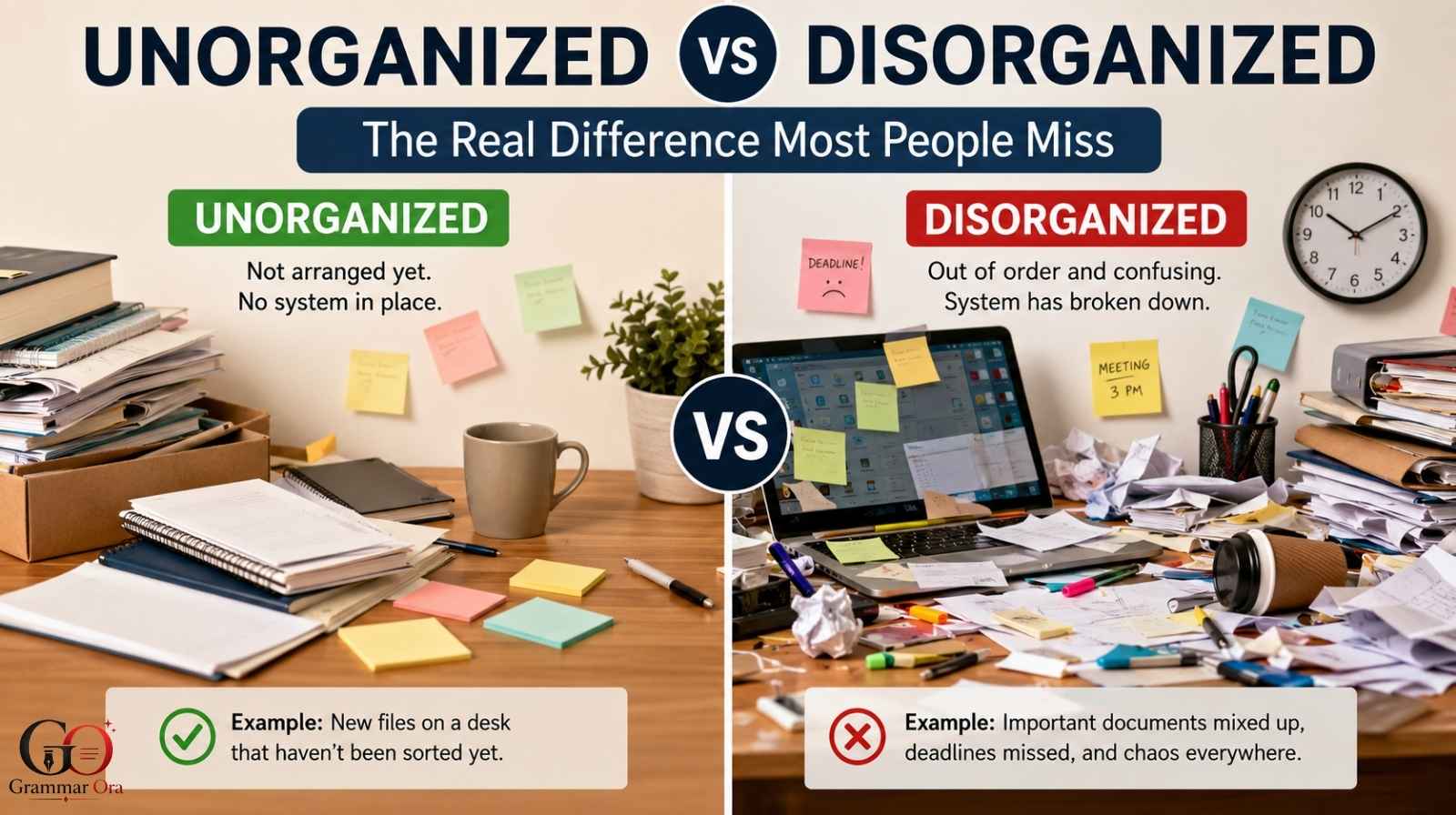
Have you ever described someone’s messy desk as unorganized, while someone else called it disorganized? At first glance, both words seem interchangeable. They both describe a lack of order, so it’s easy to assume they mean exactly the same thing.
However, there is a subtle but important difference between unorganized vs disorganized. Choosing the right word can make your writing clearer, more professional, and more accurate.
In this guide, you’ll learn the real meaning of each word, when to use them, common mistakes to avoid, and practical examples that make the difference easy to remember.
What Is the Difference Between Unorganized and Disorganized?
The simplest way to understand the difference is this:
| Unorganized | Disorganized |
|---|---|
| Something has never been arranged properly. | Something was organized before but has become messy or chaotic. |
| Often describes a lack of planning or preparation. | Often describes confusion, disorder, or loss of structure. |
| Usually less severe. | Usually suggests greater disorder. |
Quick Answer (Featured Snippet)
Unorganized means something was never properly arranged or planned.
Disorganized means something that was once organized or should be organized has become chaotic or difficult to manage.
Although both words describe disorder, disorganized often implies confusion, while unorganized simply means lacking organization.
Understanding “Unorganized”
The adjective unorganized refers to something that has not yet been organized.
It doesn’t necessarily imply chaos. Instead, it often suggests that no effort has been made to create order.
Examples
- My study notes are still unorganized because I haven’t sorted them yet.
- The new office files remain unorganized after the move.
- Her schedule looked unorganized, but she knew exactly what she needed to do.
Common Situations
You can use unorganized when talking about:
- Documents
- Files
- Plans
- Ideas
- Projects
- Inventory
The focus is simply that organization hasn’t happened yet.
Understanding “Disorganized”
The word disorganized usually describes something that is confused, chaotic, or lacking structure.
Unlike unorganized, it often suggests that poor organization is actively causing problems.
Examples
- His desk became completely disorganized after a busy week.
- The meeting was disorganized, so no decisions were made.
- Our travel plans became disorganized after the flight was delayed.
Common Situations
Use disorganized when describing:
- Meetings
- Businesses
- Teams
- Events
- Workflows
- People
- Schedules
The emphasis is on disorder and confusion rather than simply not being arranged.
Unorganized vs Disorganized in Everyday English
Although dictionaries list them as near synonyms, native English speakers often use them differently depending on the situation.
Example 1
Unorganized
“I haven’t sorted my emails yet.”
The emails simply haven’t been organized.
Example 2
Disorganized
“I can’t find anything because my inbox is completely disorganized.”
Now the disorder is causing difficulty.
Example 3
A new company without filing systems is unorganized.
A company where everyone loses documents every day is disorganized.
Notice how disorganized feels stronger and more negative.
Real-Life Example: Why the Difference Matters
Imagine two employees, Sarah and James, starting work at the same company.
Sarah has just moved into her office. Boxes are still unopened, folders haven’t been labeled, and her desk hasn’t been arranged yet. Her workspace is unorganized, but that’s expected because she’s still settling in. She knows where everything will go once she has time to sort it.
James, on the other hand, has worked in the office for two years. Papers are scattered everywhere, deadlines are missed, emails are buried under hundreds of unread messages, and important files keep disappearing. His workspace is disorganized because the lack of structure is affecting his productivity and making daily tasks harder.
Although both desks appear messy, the situations are different. Sarah simply hasn’t organized her workspace yet, while James’s workspace has become chaotic and inefficient. Understanding this distinction helps you choose the more accurate word in professional writing, workplace communication, and everyday conversations.
Common Mistakes People Make
Many English learners and even native speakers treat these words as perfect synonyms.
Here are some common mistakes.
Mistake 1
❌ The conference was unorganized.
✅ The conference was disorganized.
Why?
The event existed but lacked coordination.
Mistake 2
❌ My new folders are disorganized.
✅ My new folders are unorganized.
Why?
They simply haven’t been arranged yet.
Mistake 3
❌ She hasn’t organized her notes because they’re disorganized.
Better:
✅ Her notes are unorganized because she hasn’t sorted them yet.
How to Remember the Difference
A simple memory trick can help.
Think about time.
- Unorganized = Not organized yet
- Disorganized = Organization has broken down
Ask yourself:
Has organization simply not happened?
Choose unorganized.
Has order been lost or become chaotic?
Choose disorganized.
This small question usually gives you the correct answer instantly.
Unorganized vs Disorganized in Professional Writing
In business communication, word choice matters.
If you’re describing a new project that hasn’t been structured, unorganized is usually the better choice.
If you’re describing a poorly managed meeting, chaotic workflow, or ineffective process, disorganized sounds more accurate and professional.
Using the correct word helps readers understand whether the issue is simply incomplete planning or actual disorder.
2025–2026 Language Usage Trends
Recent writing guidance from major language and style resources shows that writers increasingly favor disorganized when describing confusion, poor management, or chaotic systems, while unorganized is more commonly used for things that simply haven’t been arranged yet. Grammar experts also recommend choosing the word based on context rather than treating them as perfect synonyms.
According to modern English usage trends:
- Disorganized appears more often in workplace, education, and productivity-related writing.
- Unorganized is frequently used in instructional content, planning guides, and organizational advice.
- Clear word choice improves readability and reduces ambiguity, which aligns with Google’s emphasis on helpful, people-first content.
Best Practices for Choosing the Right Word
Use Unorganized when:
- Something hasn’t been arranged yet.
- You’re talking about unfinished organization.
- The situation isn’t necessarily chaotic.
Use Disorganized when:
- Something lacks structure.
- Disorder causes confusion.
- People struggle because of poor organization.
Following these simple guidelines will make your writing sound more natural and precise.
FAQs
Q1: Is unorganized the same as disorganized?
A: No. While they’re closely related, unorganized means something hasn’t been organized yet, whereas disorganized suggests confusion or a breakdown of order.
Q2: Which word is more common?
A: Disorganized is generally more common in everyday English, especially when describing people, workplaces, meetings, or systems.
Q3: Can I use both words interchangeably?
A: Sometimes, but context matters. Using the more precise word makes your writing clearer.
Q4: Is disorganized more negative?
A: Yes. It usually implies inefficiency, confusion, or poor management, making it stronger than unorganized.
Q5: Which word should I use in academic writing?
A: Choose the word that accurately reflects your meaning. Academic writing values precision, so avoid treating them as exact synonyms.
Conclusion
Although unorganized and disorganized both relate to a lack of order, they aren’t exactly the same.
Unorganized describes something that has not yet been arranged, while disorganized describes something that is chaotic, confusing, or poorly structured. Understanding this distinction helps you communicate more accurately in professional writing, academic work, and everyday conversations.
The next time you’re deciding between unorganized vs disorganized, remember this simple rule: if organization hasn’t happened yet, choose unorganized. If order has broken down or confusion is the problem, disorganized is the better choice.
👉 Discover more simple and practical grammar guides on Grammar Ora

Muhammad Bilal is an expert blogger in Grammar Guide, dedicated to simplifying English grammar and helping learners write and speak with clarity, confidence, and accuracy.